

Organic traffic is one of the most valuable growth channels for online stores, but visibility alone isn’t enough. What appears in search results often determines whether a user clicks or scrolls past. That’s where E-commerce schema markup becomes a key differentiator.
Search engines can crawl your pages, but without structured data, they may miss critical product details like pricing, availability, and reviews. By adding structured data for E-commerce, you provide clear signals that help search engines present your listings as rich results, complete with ratings, prices, and stock status.
This guide explains how it all works, covering the fundamentals, best schema types for E-commerce websites, and practical e-commerce schema implementation strategies to help you improve visibility, attract qualified clicks, and stand out in competitive search results.
What is E-commerce Schema Markup?
E-commerce schema markup is a form of structured data that helps search engines accurately interpret and categorize product-related information on your website. Instead of relying only on page content, it provides explicit signals about what each element represents.
It uses a standardized vocabulary from Schema.org and is most commonly implemented through JSON-LD, Google’s preferred format for structured data.
With proper schema markup for E-commerce websites, search engines can clearly identify key product details such as:
- Product name
- Price and currency
- Availability (in stock/out of stock)
- Reviews and ratings
- Brand, SKU, and other identifiers
This structured data for online stores powers e-commerce rich snippets, enabling enhanced search listings with additional details. As a result, your pages become more informative, visually appealing, and more likely to attract qualified clicks from users actively searching for your products.
Why E-commerce Schema Markup Matters for SEO
Many store owners assume schema directly boosts rankings. It doesn’t, at least not as a direct ranking factor. But it plays a critical role in online store structured data SEO by improving how your pages appear and perform in search.
1. Higher Click-Through Rates (CTR)
Rich snippets display additional details like star ratings, pricing, and availability directly in search results. These visual enhancements make your listing more compelling and trustworthy, increasing the likelihood that users choose your page over standard blue links.
2. Better Search Visibility
Even if your page isn’t in the top position, enhanced listings naturally draw more attention. Rich results occupy more space and provide more information upfront, helping your products stand out in competitive SERPs.
3. Improved Content Understanding
Schema markup gives search engines clear, structured signals about your product data. This reduces ambiguity, allowing them to index your pages more accurately and match them with relevant search queries.
According to Google Search Central, structured data enables rich results, improving how your pages are presented, and ultimately how users interact with them in search.
Best Schema Types for E-commerce Websites
Choosing the right schema types is critical, not all structured data delivers the same SEO impact. Using the most relevant ones ensures search engines can fully interpret and display your product information.
Here are the best schema types for E-commerce websites:
1. Product Schema (Most Important)
This is the foundation of product schema markup for E-commerce. It defines the core details of a product page and helps search engines understand exactly what you’re selling.
It typically includes:
- Product name
- Images
- Description
- Brand
- SKU or unique identifiers
2. Offer Schema
This schema handles the commercial aspects of your product, making it essential for rich results. It provides real-time transactional details such as:
- Price and currency
- Availability (in stock, out of stock, pre-order)
- Discounts or special offers
3. Review & Rating Schema
This adds social proof directly in search results. By showing:
- Star ratings
- Customer reviews
- Aggregate rating
- It builds trust and can significantly influence click decisions.
4. Breadcrumb Schema
Helps search engines understand your site structure and displays clean navigation paths in SERPs, improving both usability and crawlability.
5. FAQ Schema
Allows you to answer common buyer questions directly in search results, increasing visibility and capturing more SERP space while addressing user intent upfront.
Example of E-commerce JSON-LD Schema
Here’s a simplified example of schema markup for product pages:
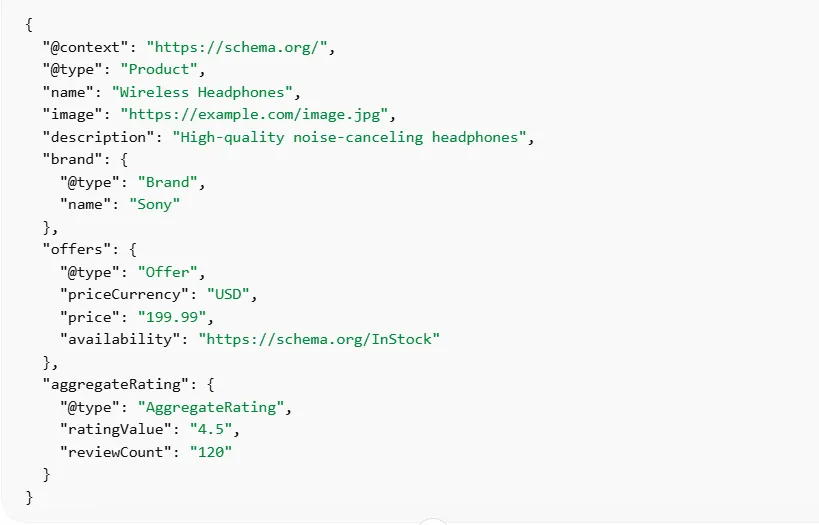
This is a basic but powerful example of e-commerce structured data that can trigger rich results.
How to Add Schema Markup to an E-commerce Website
Implementing schema markup doesn’t have to be complicated if you follow a structured approach. The goal is to prioritize high-impact pages and ensure your data is accurate and valid.
Step 1: Identify Key Pages
Start with pages that directly influence conversions and search visibility:
- Product pages (highest priority for rich snippets)
- Category pages (to improve listing visibility)
- Homepage (for brand and organizational schema)
- Focusing on these ensures your structured data for E-commerce delivers maximum SEO value.
Step 2: Choose Implementation Method
Select a method based on your technical comfort and scale:
- Manual (JSON-LD): Offers full control and customization, ideal for advanced implementations.
- Plugins / Apps: Using an E-commerce schema app simplifies setup, especially on platforms like Shopify or Wix.
- Tag Managers: Useful for deploying schema quickly without modifying core code, though harder to manage at scale.
Step 3: Add Structured Data
Implement your schema using JSON-LD and embed it within the
section or through your CMS. Ensure the data matches the visible content on the page to avoid inconsistencies.Step 4: Validate & Test
Before publishing, test your markup using e-commerce schema validators to identify and correct errors, missing fields, or eligibility issues. Proper validation ensures your pages can actually qualify for rich results.
How to Get Rich Snippets for an E-commerce Store
If your pages aren’t showing rich results, it’s usually due to gaps in implementation rather than eligibility. To improve your chances, focus on these key factors:
Complete Schema (Not Partial):
Valid Structured Data:
Sufficient Content Depth:
Compliance with Google Guidelines:
Ensure all essential properties, like product, offer, and review data, are fully implemented. Partial markup often gets ignored.
Your code must be error-free and follow proper formats (e.g., correct price, currency, and rating values). Even small issues can prevent eligibility.
Rich results rely on actual page content. Add detailed product descriptions, genuine reviews, and accurate specifications to support your schema.
Follow structured data guidelines closely, especially for reviews and ratings, to avoid manual actions or ineligibility.
Rich snippets aren’t guaranteed, but a strong e-commerce SEO schema setup significantly increases your chances of earning them and improving visibility.
Common E-commerce Schema Markup Mistakes
Even experienced SEOs can overlook critical details that limit schema performance. Here are the most common e-commerce schema markup mistakes and why they matter:
1. Missing Required Fields:
Leaving out essential properties (like price, availability, or product name) makes your schema incomplete, which disqualifies it from rich results.
2. Incorrect Data Types:
Using the wrong format, such as text instead of numeric values for price or rating, can break your structured data and cause validation errors.
3. Mismatch Between Content & Schema:
Your schema must reflect what users see on the page. If there’s a mismatch (e.g., different pricing), search engines may ignore your markup or reduce trust.
4. Duplicate or Conflicting Schema
Adding multiple or overlapping schema types without proper structure can confuse search engines, making it harder to interpret your data correctly.
5. Not Updating Dynamic Data
E-commerce data changes frequently. Outdated prices, availability, or offers reduce accuracy and can prevent your listings from qualifying for rich results.
How to Test E-commerce Structured Data
Testing is non-negotiable, without it, even a well-implemented schema may fail to generate results. The goal is to ensure your markup is valid, complete, and eligible for rich results.
Here’s how to test e-commerce structured data effectively:
1. Google Rich Results Test
This tool checks whether your page is eligible for rich snippets. Google Rich Result test highlights valid items, missing required fields, and errors that could prevent your product listings from appearing with enhanced results.
2. Schema Markup Validator
Focuses on the technical side by validating the syntax and structure of your schema. Schema Markup Validator helps identify formatting issues, incorrect properties, or misuse of schema types that might not be caught elsewhere.
3. Search Console Enhancements Report
Provides a site-wide view of your structured data performance. Google Search Console shows errors, warnings, and valid pages at scale, helping you monitor ongoing issues and track improvements after fixes.
Regular testing ensures your structured data for E-commerce remains accurate, compliant, and capable of driving rich results consistently.
E-commerce Schema Implementation Best Practices
To get the most out of schema markup for E-commerce websites, you need more than just basic implementation, you need accuracy, consistency, and scalability.
Use JSON-LD Format:
Keep Schema Updated Dynamically:
Add Schema to All Product Pages:
Combine Product + Offer + Review Schema:
Ensure Consistency Across Page and Markup:
Google recommends JSON-LD because it’s easier to implement, maintain, and update without affecting your page layout or code structure.
Product data like price, availability, and offers change frequently. Automating updates ensures your structured data always reflects real-time information.
Don’t limit the schema to a few pages, apply it across your entire product catalog to maximize visibility and rich result opportunities.
Using these together creates a complete data set, increasing your chances of qualifying for rich snippets with detailed information.
All schema data must match what users see on the page. Inconsistencies can lead to ignored markup or reduced trust.
Think of schema as a data layer for SEO, it bridges the gap between your content and search engines, helping them interpret, trust, and present your products more effectively.
Comparing Manual vs Schema Apps
| Method | Best For | Pros | Cons |
|---|---|---|---|
| Manual JSON-LD | Advanced users | Full control | Time-consuming |
| E-commerce schema app | Beginners & scaling stores | Easy, automated | Limited customization |
| Tag Manager | Marketers | Fast deployment | Debugging can be tricky |
Conclusion
E-commerce schema markup is one of the most underutilized yet powerful SEO strategies for online stores.
It doesn’t just help search engines, it helps users make decisions faster by showing the right information at the right time.
From choosing the best schema types for E-commerce websites to avoiding common mistakes and testing your implementation, the difference between average and high-performing stores often comes down to execution.
If you treat structured data as a core part of your e-commerce technical SEO schema, not an afterthought, you’ll gain a measurable edge in search visibility and user engagement.
FAQs
Q1: What is E-commerce schema markup?
E-commerce schema markup is structured data that helps search engines understand product information like price, availability, and reviews to enable rich results.
Q2: Does schema markup improve rankings?
Not directly, but it improves CTR and visibility, which can positively impact SEO performance over time.
Q3: How do I add schema markup to my e-commerce site?
You can add it manually using JSON-LD, use an E-commerce schema app, or implement it via plugins or tag managers.
Q4: What is the best schema type for product pages?
Product schema combined with Offer and Review schema is the most effective setup.
Q5: Why are my rich snippets not showing?
Common reasons include incomplete schema, validation errors, or not meeting Google’s eligibility criteria.
Q6: How often should I update schema markup?
Continuously, especially for price, stock, and reviews.
Q7: Can I use schema on category pages?
Yes, but it’s less impactful than product-level schema.
Q8: What tools can I use to test schema markup?
Google Rich Results Test, Schema Validator, and Google Search Console are the most reliable tools.