

If you’ve ever searched for a SaaS tool and noticed listings with star ratings, pricing, FAQs, or product details directly in Google results, that’s not luck. That’s SaaS schema markup for rich snippets in action.
Rich snippets don’t just make your listing look better, they directly impact click-through rate (CTR), visibility, and how users perceive your product before they even land on your site.
But here’s the catch: most SaaS websites either implement schema incorrectly or miss high-impact opportunities entirely.
This guide goes beyond the basics. You’ll learn how to add schema markup to a SaaS website, which schema types actually work, and how to turn structured data into measurable SEO gains.
What Are Rich Snippets and Why SaaS Companies Should Care?
Rich snippets are enhanced search results powered by structured data for SaaS websites. They provide additional context like:
- Product ratings
- Pricing details
- FAQs
- Reviews
- Software features
For SaaS businesses, this is critical because:
- SaaS buyers compare multiple tools quickly
- Trust signals (reviews, ratings) influence decisions
- SERP real estate is highly competitive
According to multiple industry studies (e.g., Google Search Central documentation), structured data helps search engines better understand your content, which can improve eligibility for rich results and increase CTR.
Understanding SaaS Schema Markup
Before jumping into implementation, it’s important to build a strong foundation. Understanding SaaS schema markup deeply helps you choose the right schema types and avoid common implementation mistakes.
SaaS schema markup is a form of structured data (usually in JSON-LD format) that helps search engines interpret your website content.
For SaaS companies, this typically includes:
- Software details (name, category, features)
- Pricing models (subscription tiers)
- User reviews and ratings
- Company information
Unlike eCommerce, the SaaS schema requires a hybrid approach, combining Product, SoftwareApplication, and sometimes Service schema.
Why is Schema Important for SaaS?
Schema isn’t just a technical SEO add-on, it’s a strategic advantage for SaaS companies competing in crowded search results. Here are the most important reasons why SaaS schema markup for rich snippets matters:
-
Improves visibility in search results
-
Increases click-through rates (CTR)
-
Helps search engines understand your product
-
Drives more qualified traffic
-
Builds trust and credibility
-
Creates a competitive edge
Schema markup for SaaS websites enhances your listings with rich snippets like ratings, FAQs, and pricing, helping you stand out in competitive SERPs.
Rich results with reviews and additional details build instant trust, which often leads to higher CTR compared to standard listings.
SaaS schema markup provides structured context about your software, features, and pricing, improving how search engines interpret your content.
By showing key information upfront, SaaS rich snippets attract users who are more likely to convert.
Displaying ratings, reviews, and FAQs through structured data strengthens your brand authority before users even visit your site.
Many SaaS companies still underuse structured data. A strong SaaS structured data SEO strategy gives you an advantage in crowded search results.
Best Schema Types for SaaS Rich Snippets
To get the most out of SaaS schema markup for rich snippets, you need to use the right schema types:
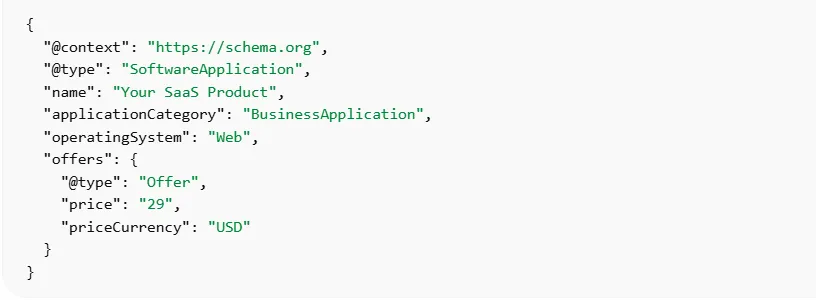
1. SoftwareApplication Schema (Core for SaaS)
This is the backbone of schema markup for SaaS websites.
It helps Google understand:
- What your product does
- Who it’s for
- How it’s categorized
Example (JSON-LD):
2. Review & AggregateRating Schema
This is what enables star ratings in SERPs, arguably the most powerful SaaS rich snippets.

Pro Tip: Only use this if reviews are genuine and visible on your page, Google penalizes misleading markup.
Here’s a shorter, cleaner version while keeping clarity and consistency:
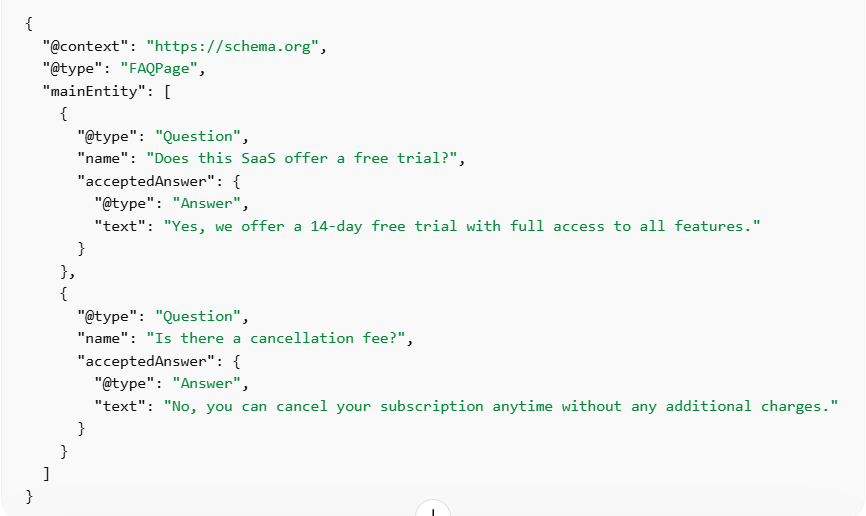
3. FAQ Schema (CTR Booster)
The FAQ schema helps your listing stand out by showing expandable questions directly in search results.
It helps Google understand:
- Common user questions
- Key concerns about your product
Best used on:
- Pricing pages
- Feature pages
- Comparison pages
Example (JSON-LD):
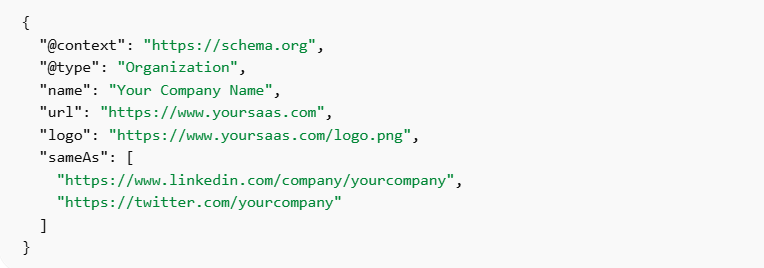
4. Organization Schema
This schema builds brand credibility and supports knowledge panel visibility.
It helps Google understand:
- Your company identity
- Website and social profiles
Example (JSON-LD):
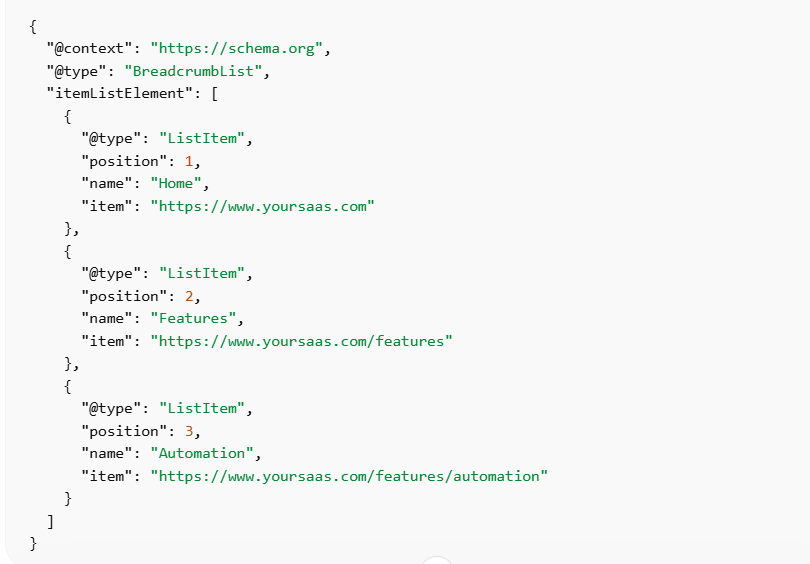
5. Breadcrumb Schema
Breadcrumb schema improves how your page hierarchy appears in search results.
It helps Google understand:
- Site structure
- Page relationships
Example (JSON-LD):
How to Add Schema Markup to a SaaS Website to Earn Rich Snippets
This is where most guides stay surface-level. Adding code alone doesn’t get you results, strategic SaaS SEO schema implementation is what actually helps you earn rich snippets.
Let’s break down a practical, real-world workflow you can follow.
Step 1: Identify High-Impact Pages (Where Rich Snippets Actually Matter)
Not every page needs schema, but the right pages can significantly improve your chances of earning SaaS rich snippets.
Focus on pages that align with search intent and conversions:
- Homepage → Add Organization + SoftwareApplication schema to establish brand and product context
- Product pages→ Core pages for SoftwareApplication + Review schema
- Pricing page→ Ideal for Offer schema (pricing tiers, plans)
- Feature pages→ Use FAQ schema to capture long-tail queries
- Blog content→ Add FAQ schema to target People Also Ask results
Think of it this way: if a page already ranks or has impressions, adding SaaS schema markup for rich snippets can amplify its performance.
Step 2: Generate Schema Markup (The Right Way)
Once you’ve identified pages, the next step is creating structured data.
You have three practical options:
-
Manual JSON-LD creation → Best for full control
-
Using a SaaS schema generator → Faster and error-free
Using your internal SaaS schema app → Best for scaling
Writing SaaS JSON-LD schema manually gives you complete flexibility and customization, but requires technical knowledge and careful validation.
A SaaS schema generator helps you quickly create structured data without worrying about syntax errors or missing fields.
A dedicated SaaS schema app lets you generate, manage, and update schema across multiple pages efficiently, especially useful for dynamic data like pricing and features.
Expert Tip:
Avoid generic templates. Customize schema based on:
- Your pricing model (freemium vs paid)
- Your product category
- Actual user reviews and ratings
This is what separates average implementations from high-performing SaaS structured data SEO.
Step 3: Add JSON-LD to Your Website (Without Breaking Anything)
Once your SaaS JSON-LD schema is ready, it needs to be correctly placed.
Use this format:

You can add it in:
- The section (recommended for consistency and crawlability)
- Via Google Tag Manager (great for non-developers and quick deployment)
Best Practice:
Keep the schema separate from your visible HTML. JSON-LD is preferred because it’s clean, easy to update, and recommended by Google.
Step 4: Validate Your Schema (Critical for Rich Snippet Eligibility)
Even small errors can prevent rich snippets from appearing.
Use trusted tools like:
A reliable SaaS schema validator helps you confirm:
- No syntax or formatting errors
- Required properties are included
- Your page is eligible for rich results
Pro Insight:
Validation isn’t a one-time task. Re-check schema after:
- Website updates
- Pricing changes
- CMS migrations
Step 5: Monitor Performance and Optimize
After implementation, the real work begins, tracking results.
Use Google Search Console to monitor:
- CTR (Click-Through Rate) improvements
- Impressions for rich results
- Enhancement reports (errors, warnings, valid schema)
If your schema is valid but not showing rich snippets:
- Improve on-page content quality
- Add missing schema types (e.g., FAQ or Review)
- Ensure your markup matches visible content
Common Mistakes in SaaS Structured Data SEO
Even a well-designed schema can fail if implemented incorrectly.
Here are real-world issues seen in SaaS structured data SEO:
- Marking up content that isn’t visible on the page
- Using incorrect schema types (e.g., Product instead of SoftwareApplication)
- Missing required fields like price or ratings
- Duplicate or conflicting schema on the same page
Fixing these often leads to noticeable improvements in rich snippet visibility.
Advanced Strategies to Win More Rich Snippets
Once the basics are covered, the real gains come from refining your SaaS schema markup for rich snippets strategically. These advanced tactics can significantly improve your chances of dominating SERP features.
1. Combine Multiple Schema Types (Stack Your Visibility)
Instead of relying on a single schema type, layer multiple schemas on the same page to unlock more SERP features.
Example:
- SoftwareApplication + FAQ + Review
- Product details
- Star ratings
- FAQ dropdowns
This approach allows your listing to show:
Why it works:
Google can pull different elements from each schema type, increasing your overall visibility and CTR.
2. Optimize Schema for Search Intent
Not all schema types work for every page. Align your schema markup for SaaS websites with user intent to maximize impact.
- Informational queries → Use FAQ schema (e.g., “What is CRM software?”)
- Commercial queries→ Use Review + Product/Software schema
- Transactional queries→ Use Offer schema (pricing, plans)
Pro Insight:
Pages that match intent + schema correctly are far more likely to earn rich snippets.
3. Use Schema Across the Entire Funnel
Most SaaS companies limit schema to product pages, but that’s a missed opportunity.
Expand your SaaS structured data SEO across different content types:
- Blog posts → FAQ schema to target People Also Ask
- Comparison pages → Review schema for trust signals
- Landing pages → Software Application schema for product clarity
Result:
You increase your chances of appearing in multiple SERP features across different stages of the buyer journey.
4. Keep Your Schema Updated and Accurate
Schema isn’t “set it and forget it.” It needs to evolve with your product.
Update your SaaS JSON-LD schema whenever:
- Pricing changes
- Features are updated
- Reviews increase
Why it matters:
Outdated or inconsistent data can:
- Reduce trust
- Disqualify your page from rich results
- Send conflicting signals to search engines
Conclusion
Getting rich snippets isn’t about adding random code, it’s about implementing SaaS schema markup for rich snippets strategically.
When done right, it helps search engines understand your product, improves how your listing appears, and ultimately drives more qualified clicks.
Start with the fundamentals, validate everything, and continuously refine your implementation. Over time, schema becomes less of a technical add-on and more of a competitive advantage in SaaS SEO.
FAQ
Q1: What is SaaS schema markup?
SaaS schema markup is structured data that helps search engines understand your software product, enabling enhanced search results like rich snippets.
Q2: How do I get rich snippets for my SaaS website?
Implement relevant schema types (SoftwareApplication, FAQ, Review), validate them, and ensure your content matches the markup.
Q3: Which schema type is best for SaaS companies?
SoftwareApplication schema is the most important, often combined with Review and FAQ schema for maximum impact.
Q4: Does schema markup improve rankings?
Not directly. However, it improves CTR and visibility, which can indirectly support SEO performance.
Q5: What is the best format for SaaS schema markup?
JSON-LD is the recommended format by Google for all schema markup for software companies.
Q6: Can I use a SaaS schema generator?
Yes. A SaaS schema generator simplifies implementation and reduces errors, especially for non-technical teams.
Q7: How do I validate my schema markup?
Use tools like Google Rich Results Test or a dedicated SaaS schema validator to check for errors and eligibility.
Q8: What pages should have schema markup?
Start with product, pricing, and homepage pages, then expand to blogs and landing pages.
Q9: What is a SaaS schema app?
A SaaS schema app automates structured data creation, deployment, and updates, ideal for scaling schema across large websites.