

Most SaaS teams invest heavily in content, backlinks, and product-led SEO, yet still struggle to consistently win valuable SERP real estate. The missing layer is often context. Search engines no longer rely solely on keywords, they evaluate entities, relationships, and meaning. That’s exactly where Schema SEO for SaaS companies becomes critical.
With the right SaaS schema markup, you can transform plain search listings into rich, clickable results while helping search engines clearly understand your product, pricing, and features. This directly improves how your pages appear for high-intent queries.
In highly competitive SaaS niches like CRM, analytics, or AI tools, this added clarity can be the difference between a user clicking your result at position #3, or completely overlooking it.
What Is Schema SEO for SaaS Companies?
At its core, schema markup for SaaS websites is a way of adding structured, machine-readable data (most commonly in JSON-LD format) to your pages so search engines can accurately interpret what your content represents, not just what it says.
Think of it this way: without a schema, Google reads your page like a human skimming text. With schema, it reads your page like a database, with clearly defined fields, relationships, and entities.
For SaaS businesses, this distinction is critical.
Instead of relying on assumptions, search engines can explicitly understand:
- Your product as a software application (not just a generic webpage)
- Your company as an entity with authority, branding, and trust signals
- Your features and use cases as structured attributes tied to user intent
- Your FAQs and support content as direct, answer-ready information
This clarity allows search engines to map your content into their Knowledge Graph, which powers modern search experiences.
How Schema Improves SaaS SEO Rankings (and CTR)
Let’s be clear: schema markup is not a direct ranking factor. However, it strongly impacts how your listings perform.
Here’s how Schema SEO for SaaS companies drives real results:
1. Higher Click-Through Rates (CTR)
Rich results, like star ratings, FAQs, pricing, or breadcrumbs, make your listing visually distinct.
In a SERP full of plain blue links, even a small enhancement can:
- Capture attention faster
- Build trust instantly
- Answer key questions before the click
For SaaS, where users compare multiple tools, this visibility advantage is huge.
2. Better Content Understanding (Semantic Clarity)
Search engines are moving toward semantic and intent-based ranking, not just keywords.
With SaaS structured data SEO, you explicitly define:
- Your product category (e.g., CRM, AI writing tool, analytics platform)
- Your pricing model (subscription, freemium, tiered)
- Your features and capabilities
- Your target use cases
This helps Google match your pages with:
- Long-tail queries
- Feature-specific searches
- Problem-solution intent
Example:
Without a schema, “email automation tool” might be ambiguous.
With schema, Google clearly understands your product fits that category.
3. Eligibility for Rich Results (Not Optional Anymore)
Many enhanced search features require structured data to even be considered.
These include:
- FAQ rich results
- Review snippets
- Product enhancements
- Breadcrumbs
Without proper SaaS SEO schema implementation, your content may never qualify, no matter how good it is.
4. Stronger Entity-Based SEO
Modern search engines don’t just rank pages, they understand entities and relationships.
With Schema SEO for SaaS companies, you help Google connect:
- Your brand → product → category → industry
- Your features → user problems → search intent
- Your content → expertise → topical authority
This strengthens your presence in:
- Knowledge graphs
- Semantic search results
- AI-driven search experiences
5. Improved Performance Without Changing Rankings
One of the most underrated benefits:
You can improve performance without increasing rankings.
Even if your position stays the same:
- A richer snippet can outperform competitors above you
- Better clarity can attract more qualified clicks
- Enhanced listings can reduce bounce rates
Best Schema Types for SaaS Websites
Not all schema types are equally useful. For SaaS, the goal is to map your business model to the right structured data.
Here are the best schema types for SaaS websites:
1. SoftwareApplication Schema
This is the foundation of schema markup for software companies. It defines your SaaS product as software, helping search engines understand its purpose, features, pricing, platform, and user ratings clearly.
Use it for:
- SaaS products
- Tools and platforms
- Apps and dashboards
It allows you to define:
- Pricing
- Operating systems
- Features
- Ratings
2. Organization Schema
Establishes your brand as a recognized entity by providing details like company name, logo, contact information, and social profiles, improving credibility and eligibility for knowledge panels in search results.
Use it to define:
- Company name
- Logo
- Contact details
- Social profiles
3. Product Schema (for SaaS Plans)
Allows you to structure subscription plans as products, making pricing tiers, billing models, and feature differences easier for search engines to interpret and potentially display in rich results.
Product schema is helpful for:
- Pricing tiers
- Feature comparisons
4. FAQ Schema
Transforms common questions into structured answers that can appear directly in search results, helping address user concerns, improve visibility, and enhance click-through rates for SaaS landing and blog pages.
Perfect for:
- Feature explanations
- Objection handling
- Bottom-of-funnel queries
Also boosts SaaS rich snippets optimization significantly.
5. Review & Rating Schema
Displays user ratings and review counts in search results, building trust and social proof, which can significantly influence user decisions and improve click-through rates for SaaS products.
6. Breadcrumb Schema
Defines your website’s hierarchical structure, helping search engines understand page relationships while improving navigation display in search results, making listings cleaner and more user-friendly.
Quick Comparison Table
| Schema Type | Best Use Case | Impact Level |
|---|---|---|
| SoftwareApplication | SaaS product pages | High |
| Organization | Brand identity | High |
| FAQ | Blog & landing pages | High |
| Product | Pricing pages | Medium |
| Review | Testimonials | High |
| Breadcrumb | Site navigation | Medium |
How to Implement Schema Markup for SaaS Companies
Let’s get practical. A successful SaaS SEO schema implementation isn’t just about adding code, it’s about aligning structured data with your product, pages, and user intent.
Step 1: Choose JSON-LD Format
Always use JSON-LD schema for SaaS.
Why this matters:
- Recommended by Google for structured data implementation
- Easier to add, edit, and scale across pages
- Keeps your HTML clean and reduces the risk of breaking layouts
Pro tip: JSON-LD can be injected via the
or through tag managers, making it flexible for both developers and marketers.Step 2: Map Schema to Page Types
Each page on your SaaS site serves a different purpose, so your schema should reflect that.
Common mappings:
- Homepage → Organization (brand identity)
- Product page → SoftwareApplication (core offering)
- Blog → Article + FAQ (content + intent targeting)
- Pricing page → Product (plans and offers)
Why this matters: Proper mapping ensures search engines interpret each page correctly, improving relevance for specific queries and increasing eligibility for rich results.
Step 3: Add Schema to Your Website
Once mapped, you can implement the schema in multiple ways depending on your setup:
- Manual implementation: Add JSON-LD inside
<script type="application/ld+json">tags - Tag managers: Use tools like Google Tag Manager for easier deployment
- Automation tools: Use a SaaS schema app SaaS schema app to scale across multiple pages
Best approach: Start manually for key pages, then automate as your site grows.
Step 4: Validate and Test Your Schema
Before going live, always validate your markup.
Use tools like:
- Google Rich Results Test
- Schema Markup Validator
Check for:
- Missing required fields (common issue)
- Syntax errors in JSON
- Incorrect nesting or schema types
Important: Even small errors can prevent your schema from being recognized, making validation a critical step in implementing schema markup for SaaS companies effectively.
SaaS Schema Markup Example (JSON-LD)
Here’s a simplified SaaS schema markup example using SoftwareApplication:
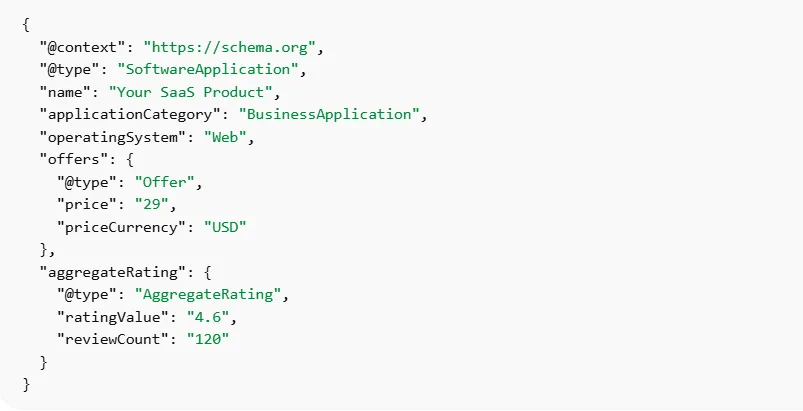
This is the backbone of how to implement schema markup for SaaS companies effectively.
Advanced SaaS Structured Data SEO Strategies
Once the basics are covered, this is where Schema SEO for SaaS companies starts creating a real competitive advantage.
1. Combine Multiple Schema Types
Instead of relying on a single schema, layer multiple types on the same page, for example, SoftwareApplication + FAQ + Review. This creates a richer context, helping search engines understand your product, trust signals, and user intent more comprehensively.
2. Use Dynamic Schema
Static schema becomes outdated quickly, especially for SaaS. Dynamic schema pulls real-time data like pricing, feature updates, and reviews automatically, ensuring accuracy and scalability. This is where a SaaS schema app becomes highly valuable.
3. Optimize for Bottom-of-Funnel Queries
High-intent pages benefit the most from schema. Add structured data to comparison pages, integration pages, and use-case pages to improve visibility for decision-stage queries and increase conversion-focused traffic
4. Align Schema with Content Strategy
Schema should support your content goals, not be an afterthought. Match schema types with intent, for example, use Review + FAQ for comparison blogs and Product schema for pricing-focused pages to improve relevance and SERP appearance.
Common Mistakes in SaaS Schema Implementation
Even experienced teams often overlook critical details in SaaS SEO schema implementation.
Avoid these common pitfalls:
- A mismatch between the schema and visible content can lead to penalties or ignored markup
- Missing required properties reduces eligibility for rich results
- Using irrelevant or excessive schema types confuses search engines
- Ignoring validation errors prevents proper indexing
- Outdated schema (pricing, features, reviews) reduces trust and accuracy
These issues don’t just limit performance, they can completely block your chances of earning rich results.
Conclusion
Schema SEO for SaaS companies is one of the most underutilized yet high-impact SEO strategies today. It doesn’t replace content or backlinks, but it amplifies their effectiveness.
By implementing the right SaaS schema markup, aligning it with your page intent, and maintaining it over time, you give search engines exactly what they need: clarity. And in modern SEO, clarity wins visibility.
FAQs
Q1: What is Schema SEO for SaaS companies?
It’s the use of structured data to help search engines understand SaaS products, features, and content, improving visibility and rich results.
Q2: Does schema markup directly improve rankings?
No, but it improves CTR, indexing clarity, and eligibility for rich results, which indirectly boosts SEO performance.
Q3: What is the best schema type for SaaS products?
SoftwareApplication schema is the most important, often combined with FAQ and Review schema.
Q4: How do I add schema markup to a SaaS website?
You can manually add JSON-LD code, use Google Tag Manager, or automate with a SaaS schema app.
Q5: Can SaaS companies use product schema?
Yes. Pricing plans and subscriptions can be structured using Product schema.
Q6: How often should schema be updated?
Whenever pricing, features, or reviews change. Outdated schema can hurt trust and eligibility.
Q7: What tools can I use to test schema?
Google Rich Results Test and Schema Validator are the most reliable tools.
Q8: Is JSON-LD better than Microdata?
Yes. JSON-LD is cleaner, easier to manage, and recommended by Google.