

SaaS SEO has evolved far beyond keywords and backlinks. Today, search engines rely heavily on structured data to understand products, features, pricing, and user experience. That’s why learning how to automate schema markup for SaaS websites is no longer optional, it’s essential.
Unlike static websites, SaaS platforms constantly change. Pricing updates, feature rollouts, landing page variations, and user-generated content make manual schema implementation inefficient and unsustainable.
Automation solves this problem by turning structured data into a dynamic, scalable system. Instead of updating the schema manually, your website can generate and update it automatically, ensuring accuracy, consistency, and better search visibility.
In this guide, you’ll learn not just how to implement SaaS schema markup automation, but also why it works, what to automate, and how to scale it effectively.
What Is SaaS Schema Markup and Why It Matters
Before diving deeper, it’s essential to understand SaaS schema markup deeply.
At its core, SaaS schema markup is structured data (typically in JSON-LD format) that helps search engines interpret your website content more precisely. It provides explicit information about your software product, what it does, how much it costs, how users rate it, and who it’s for.
For SaaS businesses, this clarity directly impacts how your pages appear in search results.
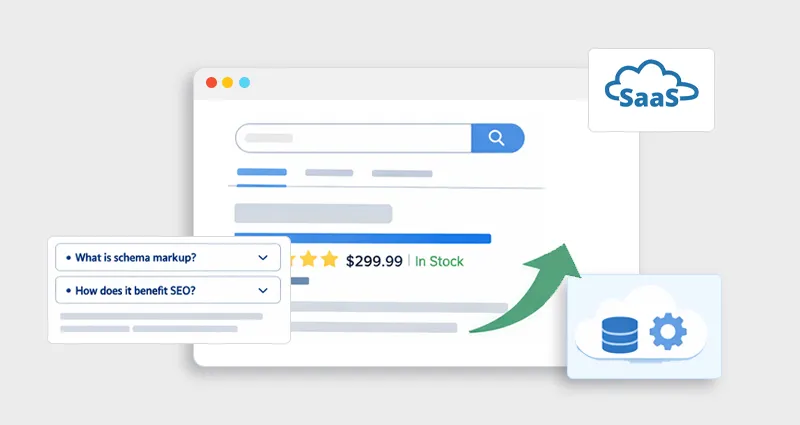
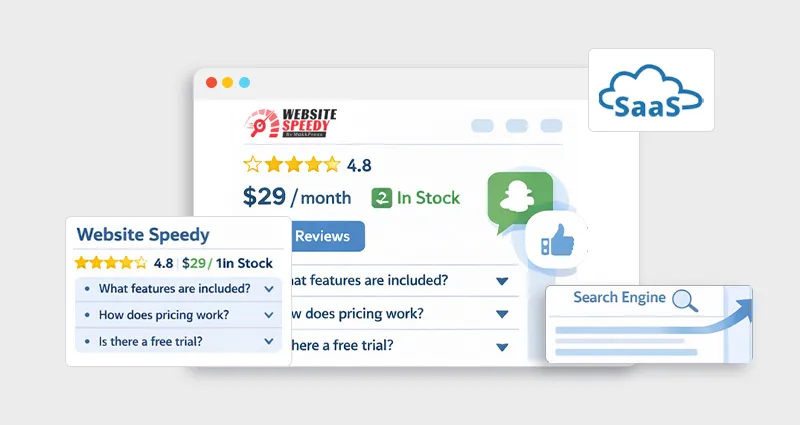
Instead of a plain blue link, you can get SaaS rich snippets that include:
- Star ratings and reviews
- Pricing information
- FAQs
- Product descriptions
These enhancements improve click-through rates and attract more qualified users, people who already understand your offering before clicking. In competitive SaaS markets, that’s a major advantage.
Why Automation Is Critical for SaaS Websites
Manual schema implementation works fine for small, static websites. But SaaS platforms operate in a dynamic environment where data changes frequently.
Imagine updating the schema every time:
- You change pricing tiers
- Add new features
- Update product descriptions
- Receive new customer reviews
Doing this manually introduces delays, inconsistencies, and errors.
This is where automating structured data for SaaS becomes crucial.
Automation ensures that:
- Schema always reflects real-time data
- Changes are instantly applied across pages
- Human error is minimized
- SEO performance remains consistent
More importantly, automation allows you to scale. Whether you have 10 landing pages or 1,000, your SaaS structured data automation system handles everything without additional effort.
Types of Schema You Should Automate for SaaS
Not all schema types are equally valuable for SaaS websites. To maximize impact, focus on schemas that directly influence search visibility and user decision-making.
SoftwareApplication Schema: It’s the foundation of any SaaS SEO schema strategy. The SoftwareApplication schema defines your product, including its category, operating system, and key attributes.
Product Schema: This schema becomes useful when you offer pricing tiers or plans. It helps search engines understand your offerings as purchasable entities.
FAQ Schema: The FAQ schema is highly effective for improving SERP real estate. It allows your content to appear with expandable questions directly in search results.
Review and Rating Schema: It builds trust by showcasing user feedback. For SaaS companies, this can significantly influence conversions.
Organization Schema: The organization schema strengthens your brand identity and credibility in search engines.
A well-structured schema markup for SaaS websites often combines multiple schema types to create a richer, more informative search result.
Step-by-Step Process to Automate Schema Markup for SaaS Websites
Automation is not a single action, it’s a system. Here’s how to build it effectively.
Start with JSON-LD as Your Foundation
Search engines, especially Google, recommend JSON-LD because it’s easy to implement and maintain. It sits separately from your HTML, making it ideal for automation.
Here’s a basic example of a SaaS JSON-LD schema:
<script type="application/ld+json">
{
"@context": "https://schema.org",
"@type": "SoftwareApplication",
"name": "Your SaaS Product",
"applicationCategory": "BusinessApplication",
"operatingSystem": "Web",
"offers": {
"@type": "Offer",
"price": "29",
"priceCurrency": "USD"
},
"aggregateRating": {
"@type": "AggregateRating",
"ratingValue": "4.7",
"reviewCount": "120"
}
}
</script>
The key difference in automation is that these values are not static, they are dynamically generated.
Connect Schema to Real-Time Data Sources
This is where SaaS schema markup automation becomes powerful.
Instead of hardcoding values, you connect schema fields to:
- Your CMS (for content and descriptions)
- Pricing databases or APIs
- Customer review platforms
- Product feature repositories
For example:
- Pricing updates automatically reflect in the schema
- New reviews update rating values
- Feature changes update descriptions
This ensures your structured data is always accurate and aligned with your actual product.
Use a SaaS Schema App or Automation Tool
For most people, the easiest way to implement automation is through a good SaaS schema tool that simplifies the process by:
- Generating schema automatically
- Allowing dynamic field mapping
- Scaling across multiple pages
- Reducing dependency on developers
If you’re a growing SaaS company, this approach saves both time and resources while ensuring consistent implementation.
Deploy Schema at Scale
Once your schema is dynamic, you need a reliable way to deploy it.
There are two common approaches:
- Google Tag Manager (GTM) is ideal for marketing teams. It allows you to inject schema scripts without modifying the website’s core code.
- Backend integration is better for large SaaS platforms. It gives developers full control and ensures the schema is tightly integrated with your data systems.
The right choice depends on your technical capabilities and scale.
Validate and Monitor Continuously
Even with automation in place, regularly using a SaaS schema validator helps identify errors, ensure compliance with search engine guidelines, and maintain accurate structured data.
Use tools like:
Check for:
- Missing required fields
- Incorrect formats
- Warnings and errors
After validation, monitor performance through:
- Search Console impressions
- CTR changes
- Rich snippet visibility
Automation is not “set it and forget it”, but it’s an ongoing optimization process. Continuous schema monitoring is a smart decision, which is now simpler with the automated schema markup tools and apps.
Common Mistakes in SaaS Schema Implementation
Automation improves efficiency, but if not implemented carefully, it can scale errors just as quickly as it scales success. Here are the most common mistakes to avoid:
Using incorrect schema types:
Applying the wrong schema (e.g., Product instead of SoftwareApplication) confuses search engines and reduces the effectiveness of your SaaS schema markup.
Not updating dynamic fields:
If pricing, features, or ratings change but your schema doesn’t update accordingly, it creates inconsistencies that can negatively impact trust and rankings.
Overusing or misusing schema:
Adding irrelevant or excessive structured data can dilute your SEO signals rather than strengthen them
Missing required properties:
An incomplete schema (like missing offers, ratingValue, or description) may prevent eligibility for rich results.
Ignoring validation errors:
A schema with errors or warnings may not be processed correctly, meaning you lose out on SaaS rich snippets.
Hardcoding instead of automating:
Static schema quickly becomes outdated in SaaS environments, leading to inaccurate structured data.
A clean, accurate, and well-maintained SaaS schema implementation will always outperform aggressive but poorly executed automation.
Manual vs Automated Schema: What Actually Changes
The core difference between manual and automated schema lies in how efficiently and reliably you can manage structured data at scale.
Manual schema requires continuous updates, making it difficult to maintain accuracy as your SaaS product evolves. It also limits how many pages you can realistically optimize
Automated schema transforms structured data into a dynamic system. Once implemented, it updates itself, scales across pages, and maintains consistency without constant intervention.
Key Differences at a Glance
| Factor | Manual Schema | Automated Schema |
|---|---|---|
| Scalability | Limited to a few pages | Easily scales across thousands of pages |
| Accuracy | Prone to human error | High accuracy with real-time updates |
| Maintenance | Time-consuming | Minimal ongoing effort |
| Data Updates | Requires manual changes | Automatically syncs |
| SEO Performance | Inconsistent | Consistent and optimized |
| Best Fit | Small/static websites | Growing and dynamic SaaS platforms |
For SaaS businesses, adopting automation is not just about saving time, it’s about building a reliable and future-proof SEO system.
Advanced Strategies for SaaS Schema Automation
Once you’ve set up the basics, you can take your SaaS schema markup automation to the next level with these advanced strategies:
-
-
Combine multiple schema types on a single page
-
Enhance search visibility by using SoftwareApplication, FAQ, and Review schema together to create richer search results.
-
-
Use template-based automation
-
Apply schema across entire page types (like feature pages, landing pages, or blogs) using predefined templates.
-
-
Leverage dynamic variables
-
Automatically populate schema fields using real-time data such as pricing, ratings, and product updates.
-
-
Integrate with analytics tools
-
Track which schema types improve CTR, impressions, and engagement to refine your strategy.
-
-
Automate schema across the content lifecycle
-
Ensure new pages automatically inherit structured data without manual input.
-
-
Stay aligned with search engine guidelines
-
Regularly update your schema based on changes in structured data policies to maintain eligibility for rich results.
-
-
Continuously optimize schema
-
Don’t treat schema as a one-time setup. Regularly review performance, fix errors, and refine your structured data based on search trends and results to keep it effective.
These strategies help you move beyond basic implementation and turn automatic schema markup for SaaS platforms into a long-term competitive advantage.
Conclusion
As SaaS websites grow in complexity, structured data needs to evolve with them. Manual implementation simply can’t keep up with dynamic content, frequent updates, and scaling demands.
When you automate schema markup for SaaS websites, you move from a reactive approach to a proactive system, one that keeps your data accurate, your SEO consistent, and your search presence competitive.
By combining the right schema types, dynamic data integration, and scalable deployment methods, SaaS schema markup automation becomes a powerful asset, not just for visibility, but for long-term growth in search.
FAQs
Q1: What is SaaS schema markup automation?
It’s the process of automatically generating and updating structured data for SaaS websites using tools or scripts instead of manual coding.
Q2: Why should I automate schema markup for SaaS websites?
Because SaaS platforms are dynamic, automation ensures your schema stays accurate, scalable, and aligned with real-time data.
Q3: Which schema type is most important for SaaS?
SoftwareApplication schema is the most critical, supported by Product, FAQ, and Review schema.
Q4: Can non-technical users implement schema automation?
Yes, using a SaaS schema app or tools, you can implement automation without deep coding knowledge.
Q5: How does schema markup improve SaaS SEO?
It helps search engines understand your content better, enabling rich snippets that increase visibility and CTR.
Q6: Is JSON-LD necessary for SaaS schema?
It’s not mandatory, but it’s highly recommended due to its flexibility and search engine compatibility.
Q7: How often should the schema be updated?
With automation, updates happen in real time. Without it, regular manual updates are required.
Q8: What are SaaS rich snippets?
They are enhanced search results that display additional information like ratings, FAQs, and pricing for SaaS products.








 Wix Schema
 Squarespace Schema
 BigCommerce Schema
 Shopify Schema
 Hubspot Schema
 Webflow Schema
 GoHighlevel Schema
 Duda Schema
 Weebly Schema
 ClickFunnel Schema