

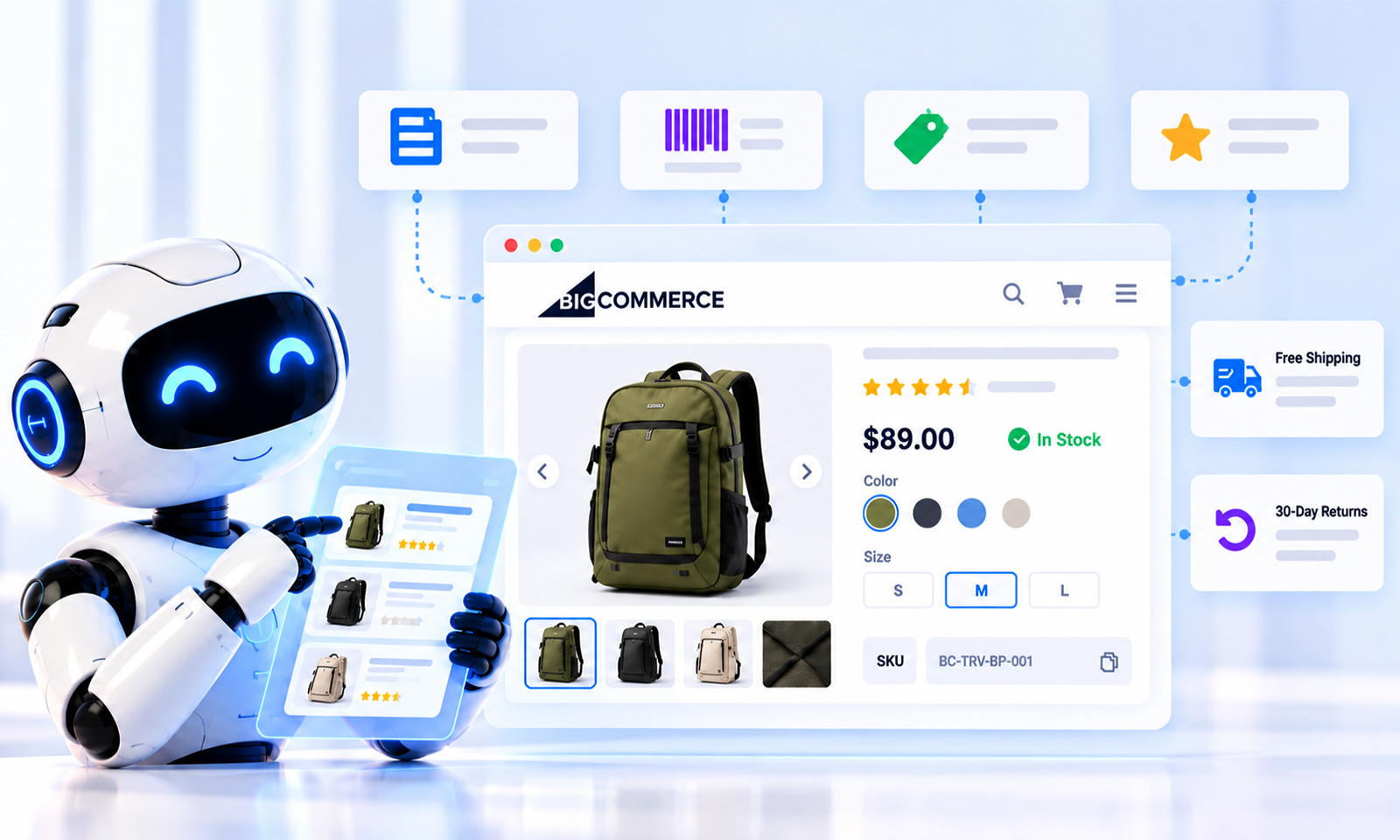
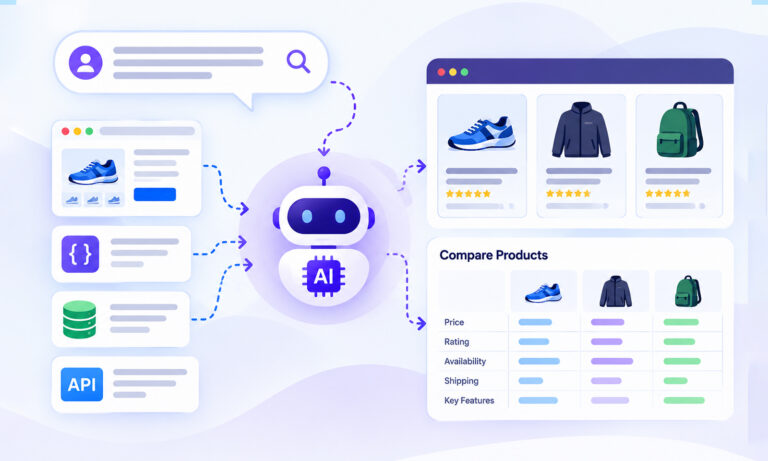
AI shopping agents need more than a product URL to evaluate an ecommerce product. To determine whether an item matches a shopper’s request, they need to understand what the product is, what features it has, which version is available, how much it costs, and whether it can actually be purchased.
That makes BigCommerce product data for AI agents an important consideration as ecommerce moves toward AI-assisted product discovery and comparison.
The goal isn’t to create a separate “AI version” of a product page. It’s to make the existing product information complete, specific, current, and consistent.
BigCommerce Product Data Checklist to Help AI Shopping Agents Evaluate Products
AI shopping agents need product data that answers the basic questions a shopper would ask: What is it? What makes it different? How much does it cost? Is the right version available? Can it be purchased?
| Product data | Why it matters |
|---|---|
| Product name | Identifies the product |
| Description | Explains what it does and who it is for |
| Brand | Identifies the manufacturer or brand |
| Category | Establishes the product’s context |
| Attributes | Describes features such as size, material, capacity, or compatibility |
| Variants | Identifies purchasable combinations such as size and color |
| SKU / product IDs | Distinguishes products and variants |
| GTIN/UPC/EAN | Helps identify standardized products where applicable |
| Price | Enables price comparison |
| Currency | Establishes the monetary value |
| Availability | Indicates whether the product can be purchased |
| Reviews and ratings | Provides customer feedback where applicable |
| Shipping and returns | Adds important purchase information |
These fields work together. A product with a detailed description but outdated inventory can still lead to an unreliable shopping decision. Likewise, accurate pricing is less useful if the product’s important specifications are missing.
What Product Information Helps AI Agents Evaluate BigCommerce Products?
AI shopping agents need enough product information to determine whether an item matches a shopper’s requirements. For BigCommerce stores, the most important data includes product details, attributes, variants, identifiers, price, availability, and relevant purchase information.
1. Product Name, Description, and Attributes
The product name and description should clearly explain what the product is and what makes it relevant. Specific facts are more useful for comparison than broad promotional language.
For example:
“Premium next-generation backpack for modern adventures.”
provides little information for comparison.
A description such as:
“28L waterproof backpack with a padded 16-inch laptop compartment and recycled polyester shell.”
gives both shoppers and automated systems concrete information about capacity, water resistance, compatibility, and material.
Important attributes can include size, color, material, dimensions, capacity, compatibility, technical specifications, and features, depending on the product category.
2. Product Variants
Variants tell an AI agent which versions of a product can actually be purchased.
For example:
| Variant | Price | Availability |
|---|---|---|
| Small / Blue | $29 | In stock |
| Medium / Blue | $29 | Out of stock |
| Large / Blue | $34 | In stock |
A shopper looking for a medium blue version needs information about that specific variant, not simply the availability of the parent product.
BigCommerce supports variant-level information such as SKU, option values, pricing, and inventory, making accurate variant data particularly important for product comparisons.
3. Product Identifiers
Identifiers help distinguish products and variants. Depending on the catalog, these can include SKU, GTIN, UPC, EAN, or MPN.
Use valid identifiers that actually belong to the product. Incorrect identifiers can create confusion rather than helping an AI agent distinguish between similar products.
4. Price and Availability
Price and availability are essential when an AI agent is matching products against a shopper’s purchasing requirements.
For example:
“Find a laptop under $1,000 that’s available now.”
requires current price and availability information. If the product page shows one price while another product-data source contains an outdated value, the system may receive conflicting information.
For products with variants, price and availability should reflect the specific purchasable version where applicable.
5. Brand, Reviews, Shipping, and Returns
Brand and category information provide useful product context, while reviews and ratings can provide customer feedback where applicable.
Shipping and return information can also become important when a shopper includes those requirements in a request, such as:
“Find a laptop under $1,000 with free shipping and easy returns.”
The product price alone cannot answer that question.
6. Keep Product Data Consistent Across Sources
When a product’s price, inventory, or variant options change, check that the storefront, catalog data, and structured data reflect the update. Pay particular attention to sale prices and variant-level availability, where outdated information can create conflicting product details.
For BigCommerce stores, this means checking the information shoppers see against the product data and JSON-LD exposed to automated systems.
Why Do AI Shopping Agents Need Accurate Price and Variant Availability?
Current price and availability help determine whether a product meets a shopper’s budget and can actually be purchased. For products with multiple variants, these details should reflect the selected size, color, or configuration wherever the catalog and shopping experience support variant-level information.
For example, a shirt may be in stock overall while the selected size and color combination is sold out. Keeping the product page, catalog data, and relevant structured data consistent helps reduce ambiguity about which version is available.
For BigCommerce stores, the key is to keep product and variant information accurate and synchronized as prices, inventory, and purchasable options change.
Does Structured Data Help AI Agents Understand Ecommerce Products?
Structured data makes product information explicit and machine-readable. Schema.org’s Product and Offer types can describe product details, identifiers, prices, and availability.
Google can use eligible product markup to display enhanced shopping information in Search, but structured data does not guarantee that every AI shopping agent will read, use, or recommend a product. It also does not provide shopping actions such as adding items to a cart or creating a checkout link.
Schema.org’s Product vocabulary can represent information such as product names, descriptions, brands, identifiers, reviews, ratings, and offers. Offer can represent commercial information such as price and availability.
For example, the following JSON-LD describes a product and its offer. These sample values are illustrative and should be replaced with accurate information for the actual product.
{
"@context": "https://schema.org",
"@type": "Product",
"name": "Waterproof 28L Backpack",
"brand": {
"@type": "Brand",
"name": "Example Brand"
},
"sku": "BP-28-BLK",
"offers": {
"@type": "Offer",
"price": "129.00",
"priceCurrency": "USD",
"availability": "https://schema.org/InStock"
}
}
The important part isn’t simply adding Product JSON-LD. The structured data needs to accurately represent the product information shown to shoppers and stay updated when that information changes.
This is particularly relevant when prices, inventory, variants, or other catalog information changes frequently.
Can Inaccurate Product Data Affect AI Shopping Recommendations?
Inaccurate or incomplete product data can make automated product interpretation less reliable.
Imagine a product page showing a price of $89 while another machine-readable source still contains $119. Or a product is marked as available even though the selected variant is sold out.
The problem is not just one incorrect field. The system now has conflicting information about the same product.
For a BigCommerce store, check that these remain consistent:
- Product-page content
- Product and variant information
- Price and sale price
- Inventory and availability
- Product identifiers
- Structured data
- Connected product feeds or catalog data
- Shipping and return information
This is why product-data maintenance matters as much as the initial implementation.
How Can BigCommerce Stores Make Product Information Easier for AI Agents to Interpret?
Start with the catalog itself.
Make product information specific. Product titles and descriptions should clearly explain what the product is and include important characteristics.
Represent variants accurately. Size, color, material, configuration, and other options should correspond to actual purchasable variants.
Keep commercial data current. Price, currency, inventory, and availability should reflect what shoppers can actually purchase.
Use valid product identifiers. Where applicable, provide accurate SKU, GTIN, UPC, EAN, or MPN information.
Use structured data appropriately. Product and Offer markup can provide explicit machine-readable information about products and offers.
Keep everything synchronized. When catalog information changes, the corresponding structured data and other product-data sources should not remain outdated.
JSON Schema App fits naturally into this last part as a way of maintaining site-wide JSON-LD, but the underlying principle is more important than the tool: structured data should accurately reflect the products shoppers see and can purchase.
Product Data Is Only Part of AI-Agent Readiness
Accurate product data helps AI agents evaluate products, but some shopping experiences also require tools to interact with the storefront. BigCommerce’s WebMCP documentation explains how supported browser-based AI agents can access storefront tools.
WebMCP is enabled by default on Stencil storefronts and Catalyst storefronts hosted on Cloudflare, but product search, cart management, and checkout-link tools require Storefront MCP to be enabled. Browser support is still evolving, so these capabilities are not available to every AI agent. Product data describes what is being sold; agent-accessible tools enable supported shopping actions.
BigCommerce Product Data Checklist for AI Shopping
Before considering a product catalog ready for AI-driven shopping experiences, check:
| Check | What to verify |
|---|---|
| Product identity | Clear product name and valid identifiers |
| Description | Specific information about the product |
| Attributes | Important specifications are explicitly stated |
| Variants | Purchasable combinations are accurately represented |
| Price | Matches the actual offer |
| Availability | Matches the actual product or variant |
| Reviews | Accurate where applicable |
| Shipping | Important delivery information is available |
| Returns | Return conditions are clearly stated |
| Structured data | JSON-LD matches visible product information |
| Updates | Changes are reflected consistently |
The objective isn’t to optimize for a hypothetical universal “AI ranking factor.” Instead, make the catalog clear enough to understand, detailed enough to compare, and current enough to support a real purchasing decision.
Conclusion
AI shopping agents need reliable product information to make useful comparisons and shopping decisions. For BigCommerce stores, that means maintaining clear descriptions, meaningful attributes, accurate variants and identifiers, current prices and availability, and consistent structured data.
The strongest approach is not to create a separate AI-focused version of the catalog. It is to make the existing product data accurate, complete, machine-readable where appropriate, and synchronized across the store.
That gives AI shopping systems clearer information to work with while also creating a better foundation for shoppers, search engines, and other automated experiences.
FAQs
Q1: Can AI shopping agents identify the correct product variant in a BigCommerce store?
They can identify a variant when the available product data clearly connects its options, such as size or color, with the correct SKU, price, and availability. Incomplete or inconsistent variant data can make it harder to determine which version matches a shopper’s request.
Q2: What happens if a BigCommerce product’s price or inventory data is outdated?
An AI shopping system may receive conflicting information about the product’s cost or availability. Keep catalog records, product pages, and relevant structured data synchronized, particularly when sale prices or variant inventory change.
Q3: Is adding Product schema enough to make a BigCommerce store ready for AI shopping agents?
No. Product structured data helps describe products in a machine-readable format, but it does not replace complete catalog information or provide tools for shopping actions. Readiness also depends on accurate product data and, where supported, the integrations an AI shopping experience uses.
Q4: What is the difference between WebMCP and product structured data?
Product structured data describes information such as a product’s name, brand, SKU, price, and availability. WebMCP can expose supported storefront tools to compatible browser-based AI agents, allowing them to perform certain shopping actions. They serve different purposes and are not interchangeable.
Q5: Does every AI shopping agent support BigCommerce WebMCP?
No. WebMCP capabilities depend on browser support, storefront configuration, and the tools available to the agent. BigCommerce merchants should consult the current WebMCP documentation before relying on these capabilities.
Q6: How can merchants check whether their BigCommerce product data is ready for AI-assisted shopping?
Review a representative set of products and variants. Confirm that product details, identifiers, prices, inventory, and relevant structured data agree with the actual storefront. Then check whether any AI-shopping integrations or storefront tools you intend to support are configured and working as expected.





 Wix Schema
 Squarespace Schema
 BigCommerce Schema
 Shopify Schema
 Hubspot Schema
 Webflow Schema
 GoHighlevel Schema
 Duda Schema
 Weebly Schema
 ClickFunnel Schema