

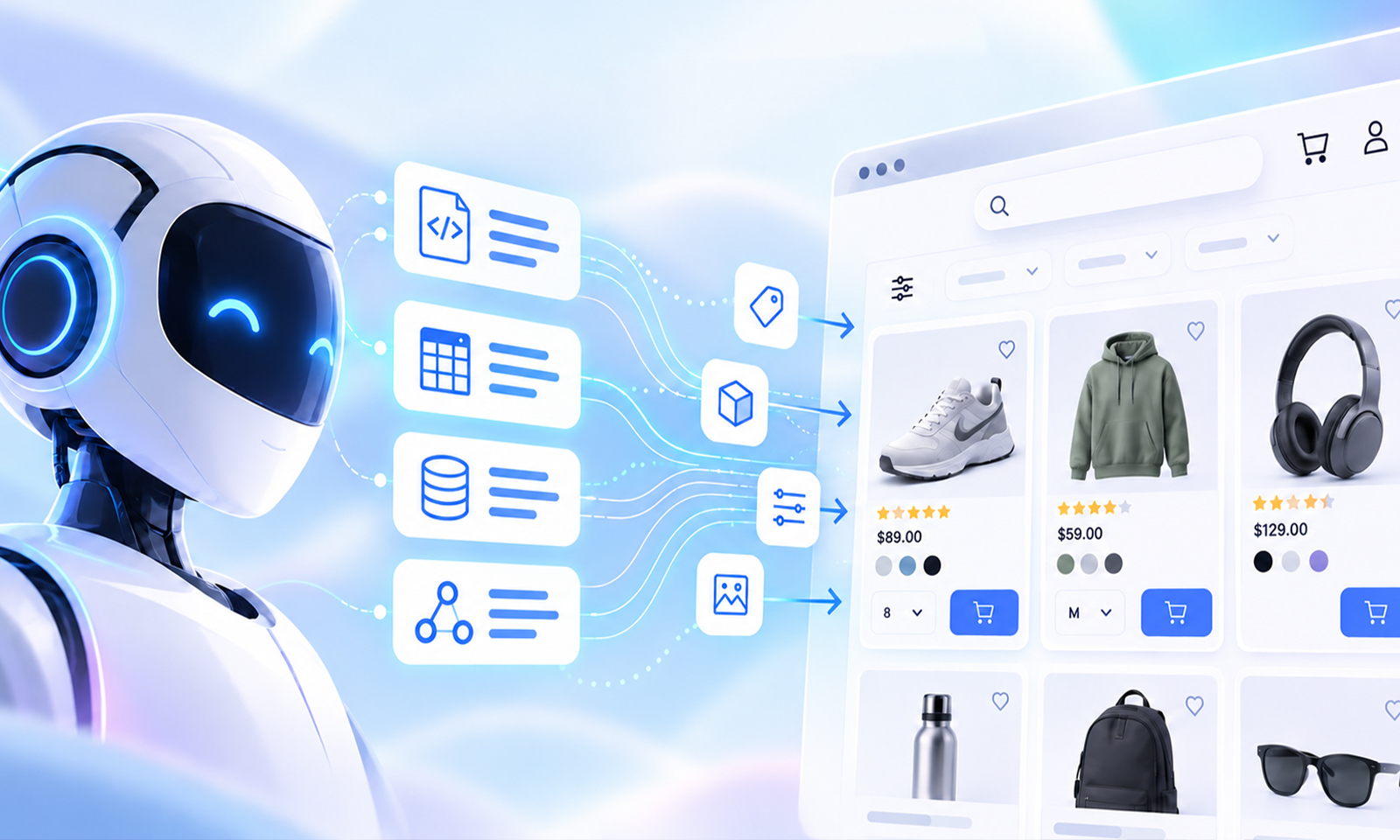
AI shopping is moving beyond the traditional search-and-click journey. Instead of simply returning links, AI agents for ecommerce can increasingly search catalogs, evaluate products against a shopper’s requirements, compare options, and, where the necessary integrations exist, help complete shopping tasks.
That creates a practical question for ecommerce businesses: how do AI shopping agents understand products in the first place?
The answer isn’t a single piece of code or one optimization technique. AI shopping agents can use several information sources, including visible product content, structured data, product catalogs, feeds, APIs, and agent-accessible commerce tools. The more clearly and consistently a store exposes its product information, the less an agent has to infer.
How AI Agents Process Ecommerce Product Data
AI agents understand ecommerce data by connecting individual product details such as attributes, price, availability, and variants to the shopper’s specific requirements. They can then use those signals to identify relevant products, filter options, and compare them against the request.
| Signal | What it tells an AI shopping agent |
|---|---|
| Product page content | What the product is and who it is for |
| Product attributes | Size, color, material, dimensions, features, and other characteristics |
| Structured data | Machine-readable relationships between products, offers, prices, availability, and reviews |
| Product feeds | Catalog-level product information in a structured format |
| APIs | Current product, inventory, pricing, and commerce data |
| Variants | Which specific versions of a product are available |
| Reviews and ratings | Customer feedback and product sentiment |
| Shipping and policies | Delivery, returns, and purchasing constraints |
| Agent tools or protocols | Ways an AI agent can search, retrieve information, or perform commerce actions |
What Are AI Shopping Agents?
AI shopping agents are AI systems designed to help users with shopping-related tasks using natural-language instructions. A traditional search query might be:
“running shoes under $150”
An AI shopping request could be more specific:
“Find me lightweight running shoes under $150, available in men’s size 10, with good reviews and free shipping.”
The agent has to interpret several requirements, find relevant products, retrieve product information, compare options, and potentially take further actions.
Research into ecommerce agents is also moving toward systems that perform more complex, multi-step product research rather than simply generating conversational recommendations.
This distinction matters for merchants. A product page isn’t just being evaluated for whether it contains useful copy. Its information may need to be discoverable, understandable, current, and consistent across machine-readable sources.
How Do AI Shopping Agents Understand Ecommerce Websites?
AI shopping agents can understand ecommerce websites by combining several layers of information rather than reading a page exactly as a human shopper would.
At a basic level, the process looks like this:
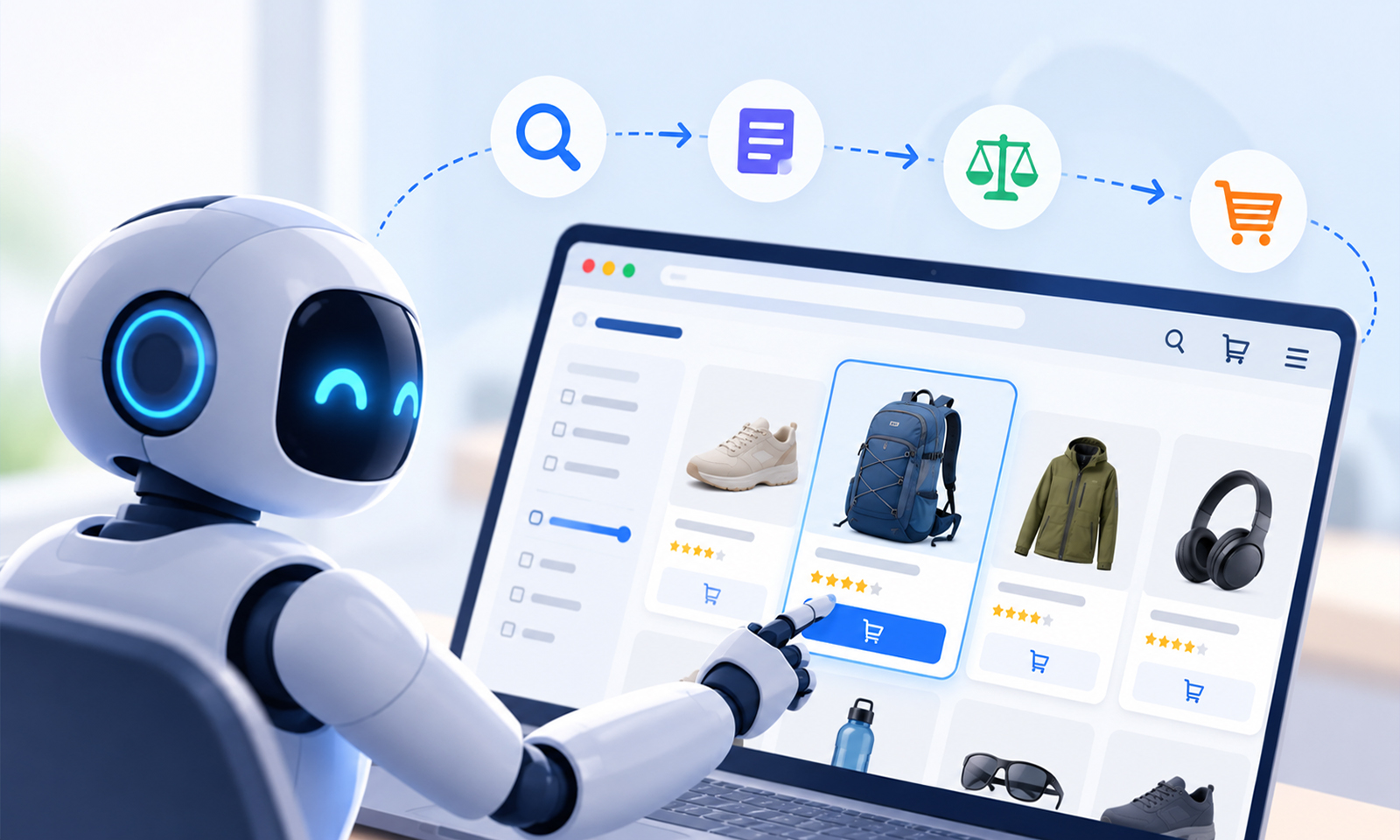
Discover information → identify products → interpret attributes → check constraints → compare products → complete an action
The way these signals are exposed can vary by ecommerce platform. A Shopify, Wix, BigCommerce, WooCommerce, or Webflow store may use different combinations of storefront content, structured data, product feeds, APIs, and platform integrations.
The exact process varies between AI systems, but ecommerce merchants should think about five major information layers.
1. Visible Product Content
The first layer is the content available on the ecommerce website itself.
A product page usually contains information such as:
- Product name
- Description
- Images
- Brand
- Specifications
- Price
- Availability
- Size and color options
- Shipping information
- Reviews
- Return information
This content provides context about what a product actually is.
For example, consider a product described as:
“Water-resistant hiking jacket with a 10,000 mm waterproof rating, available in black and navy.”
An AI shopping agent needs to identify that the product is a jacket, that it is intended for outdoor use, and that waterproofing is one of its attributes.
Clear product content therefore remains important even when structured data is implemented correctly.
2. Structured Product Data
The second layer is structured data.
Structured data gives machines a standardized way to interpret information on a page. Schema.org provides vocabulary for representing entities such as products, offers, brands, reviews, and organizations.
For ecommerce, Product and Offer are particularly relevant. Google documents how product structured data can communicate information such as price, availability, shipping, and returns for supported Search experiences.
A simplified example looks like this:
{
"@context": "https://schema.org",
"@type": "Product",
"name": "Waterproof Hiking Jacket",
"brand": {
"@type": "Brand",
"name": "Example Outdoor"
},
"offers": {
"@type": "Offer",
"price": "129.99",
"priceCurrency": "USD",
"availability": "https://schema.org/InStock"
}
}
This doesn’t mean an AI agent will automatically use this exact JSON-LD block to make a shopping decision. Rather, it provides a standardized representation of product information that compatible machine systems can interpret.
That distinction is important. Structured data is an information layer, not a guarantee of AI visibility or product recommendations.
What Product Data Do AI Shopping Agents Need?
For AI shopping agents, product data needs to answer the same practical questions a human shopper would ask, but in a form that software can reliably process.
| Product data | Example | Why it matters |
|---|---|---|
| Product name | Trail Runner X | Identifies the product |
| Brand | Example Sports | Helps satisfy brand preferences |
| Category | Running shoes | Establishes product context |
| Price | $129.99 | Enables price filtering and comparison |
| Availability | In stock | Determines whether it can be purchased |
| Variant | Men’s / Size 10 / Black | Matches specific requirements |
| SKU/GTIN | Product identifier | Helps distinguish products |
| Attributes | Waterproof, lightweight | Supports requirement matching |
| Reviews | 4.6/5 from 320 reviews | Provides customer feedback context |
| Shipping | Free 2-day shipping | Helps evaluate purchasing conditions |
This is why AI shopping agents product data should be treated as more than product descriptions.
A shopper might ask:
“Show me a black waterproof jacket under $200 that’s available in medium.”
If the store only provides a general product description but doesn’t clearly expose color, size, waterproofing, price, and availability, the agent has less reliable information to work with.
Google’s documentation similarly emphasizes structured product information such as price, currency, availability, and variant relationships for ecommerce search experiences.
How Do AI Agents Use Structured Data for Ecommerce?
AI agents and structured data are related because structured data gives compatible machine systems a standardized way to interpret important information about products, offers, and other entities on a page.
Consider two product pages.
Page A:
Blue running shoes. Great for everyday training. $120. Available now.
Page B:
The page contains the same information, but its structured data explicitly identifies the product, brand, offer, price, currency, and availability.
The second implementation gives compatible systems additional semantic context.
However, merchants should avoid treating schema as a special “AI ranking signal.” There is no universal rule saying that an AI shopping agent must use Product schema when deciding which product to recommend.
Instead, think of ecommerce structured data for AI as part of a broader data architecture:
Visible content + structured data + catalog data + feeds + APIs + commerce interfaces
The goal is consistency across those layers.
Do AI Shopping Agents Use Product Feeds?
They can, depending on the system and integration. Product feeds for AI agents can provide structured catalog information at scale. Instead of an agent discovering products one page at a time, an integration can expose catalog information through a structured feed or API.
This becomes particularly useful for stores with thousands of products, especially on platforms such as Shopify, BigCommerce, WooCommerce, and Wix, where product catalogs can be managed through platform features, feeds, apps, or APIs. A feed or API may expose information such as:
- Product identifiers
- Titles
- Descriptions
- Prices
- Availability
- Categories
- Variants
- Images
- Product URLs
APIs can provide another advantage: access to current commerce data.
For example, BigCommerce’s current storefront APIs expose product information including names, descriptions, SKUs, pricing, options, and other catalog data.
So when thinking about product data for AI agents, don’t limit the strategy to webpage markup. A scalable ecommerce implementation should consider every reliable machine-readable source.
How Does Agentic Commerce Change Product Discovery?
The shift becomes more significant when AI agents move from finding information to performing shopping tasks.
BigCommerce’s current MCP implementation is a useful example. Its B2C Storefront MCP server (currently in beta) allows AI agents to search a product catalog, retrieve product details, add products to a cart, and generate a checkout link.
A simplified agentic commerce journey can therefore look like:
Shopper request
↓
AI interprets requirements
↓
Product discovery
↓
Product details and variants
↓
Price and availability checks
↓
Product comparison
↓
Cart
↓
Checkout
The important implication for merchants is that product information needs to remain accurate beyond the visible page.
If an agent can retrieve a product’s price or availability through a commerce interface, that information should agree with what shoppers see on the storefront.
Why Product Accuracy Matters for AI Shopping Agents
One of the biggest practical problems isn’t a lack of schema. It’s inconsistent product information. Imagine a store where:
- The product page shows $89
- Structured data says $99
- A product feed says $79
- Inventory says out of stock
- The API reports in stock
Adding more markup doesn’t solve that underlying problem. AI systems need reliable information from the sources they can access. Conflicting values create ambiguity regardless of whether the data is beautifully formatted.
This is especially important for rapidly changing ecommerce properties such as price and availability. Google specifically notes that dynamically generated product markup needs careful handling because rapidly changing information can be affected by crawling and rendering behavior.
For that reason, a strong AI-readiness strategy starts with data accuracy and synchronization, then adds structured representation.
How Can Ecommerce Stores Make Product Data Easier for AI Agents to Understand?
There isn’t a single “AI shopping agent optimization” switch. Instead, merchants should improve the quality and accessibility of the information agents may need.
Keep product information complete
Make important attributes explicit rather than forcing systems to infer them from marketing copy.
For example, instead of:
“Perfect for chilly mornings.”
Use:
“Insulated jacket designed for temperatures from 35°F to 50°F.”
Where the information is accurate and supported, explicit attributes are easier to interpret.
Keep price and availability synchronized
Product pages, structured data, feeds, and APIs should reflect the same underlying product state.
This is particularly important for products with frequent inventory or pricing changes.
Implement relevant structured data
Use relevant Schema.org types and properties to describe products, offers, variants, and other important entities in a machine-readable format. On a large ecommerce site, tools such as JSON Schema App can help manage and maintain this structured data without requiring each product page to be edited manually.
The goal is not to add as much schema as possible, but to ensure the markup accurately represents the product information shown on the page.
Handle product variants correctly
A product with 30 sizes and colors isn’t the same as a single product with one offer. Google’s ProductGroup guidance provides a standardized approach for representing relationships between a parent product and its variants in structured data.
This is particularly relevant when shoppers give AI agents requirements such as:
“Find this shoe in women’s size 8 in white.”
Avoid duplicate or conflicting structured data
Multiple schema implementations can create conflicting product information. Before adding custom JSON-LD, inspect what your ecommerce platform and installed apps already generate.
This is particularly important on platforms such as Shopify, Wix, BigCommerce, and WooCommerce, where themes, apps, plugins, or platform features may already add structured data.
Keeping one consistent, accurate representation of each product makes the structured data easier to interpret.
A Practical AI-Readiness Checklist for Ecommerce Product Pages
Before worrying about whether an AI system can understand your products, check the fundamentals.
- Product content: Is the product name, description, category, and key attributes clear?
- Pricing: Does the visible price match structured data and other product sources?
- Availability: Is stock status accurate wherever it is exposed?
- Variants: Are size, color, material, and other purchasable variations clearly represented?
- Identifiers: Are SKU, GTIN, MPN, or other applicable identifiers consistent?
- Structured data: Is relevant Product/Offer markup valid and aligned with visible content?
- Feeds and APIs: If your store exposes catalog data through feeds or APIs, is that information current?
- Reviews: Are ratings and review counts based on genuine, current review data?
- Commerce actions: If you support agentic commerce, can the agent reliably retrieve product details and perform permitted actions?
This is a more durable approach than optimizing for one particular AI platform.
How Do AI Shopping Agents Compare Products?
Once an AI shopping agent has access to relevant product information, comparison becomes a matter of matching the shopper’s requirements against available product attributes.
Suppose the request is:
“Find me a laptop under $1,000 with at least 16 GB RAM, 512 GB storage, and a 14-inch display.”
An agent needs to identify products, extract or retrieve those attributes, filter products that don’t meet the constraints, and compare the remaining options.
This is where structured and consistent product data becomes particularly useful.
If one store describes RAM as “16GB memory” while another exposes it as a structured 16 GB attribute through a product interface, the agent still has to normalize those values. Better data doesn’t eliminate the AI’s reasoning step, but it can reduce ambiguity.
That’s the real opportunity with AI agent product discovery: make the underlying product facts as explicit, accurate, and machine-readable as practical.
Does Product Schema Make a Website AI-Ready?
No, not by itself.
Product schema is one component of an AI-ready ecommerce architecture. A store can have technically valid Product JSON-LD and still have:
- inaccurate prices
- missing variants
- incomplete product descriptions
- stale inventory
- inconsistent feeds
- inaccessible product pages
- conflicting data across APIs and storefronts
Conversely, a technically strong product catalog needs appropriate machine-readable representations if those representations are part of the systems consuming the store.
The better approach is to treat product schema for AI agents as one layer of a broader strategy rather than a standalone optimization.
Conclusion
AI shopping agents need more than keyword-rich product pages. They need reliable information they can discover, interpret, compare, and increasingly act on.
For ecommerce businesses, that means keeping product content clear, prices and availability accurate, variants properly represented, and structured data, feeds, and APIs aligned with the storefront. The quality and consistency of product information directly affect how useful that information is for AI-driven shopping experiences.
For ecommerce merchants, maintaining this foundation is an important step toward agentic commerce, where product discovery and purchasing can increasingly happen through AI-mediated experiences.
FAQs
Q1: How do AI shopping agents understand ecommerce websites?
AI shopping agents can combine webpage content, structured data, product catalogs, feeds, APIs, and commerce-specific tools to understand products and shopping options. The exact sources depend on the AI system and the merchant’s integrations.
Q2: How do AI shopping agents understand products?
They use product information such as names, descriptions, categories, attributes, prices, availability, variants, reviews, and other signals. Structured data and APIs can provide additional machine-readable context.
Q3: Does structured data help AI shopping agents?
Structured data provides standardized, machine-readable information about entities such as products and offers. It can make product information clearer to compatible machine systems, but it does not guarantee that an AI agent will use the markup or recommend a product.
Q4: Do AI shopping agents read JSON-LD?
Some systems may access structured data while processing webpages, but there is no universal rule that every AI shopping agent reads or relies on JSON-LD. AI agents can also use visible content, feeds, APIs, catalogs, and dedicated commerce interfaces.
Q5: What product data do AI agents need?
Useful product data includes product names, descriptions, categories, attributes, identifiers, prices, currency, availability, variants, reviews, shipping information, and relevant purchasing policies. Accuracy and consistency are as important as completeness.
Q6: Is product schema enough to prepare an ecommerce website for AI agents?
No. Product schema is only one part of AI readiness. Ecommerce businesses should also maintain accurate product content, synchronized pricing and inventory, accessible product pages, reliable feeds or APIs, correct variant information, and appropriate agent-facing commerce integrations where applicable.







 Wix Schema
 Squarespace Schema
 BigCommerce Schema
 Shopify Schema
 Hubspot Schema
 Webflow Schema
 GoHighlevel Schema
 Duda Schema
 Weebly Schema
 ClickFunnel Schema