

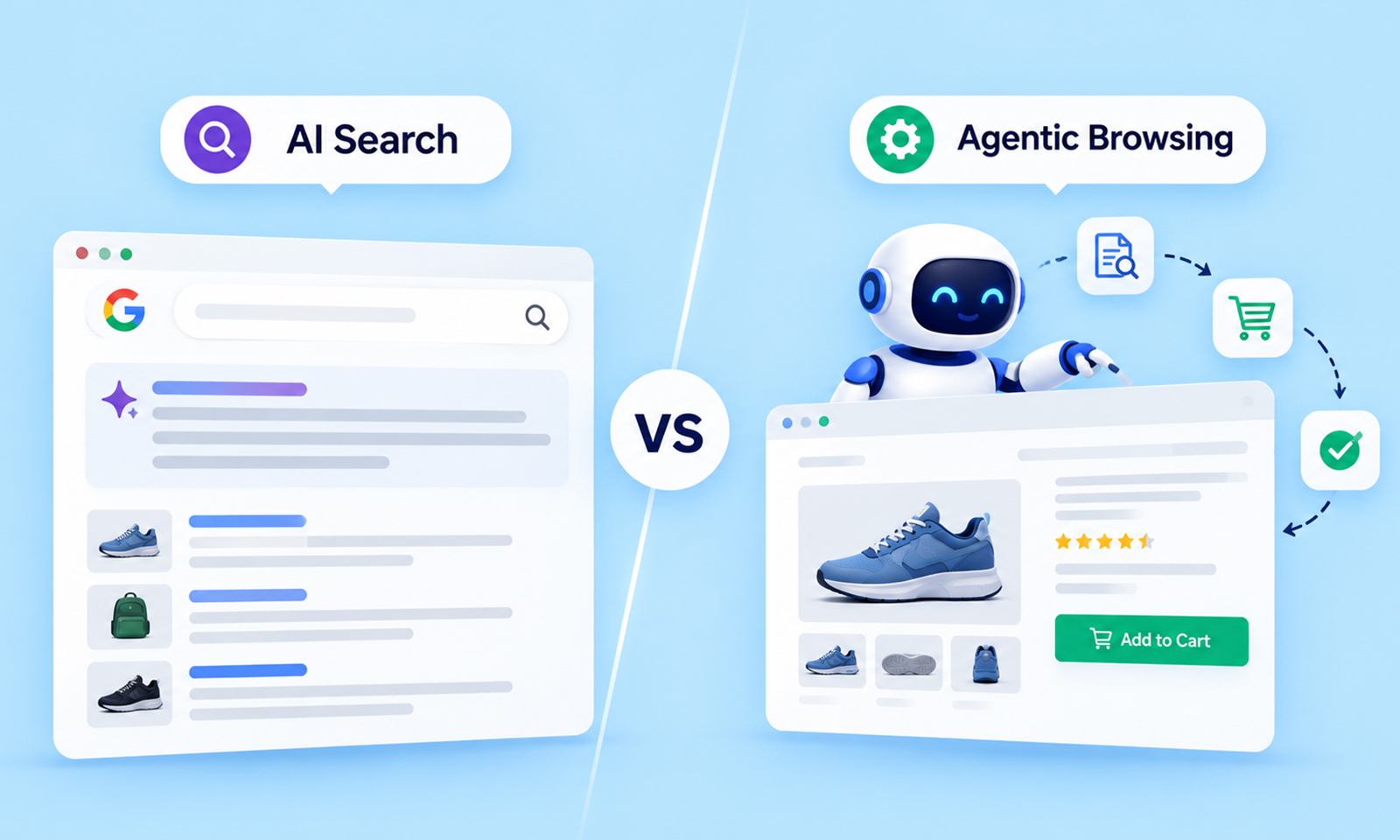
AI is changing how people discover information and products online. Instead of typing a short query into a search box and opening several results, users can increasingly ask AI systems complex questions and expect them to research, compare, and sometimes take action. That shift makes two concepts especially important: AI search and agentic browsing.
They overlap, but they serve different primary purposes. AI search helps users find, interpret, and summarize information, while agentic browsing allows an AI agent to navigate websites, interact with pages, and work toward completing tasks. Some AI systems combine both capabilities.
Understanding the difference between AI search and agentic browsing matters for ecommerce businesses because each capability can interact with website content and product information differently.
AI Search vs. Agentic Browsing at a Glance
AI search and agentic browsing can overlap, but they serve different purposes. The table below highlights the key differences in how they find information, interact with websites, and support ecommerce tasks.
| AI Search | Agentic Browsing | |
|---|---|---|
| Main purpose | Find and synthesize information | Navigate and act on information |
| Typical behavior | Searches, retrieves, summarizes | Opens pages, evaluates information, interacts |
| User interaction | Primarily conversational | Conversational plus task-oriented |
| Example | “What are the best running shoes for flat feet?” | “Find running shoes under $150, compare three options, and add the best match to my cart.” |
| Website dependency | Primarily discoverable, understandable content | Accessible, navigable, accurate, interactive website |
| Ecommerce role | Product discovery and comparison | Product research, selection, and potentially transactions |
In short : AI search helps answer a question using information from the web and other sources, while agentic browsing allows an AI agent to work through the web as part of completing a task.
What Is AI Search?
AI search is a search experience that uses artificial intelligence to understand a user’s question, retrieve relevant information, reason over multiple sources, and generate a synthesized response.
Traditional search generally returns a ranked set of webpages. AI search can instead provide a conversational answer and supporting links.
Google’s AI Overviews and AI Mode illustrate this evolution. Google says AI Mode can break complex questions into multiple related searches, retrieve information from different sources, and combine the results into a response.
For example, someone searching for:
“What should I look for when buying a waterproof hiking jacket?”
may receive a synthesized explanation covering waterproof ratings, breathability, materials, and use cases, along with links to supporting pages.
For ecommerce, the same concept can apply to product discovery:
“Compare lightweight laptops under $1,000 with at least 16GB RAM and eight hours of battery life.”
The AI search system needs to discover product information, understand the attributes, and synthesize the available evidence.
This is why AI search vs. web browsing is not simply a matter of replacing ten blue links with a chatbot. The underlying process can involve search, retrieval, ranking, reasoning, and synthesis.
What Is Agentic Browsing?
Agentic browsing is more task-oriented. Instead of stopping after finding and summarizing information, an AI agent can navigate websites to accomplish a sequence of actions.
Depending on the system and permissions available, that might involve opening pages, following links, entering information, comparing options, selecting products, or interacting with forms.
Research into web agents reflects this distinction. AI agents can interact with the internet through browser interfaces, while APIs provide another machine-oriented way to access online services. Research has also found that combining browser interaction with APIs can be useful for complex web tasks.
Imagine a shopper says:
“Find a black waterproof jacket, size medium, under $200, available for delivery this week.”
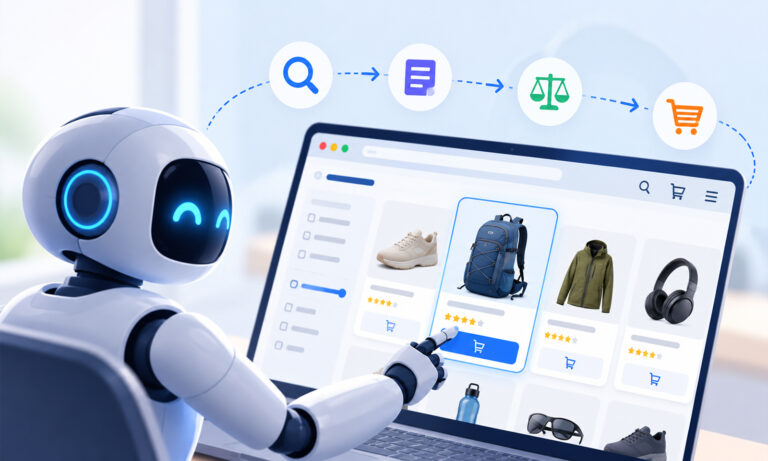
An AI shopping agent may need to:
- Search for suitable products.
- Open ecommerce product pages.
- Understand product attributes and variants.
- Check price and availability.
- Compare several products.
- Select an option that matches the user’s constraints.
- Potentially interact with the merchant’s website.
That is fundamentally different from simply producing a list of search results.
How agentic browsing works
A simplified agentic browsing workflow looks like this:
User request → AI interprets requirements → discovers relevant sites → navigates pages → extracts information → evaluates options → takes permitted actions
The exact implementation varies between AI systems. Some agents may use browser interfaces, while others may rely on APIs, feeds, structured data, or a combination of these methods.
So, agentic browsing does not mean every AI agent literally browses webpages in the same way a person does.
Agentic Browsing vs AI Search: Key Differences
The easiest way to understand the agentic browsing vs AI search difference is to look at what happens after information is found.
AI search primarily retrieves and synthesizes information to answer a question. Agentic browsing can take the process further by navigating websites, evaluating options against specific requirements, and potentially interacting with pages to complete a task.
For example, AI search might compare TVs based on screen size, price, and display technology. An agentic workflow could use that information to inspect product pages, check availability, and potentially add a suitable TV to a cart if the required tools and permissions are available.
The key difference is that AI search focuses on answering questions, while agentic browsing can help carry out tasks using information found online. The two can also work together within the same AI experience.
Why the Difference Matters for Ecommerce
For ecommerce businesses, the distinction becomes practical. An AI search system needs product information it can discover and understand.
An agent navigating an ecommerce website may additionally need the site to be accessible, navigable, and capable of exposing important product and transaction information clearly.
Consider a product page containing:
- Product name
- Description
- Brand
- Price
- Availability
- Size and color variants
- Images
- Reviews
- Shipping information
- Return policy
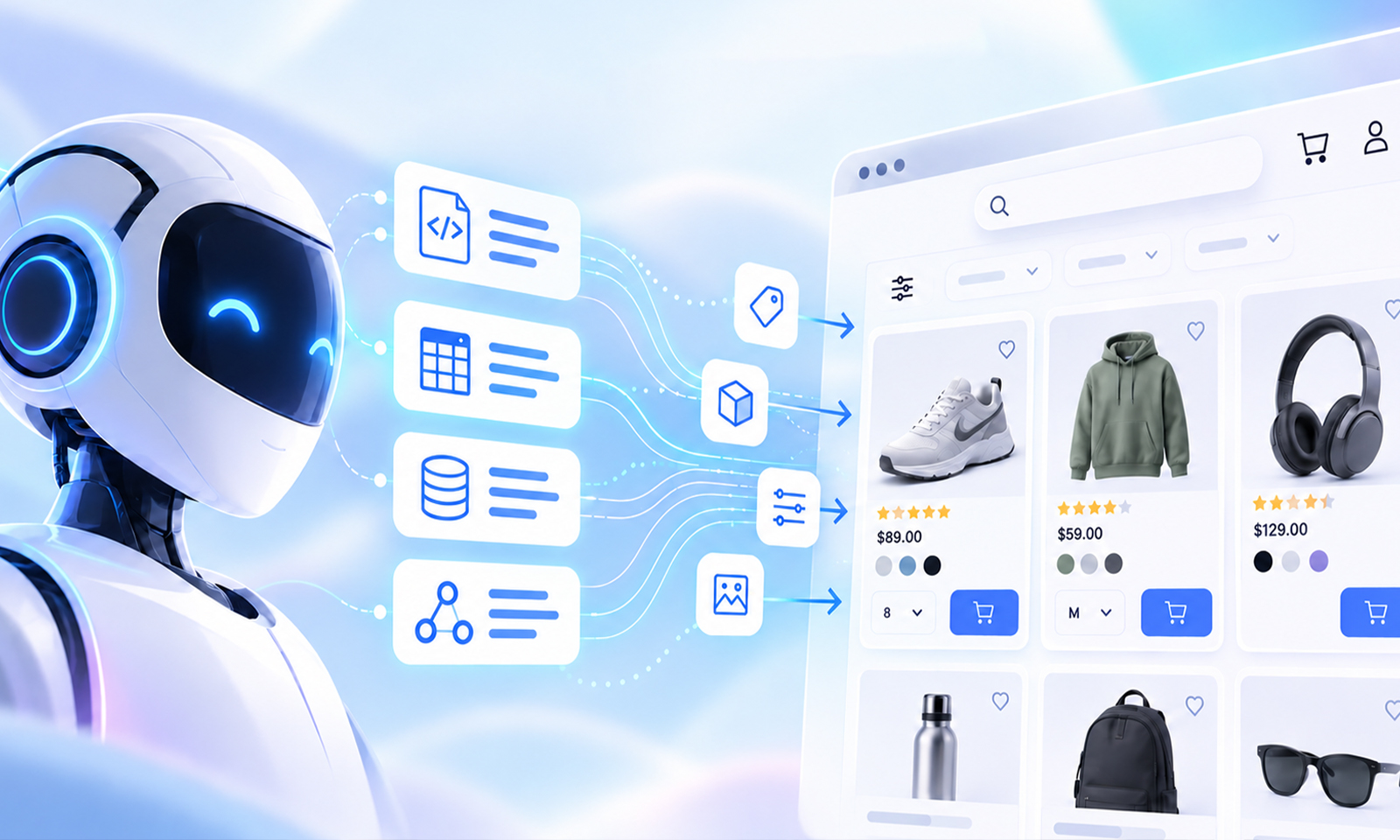
When product details differ between the visible page, structured data, product feeds, and inventory systems, automated systems may encounter conflicting information about price, availability, or product attributes. Keeping these sources consistent helps reduce ambiguity and supports more reliable product discovery.
Google specifically recommends sharing ecommerce product data through both product-page structured data and Merchant Center feeds. Google notes that structured data can help it understand details such as price, discounts, and shipping costs, while feeds can provide additional product data.
This does not mean that AI agents require Product schema to browse a website. Rather, structured data is one useful way of making important information explicit and machine-readable.
Structured data can make product meaning clearer
For example, a product page can communicate information using JSON-LD:
{
"@context": "https://schema.org",
"@type": "Product",
"name": "Waterproof Hiking Jacket",
"brand": {
"@type": "Brand",
"name": "Example Brand"
},
"offers": {
"@type": "Offer",
"price": "149.00",
"priceCurrency": "USD",
"availability": "https://schema.org/InStock"
}
}
Schema.org defines Product as a structured representation of product information, while Google supports specific Product and Offer properties for eligible search experiences.
For ecommerce teams, the bigger lesson is data consistency. If a product costs $149 on the page but structured data says $129, or the page says “in stock” while the underlying inventory has changed, machine interpretation becomes less reliable.
How to Prepare an Ecommerce Website for Agentic Browsing
Preparing for agentic browsing is broader than adding schema markup.
Keep product information accurate
Product names, descriptions, prices, availability, variants, shipping details, and policies should accurately reflect what customers can actually purchase.
This is especially important for stores with frequently changing inventory.
Google’s ecommerce documentation recommends using structured data and Merchant Center data to communicate product information, while also emphasizing that structured data does not guarantee a particular Search appearance.
Make important information machine-readable
Use appropriate structured data where it accurately represents the visible content. For ecommerce, that can include Product, Offer, ProductGroup, Organization, Review, and other relevant Schema.org types.
Product variants are particularly important for stores selling different sizes, colors, materials, or configurations. Google recommends ProductGroup with related properties to help describe relationships between variants.
Make the website accessible and navigable
An AI agent interacting with a website needs more than text to understand the page.
Clear navigation, meaningful labels, usable forms, descriptive buttons, and conventional interaction patterns can make a website easier for both people and software to work with.
Avoid hiding essential product information behind unnecessary interaction when that information can be presented clearly in the page structure.
Keep structured data synchronized
Adding schema once is not enough for a store where inventory and prices change frequently.
Your structured data should stay aligned with the current product page. Google specifically warns that dynamically generated Product markup can create challenges for frequently changing information such as price and availability if it is not handled reliably.
Don’t overlook APIs and feeds
Agentic web experiences do not necessarily depend entirely on browser interaction.
APIs and product feeds can provide structured access to product information and, where supported, specific functionality. Browser interaction may still be needed for tasks that depend on website interfaces. The appropriate approach depends on the agent’s capabilities, the available integrations, and the task being performed.
That means an ecommerce strategy should not be reduced to “add schema for AI agents.” The stronger approach is to make the underlying product information accurate, accessible, consistent, and available through appropriate machine-readable channels.
Do AI Search and Agentic Browsing Work Together?
Yes. In practice, the boundary between them can become less obvious as AI systems add agentic capabilities.
A system might first use AI search to discover suitable websites or products. It can then move into an agentic workflow to inspect a product page, compare options, or perform an action.
Google has already described agentic capabilities being incorporated into AI Mode for tasks such as searching across options and helping with transactions.
This creates a useful mental model:
AI Search = Discover and understand
Agentic Browsing = Navigate and act
Ecommerce readiness = Make the information and experience usable for both
That distinction is more useful than treating AI search and agentic browsing as competing technologies.
What Does This Mean for SEO and AI Visibility?
The rise of AI search does not eliminate traditional SEO fundamentals. Google states that its existing SEO best practices remain relevant for AI Overviews and AI Mode. For ecommerce businesses, the priority remains creating helpful content, maintaining crawlable and indexable pages, and providing accurate product information rather than relying on special AI-specific markup.
Pages still need to meet Google’s technical requirements and be eligible for indexing and Search snippets. For ecommerce businesses, that means continuing to focus on:
- Helpful, accurate product and category content
- Crawlable and indexable pages
- Clear site architecture
- Accurate structured data
- Consistent product information
- High-quality images and descriptive metadata
- Reliable feeds and APIs where applicable
- Accessible website interactions
The important change is not that SEO suddenly becomes irrelevant. It is that AI systems can become another layer through which users discover and interact with your website and products.
Conclusion
AI search and agentic browsing serve different primary purposes, but they can work together. AI search helps users discover and understand information, while agentic browsing allows AI agents to navigate websites and work toward completing tasks.
For ecommerce businesses, the priority is to maintain accurate product information, clear page structure, reliable structured data, and accessible website interactions. Consistent feeds and APIs can also help where they are supported and relevant.
These fundamentals help make product information easier to discover and understand across different AI-powered experiences.
FAQs
Q1: Is agentic browsing the same as AI search?
No. AI search primarily focuses on finding, interpreting, and synthesizing information. Agentic browsing is more task-oriented and can involve navigating websites and interacting with webpages to accomplish a goal.
Q2: What is the difference between AI search and agentic browsing for ecommerce?
AI search can help shoppers discover and compare products using information gathered from the web. Agentic browsing can extend that workflow by allowing an AI agent to navigate ecommerce sites, inspect product details, compare options, and potentially perform permitted actions.
Q3: Does agentic browsing require structured data?
Not necessarily. AI agents can use visible page content, navigation, browser interfaces, APIs, feeds, and other signals. Structured data is one machine-readable way to communicate information explicitly and can also support eligible Google Search experiences.
Q4: Does Product schema make a website ready for AI agents?
Product schema alone does not make an ecommerce website agent-ready. Product information also needs to be accurate, current, accessible, and consistent across the page and other relevant data sources.
Q5: How can ecommerce websites prepare for AI agents?
Start with accurate product information, crawlable pages, clear navigation, accessible interactions, reliable structured data, synchronized prices and availability, and appropriate APIs or product feeds. The goal is to make the website understandable and usable rather than optimizing for one specific AI system.
Q6: Is AI search replacing traditional search?
AI is changing how search experiences work, but traditional search remains part of the ecosystem. Google’s AI features continue to provide links to supporting webpages, and Google states that its core SEO practices remain relevant to AI Overviews and AI Mode.





 Wix Schema
 Squarespace Schema
 BigCommerce Schema
 Shopify Schema
 Hubspot Schema
 Webflow Schema
 GoHighlevel Schema
 Duda Schema
 Weebly Schema
 ClickFunnel Schema