

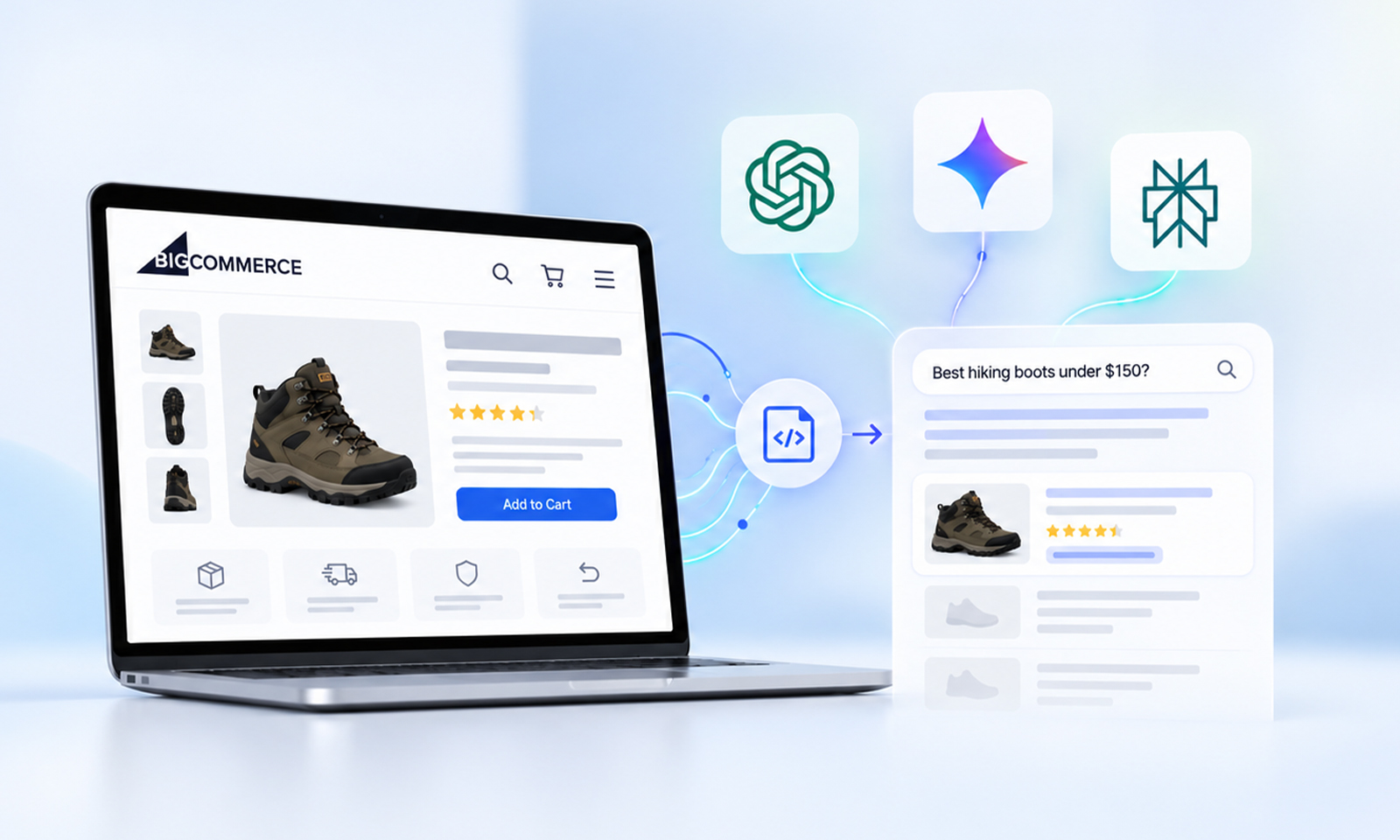
A BigCommerce store can rank well in traditional search and still have limited visibility in AI-generated answers.
That is because AI search experiences do more than return a list of pages. They can interpret a shopper’s question, combine information from multiple sources, and produce an answer that mentions particular products, brands, or retailers.
For ecommerce stores, that creates a different visibility problem: Can AI systems discover the store, understand its products, and confidently use that information when answering relevant questions?
Improving BigCommerce AI visibility is therefore not about adding an “AI” keyword to product descriptions. It is about making the store’s information clear, accessible, consistent, structured, and useful across the web.
What Helps a BigCommerce Store Appear in AI Search?
A BigCommerce store is more likely to appear in AI search when its product information is accurate, accessible, well-structured, and supported by useful content and credible sources. Focus on making the store easy for AI systems to discover, understand, and verify.
| Area | What to improve |
|---|---|
| Product data | Keep names, descriptions, prices, availability, variants, identifiers, and attributes accurate |
| Structured data | Use relevant Product, Offer, Review, Organization, and other applicable Schema.org markup |
| Content | Answer real product, category, comparison, and buying questions clearly |
| Crawlability | Make important pages accessible to relevant crawlers and avoid accidental blocking |
| Brand signals | Build consistent information about the business, products, expertise, and reputation |
| Citations | Publish useful, original information that other reputable sources can reference |
| Monitoring | Regularly test important queries in ChatGPT, Gemini, Perplexity, and other AI search experiences |
Google’s guidance similarly emphasizes helpful content, crawlable links, structured data, and making content understandable to search systems.
What Does BigCommerce AI Visibility Actually Mean?
BigCommerce AI visibility means how easily AI search tools can discover, understand, mention, or cite a BigCommerce store and its products in relevant answers. It is about whether the store’s information can be found and accurately represented when shoppers search through tools such as ChatGPT, Gemini, or Perplexity.
Unlike a traditional search ranking, AI visibility is not one fixed position. An AI system may mention a brand, recommend a product, cite a product page, or use information from the store when answering a broader shopping question.
For example, someone might ask:
“What are the best waterproof hiking boots for winter under $150?”
For a BigCommerce store, AI visibility means having product and brand information that is clear and accessible enough to be considered for relevant answers like this.
That depends on factors such as accurate product information, useful content, structured data, crawlability, and consistent information across the website and other relevant sources.
So, improving BigCommerce AI visibility is not about adding AI-related keywords to pages. It is about making the store’s information easy to discover, understand, verify, and use when it is relevant to a shopper’s question.
How Can I Make My BigCommerce Products Visible in AI Search?
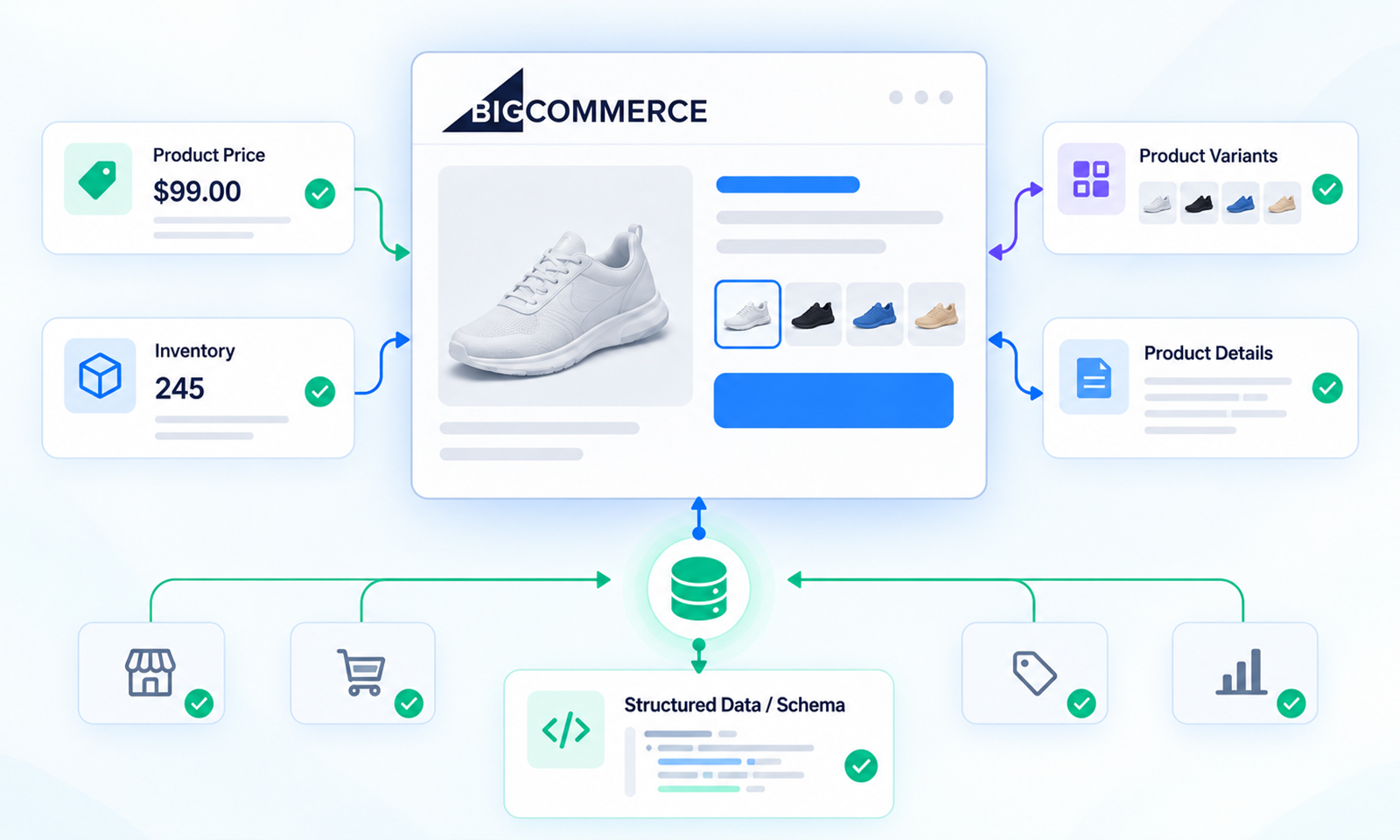
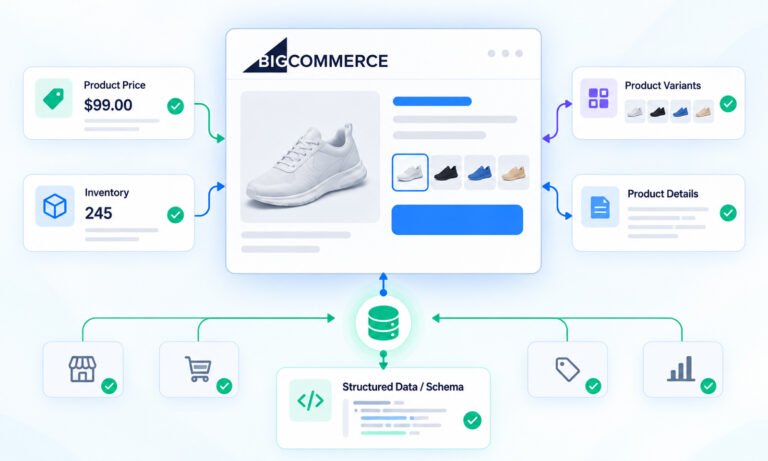
Make the product page a reliable, machine-readable source of product information. Keep the visible content, structured data, feeds, and other representations of the product consistent and current.
Accurate product information, structured data, accessibility, and commerce functionality are also important for BigCommerce agentic browsing, since AI agents need to understand and act on the information provided by the store.
For BigCommerce product visibility in AI search, start with the information a shopper or AI system would need to make a meaningful product comparison.
That usually includes:
- Clear product name and description
- Brand
- SKU and relevant identifiers such as GTIN or MPN, where applicable
- Current price and currency
- Availability
- Product variants
- Images
- Relevant specifications and attributes
- Shipping, returns, warranty, or other important purchasing information
- Genuine reviews and ratings where available
The important point is consistency. If a product page says an item is $129 and available, while another data source says $149 and out of stock, the store is providing conflicting signals.
Google’s merchant-listing documentation specifically identifies product information such as price, availability, shipping, returns, brand, and identifiers as important structured information for ecommerce pages.
Why Doesn’t My BigCommerce Store Appear in ChatGPT?
There is no single setting that guarantees a BigCommerce store will appear in ChatGPT. Visibility depends on whether relevant information can be discovered and whether the system considers that information useful for the particular query.
One basic technical check is crawler access. According to OpenAI’s official crawler documentation, OAI-SearchBot is used to discover websites for ChatGPT search results. Check that your robots.txt rules, hosting infrastructure, CDN, and firewall allow the crawler to access the pages you want to make available in ChatGPT search.
That does not mean allowing the crawler guarantees a mention. It simply removes one potential access barrier.
Then examine the content itself. If a product page has thin descriptions, unclear attributes, missing specifications, inaccessible content, or inconsistent product information, there is less useful information for an AI system to work with.
How Can I Optimize BigCommerce Product Pages for AI Search?
Write product pages for people first, but make the important facts exceptionally clear and consistent. AI systems need understandable source material, not pages filled with artificial AI-search wording.
Instead of:
Premium outdoor footwear with excellent performance.
Use specific information:
Waterproof hiking boot with a Vibram outsole, 200g insulation, and a waterproof leather upper, designed for cold-weather hiking.
The second description gives both shoppers and information systems more concrete information to work with.
This follows the broader principle behind Google’s people-first content guidance: useful content should provide substantial information, demonstrate expertise, and leave readers with enough information to accomplish their goal.
Does BigCommerce Product Schema Help With AI Visibility?
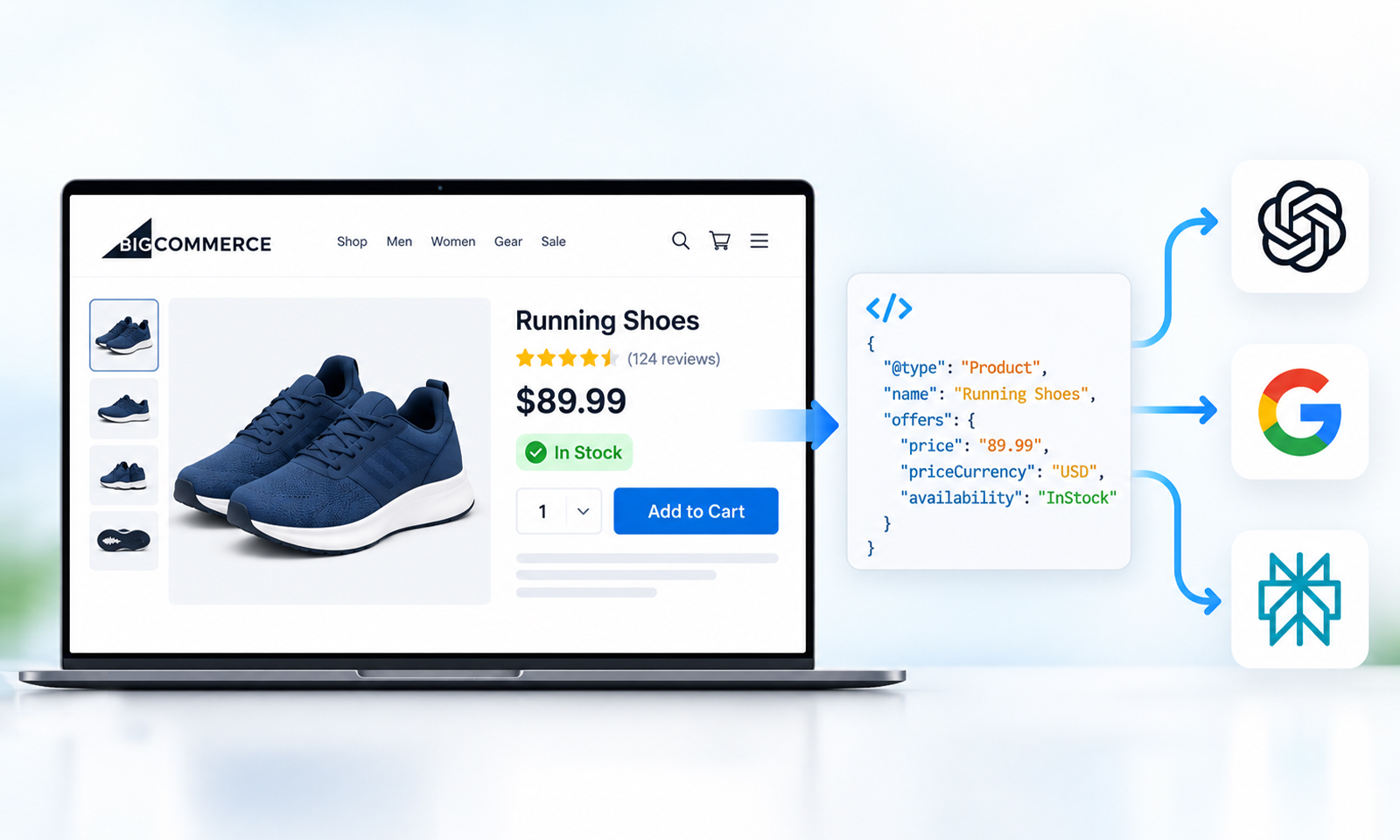
Product Schema can make product information easier for search systems to interpret, but it should not be presented as a guaranteed way to get cited by ChatGPT, Gemini, or Perplexity.
Schema.org structured data gives machine-readable meaning to information already represented on a page. Google specifically recommends JSON-LD as its preferred structured-data format and uses Product structured data for supported search experiences.
For a BigCommerce product, relevant structured information can include:
{
"@context": "https://schema.org",
"@type": "Product",
"name": "Example Hiking Boot",
"brand": {
"@type": "Brand",
"name": "Example Brand"
},
"sku": "HB-100",
"offers": {
"@type": "Offer",
"price": 129.00,
"priceCurrency": "USD",
"availability": "https://schema.org/InStock"
}
}
The properties used should accurately describe the product and match the information visible on the page. Do not add structured data for information that shoppers cannot see or that is not actually true.
For example, if a product is out of stock, its structured data should not continue to show InStock. The same applies to price, product name, brand, variants, reviews, and other changing information.
BigCommerce Structured data is therefore best treated as one part of a broader AI search foundation. Accurate product content, crawlable pages, consistent information, and useful supporting content still matter when working to improve BigCommerce AI visibility.
What Should BigCommerce Product Schema Include?
At minimum, structured data should accurately describe the product and its relevant commercial information. Depending on the product and page, that can include name, image, description, brand, identifiers, offers, availability, and genuine review information.
Google’s current merchant-listing documentation lists properties such as brand, category, Offer, and product identifiers among the information that can make product markup more complete.
For stores with frequent price, inventory, variant, or review changes, the bigger challenge is maintenance.
A product schema implementation that was accurate six months ago can become inaccurate after hundreds of catalog changes.
For large catalogs, generating or updating structured data from current product information can reduce manual maintenance and help keep prices, availability, variants, and other changing details accurate.
How Can BigCommerce GEO Improve AI Search Visibility?
BigCommerce GEO, or Generative Engine Optimization, focuses on making ecommerce content and product information easier for AI-powered search systems to understand, select, summarize, and cite.
GEO should complement SEO rather than replace it. A strong GEO foundation includes:
- Clear product and category information.
- Helpful content answering real customer questions.
- Accurate structured data.
- Strong internal linking and crawlable pages.
- Consistent business and product entities.
- Credible third-party references.
- Regular monitoring of AI-generated answers.
BigCommerce’s own GEO guidance recommends combining structured content, accurate product feeds, schema markup, conversational content, and trustworthy information.
How Do I Get My BigCommerce Store Cited by ChatGPT or Perplexity?
There is no reliable tactic that guarantees a citation. The practical approach is to create pages that provide useful, specific information and make those pages accessible to the relevant search systems.
For example, a generic article titled “Best Products” gives an AI system relatively little original information.
A detailed comparison that explains product specifications, use cases, limitations, compatibility, sizing, pricing context, or selection criteria is much more useful.
The same principle applies to AI search citations for ecommerce. If a page contains original, verifiable information that directly answers a question, it has a stronger reason to be considered as a source.
Google’s guidance for AI Overviews and AI Mode emphasizes established SEO fundamentals, including helpful, reliable content, crawlable internal links, and accurate structured data. Apply these principles to your buying guides and product comparisons rather than creating pages solely to target AI search.
How Can I Build Stronger BigCommerce AI Discovery Signals?
Make the store’s important entities unambiguous: the business, products, brands, categories, and relationships between them should be consistently represented across the site and relevant external sources.
This is the less obvious side of BigCommerce AI SEO.
Suppose a store sells several brands. A product page should make the relationship clear:
Store → Brand → Product → Variant → Offer → Review
The same product should not have substantially different names, specifications, or identifiers across important sources without a reason.
Internal links also help establish context. Product pages should connect naturally to relevant categories, buying guides, comparisons, and supporting content.
For example:
Product page → Hiking Boots category → Hiking boot buying guide → Waterproof hiking comparison
This gives both users and search systems a clearer understanding of the site’s topical relationships.
How Can I Increase BigCommerce AI Mentions and Recommendations?
Focus on becoming a useful source for the questions customers ask before buying, not just optimizing individual product pages.
This is particularly important for BigCommerce AI recommendations.
A shopper may not ask:
“Show me Product X.”
They may ask:
“What is a good lightweight hiking boot for long summer hikes?”
A product page alone may not address that broader decision. Supporting content can explain how weight, materials, grip, waterproofing, fit, and intended use affect the choice.
This creates opportunities for the store to provide useful information before the shopper reaches the product.
The same approach supports AI brand visibility and brand mentions in AI-generated answers without relying on repetitive brand references.
How Do I Measure BigCommerce AI Visibility?
Measure AI visibility by tracking whether the store and its products appear in relevant AI answers, how they are represented, and whether the cited information is accurate.
There is no universal AI visibility metric comparable to a Google ranking position.
Instead, create a repeatable set of high-value prompts around products, categories, use cases, and brand comparisons.
For example:
| Prompt type | What to monitor |
|---|---|
| Product discovery | Is the product mentioned? |
| Category research | Is the brand included among relevant options? |
| Comparison | Is the product accurately described? |
| Brand query | Is the store represented correctly? |
| Buying advice | Are relevant products recommended? |
| Source query | Does the AI answer cite the store or its content? |
This is the foundation of BigCommerce AI visibility monitoring. Track the same prompts periodically rather than checking random queries once. Record mentions, citations, product information, competitors mentioned, and factual errors.
What Should I Monitor in ChatGPT, Gemini, and Perplexity?
Monitor visibility across multiple systems because their answers and source selection can differ.
For BigCommerce visibility in ChatGPT, check whether product pages and useful content are surfaced or cited for relevant shopping and research prompts.
For BigCommerce visibility in Gemini, test comparable prompts and record whether the same products and brand information appear.
For BigCommerce visibility in Perplexity, pay particular attention to citations because Perplexity’s answer experience prominently exposes sources.
The objective is not to make every platform produce the same answer. It is to identify recurring patterns and factual inconsistencies.
A simple monthly monitoring sheet can contain:
Prompt → AI platform → Brand mentioned → Product mentioned → URL cited → Product data accurate → Competitors cited → Notes
Over time, this becomes much more actionable than a vague goal of “improving AI SEO.”
What Technical Issues Can Reduce BigCommerce AI Visibility?
Important product and content pages need to be discoverable, crawlable, and accessible; technical barriers can prevent useful information from being retrieved regardless of how good the content is.
Check the basics first:
- Important product and category URLs return successful responses.
- Canonical URLs point to the intended versions.
- Important pages are not accidentally marked noindex.
- Robots directives are not blocking important content.
- Internal links are crawlable.
- Product information is available in accessible page content.
- Structured data is present on the pages it describes.
- Structured data matches visible information.
- Prices and availability are current.
Google’s crawling documentation explains the roles of robots.txt, canonicalization, JavaScript rendering, metadata, and crawlable links in discovery and indexing.
Remember that robots.txt controls crawler access; it is not itself a guarantee that a page will be excluded from search. Google’s documentation recommends noindex when the goal is to prevent indexing.
A Practical BigCommerce AI Visibility Audit
Start with the products and queries that matter most commercially rather than trying to optimize the entire store at once.
Choose 10-20 important products and several high-intent questions customers might ask about them.
Then check:
1. Product information
Is the product name specific? Are important specifications visible? Are price, availability, variants, brand, and identifiers accurate?
2. Structured data
Inspect the Product markup and verify that it describes the visible page. Test eligible structured data with Google’s Rich Results Test and investigate errors or missing information. Google notes that valid structured data makes a page eligible for certain search features but does not guarantee that those features will appear.
3. Content depth
Does the site answer the questions a shopper would ask before buying?
4. Crawlability
Make sure important pages and resources are accessible to the relevant crawlers.
5. External signals
Check whether reputable websites, publications, reviewers, and other relevant sources describe the brand and products accurately.
6. AI results
Run the same priority prompts in ChatGPT, Gemini, and Perplexity and record mentions, citations, product accuracy, and competitors.
This process turns BigCommerce AI visibility from an abstract marketing goal into something that can actually be audited and improved.
Common Mistakes That Can Hurt AI Search Visibility
Most AI-visibility problems come from unclear, inconsistent, or inaccessible information rather than a lack of AI-focused content.
- Creating generic AI content: Avoid repetitive product descriptions that provide little useful information.
- Keyword stuffing: Repeating GEO, AI search, or ChatGPT terms does not automatically improve visibility.
- Using inaccurate schema: Structured data should match the information actually shown on the page.
- Expecting schema to guarantee citations: Passing a validation test does not mean ChatGPT, Gemini, or Perplexity will cite the page.
- Ignoring changing product data: Keep prices, availability, variants, and specifications consistent and current.
- Overlooking crawlability: Important product and content pages need to be accessible to relevant crawlers.
The foundation is straightforward: accurate product information, useful content, accessible pages, consistent structured data, and credible sources.
Conclusion
Improving BigCommerce AI visibility is less about finding a secret optimization for ChatGPT, Gemini, or Perplexity and more about improving the quality and accessibility of the information those systems can use.
Start with accurate product data, clear product pages, relevant structured data, crawlable content, strong internal relationships, useful buying information, and credible external references. Then monitor the actual AI results for important queries and correct the gaps you find.
The same foundation also supports traditional search. When product information is clear enough for shoppers, search engines, and AI systems to interpret consistently, the store is better prepared for both today’s AI search experiences and the broader shift toward AI-assisted ecommerce discovery.
FAQs
Q1: Does BigCommerce AI SEO replace traditional SEO?
No. BigCommerce AI SEO should complement technical SEO and content SEO. Crawlability, indexing, useful content, internal linking, and structured data remain important foundations for discoverability across search environments.
Q2: How do I get mentioned in ChatGPT?
There is no guaranteed method to get mentioned in ChatGPT. Make important pages accessible, provide specific and useful information, maintain accurate product data, and publish content that genuinely answers questions relevant to the products and audience.
Q3: Can structured data guarantee BigCommerce products appear in AI search?
No. BigCommerce Product Schema for AI can provide machine-readable product information, but structured data does not guarantee AI citations, recommendations, or visibility. Google likewise states that correctly implemented structured data does not guarantee a particular search appearance.
Q4: How can I get my products mentioned by AI?
Make the product information easy to understand and verify. Clear specifications, accurate pricing and availability, useful product descriptions, relevant structured data, reviews, and supporting content can all contribute to a stronger information foundation.
Q5: Does BigCommerce GEO mean writing content specifically for AI?
Not exactly. BigCommerce GEO is better understood as improving the likelihood that useful content and product information can be understood, selected, summarized, and cited in AI-powered search. It should remain useful to people first.
Q6: How often should I monitor BigCommerce AI visibility?
For important products and commercial queries, a monthly monitoring cycle is a practical starting point. Monitor more frequently after major catalog, pricing, content, technical, or brand changes.






 Wix Schema
 Squarespace Schema
 BigCommerce Schema
 Shopify Schema
 Hubspot Schema
 Webflow Schema
 GoHighlevel Schema
 Duda Schema
 Weebly Schema
 ClickFunnel Schema