

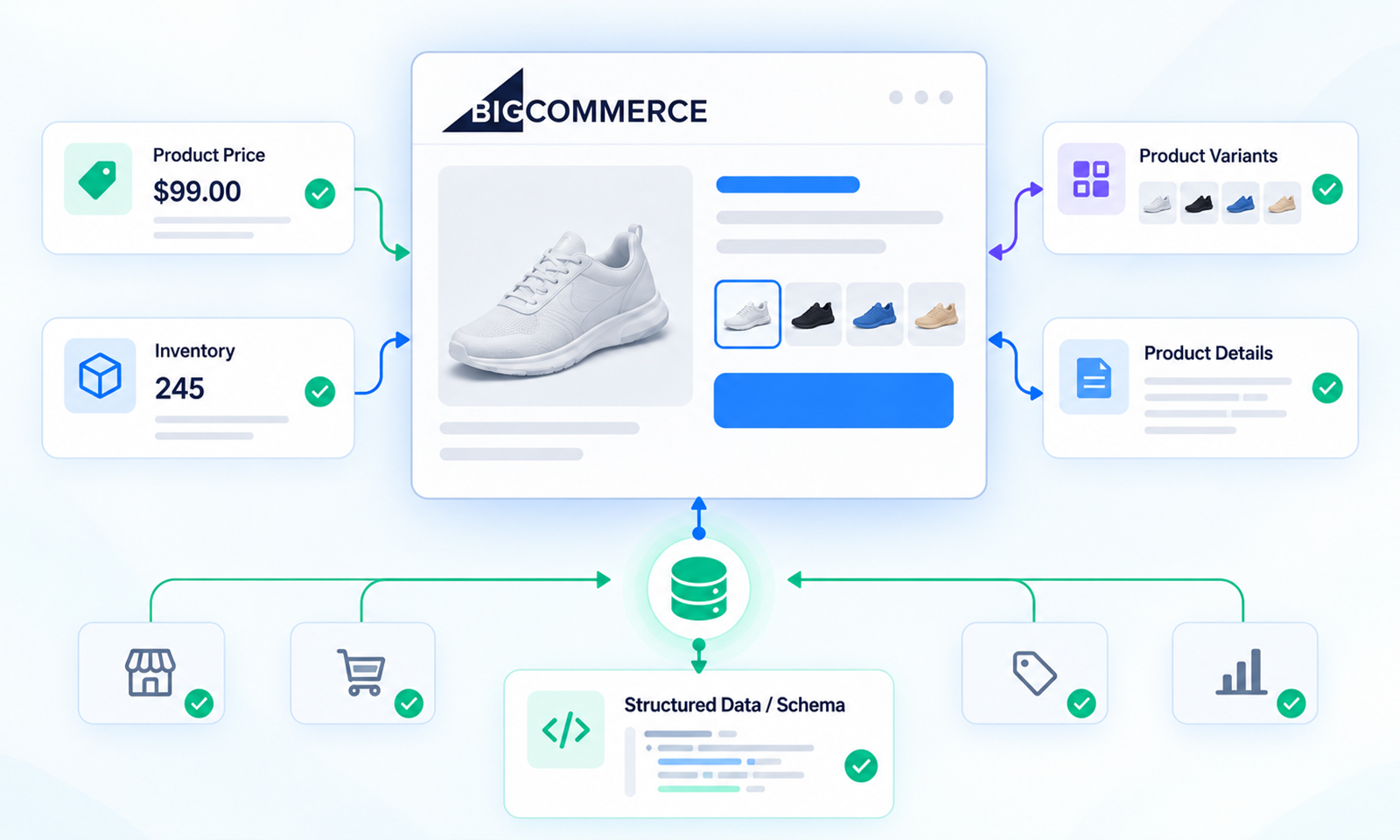
Product information changes constantly. Prices are updated, inventory moves, new variants are added, descriptions change, and promotions come and go.
The problem starts when an update reaches one place but not another. A product page might show a new price while structured data contains the old one, or a variant may be out of stock while another system still reports it as available.
For a growing BigCommerce store, BigCommerce product data consistency means keeping important product information accurate and aligned wherever it appears across the store and connected systems.
This matters not only for shoppers and search engines, but also for systems that increasingly consume product information programmatically.
How Do I Maintain Consistent BigCommerce Product Data?
Maintain consistency by defining a clear source of truth, standardizing product fields, synchronizing price and inventory changes, and keeping variants and structured data aligned with the current product information.
| Action | What to do |
|---|---|
| Establish a source of truth | Decide which system owns each important product field. |
| Standardize product data | Use consistent naming, descriptions, attributes, SKUs, and variant conventions. |
| Synchronize changes | Make sure price, inventory, and catalog updates reach relevant systems. |
| Manage variants separately | Keep variant-specific SKU, price, availability, and attributes accurate. |
| Align structured data | Make sure Product and Offer markup reflects the visible product information. |
| Validate regularly | Check important products for outdated or conflicting information. |
| Prepare for AI discovery | Keep product information clear and consistent for automated systems and AI shopping experiences. |
Key Steps for Maintaining BigCommerce Product Data Consistency
The most reliable approach is to treat product information as one connected dataset with a defined source of truth, rather than maintaining separate versions of the same product manually.
Establish a Clear Source of Truth
The first step in BigCommerce product data management is deciding which system is authoritative for each type of information.
For example, BigCommerce might be the source of truth for product names, descriptions, and attributes, while an inventory platform controls stock quantities. Another system might manage product information for a marketplace or feed.
The exact architecture varies by store, but every important field should have a defined owner.
Otherwise, different systems can gradually develop different versions of the same product.
For example:
- Product page: $49.99
- Product schema: $39.99
- Product feed: $49.99
The storefront may look correct, but the overall product information is inconsistent.
A good BigCommerce product information management process therefore defines which system owns each field, which systems consume it, and what happens when values conflict.
Standardize Product Information
How do I keep BigCommerce product descriptions and attributes consistent?
Standardize how important product information is represented throughout the catalog.
For example, one product might say:
Material: 100% Cotton
while another says:
Fabric: Cotton
and another mentions the material only inside the description. The descriptions do not need to be identical, but the underlying product information should follow a predictable structure.
Important fields can include:
- Product name
- Brand
- Material
- Size
- Color
- Dimensions
- Weight
- SKU
- Model number
- GTIN, where applicable
This becomes particularly valuable as the catalog grows. Consistent fields make BigCommerce product catalog management easier and reduce ambiguity for connected systems.
How Do I Keep BigCommerce Product Prices and Inventory Accurate?
Price and inventory deserve special attention because they can change frequently. BigCommerce supports product variants with their own SKUs and inventory, while its inventory functionality also supports location-based inventory management.
When a price or inventory value changes, the update should reach every relevant representation. For example:
Inventory change → variant availability → product page → structured data → connected feed
The exact workflow depends on the store’s integrations, but the principle is simple: the current commercial state should flow from the authoritative source to the systems that consume it.
This is especially important when different variants have different prices or inventory levels.
How Do I Keep BigCommerce Product Variant Information Consistent?
Variants should be treated as individual sellable items when their information differs.
For example:
| Variant | SKU | Price | Inventory |
|---|---|---|---|
| Blue / Small | TSH-BLU-S | $29 | 12 |
| Blue / Medium | TSH-BLU-M | $29 | 4 |
| Blue / Large | TSH-BLU-L | $32 | 0 |
The parent product can contain shared information, while each variant needs its own relevant SKU, price, availability, and variant attributes.
BigCommerce describes variants as versions of a product with their own SKU, and variants are also the objects used to map SKUs and track inventory.
That distinction matters when managing both the catalog and structured data. Google’s guidance for product variants uses ProductGroup to connect related variants and properties such as variesBy, hasVariant, and productGroupID to describe the relationship.
How Do I Prevent Outdated Product Information in BigCommerce?
Treat important catalog changes as synchronization events rather than isolated edits.
For example:
Price change → catalog → product page → structured data → feeds
Inventory change → catalog → variant → availability → structured data
New variant → catalog → product page → variant information
For a small catalog, periodic manual checks may be enough. Larger stores can use automated workflows to detect and distribute changes.
BigCommerce supports product and inventory webhook events, including product updates and variant inventory updates, which can be used to trigger downstream processes.
One useful implementation detail is that inventory changes should not always be detected by simply checking a product’s date_modified. BigCommerce notes that inventory updates processed through its Inventory API can leave date_modified unchanged and recommends webhooks for reliably detecting product and inventory changes.
That makes event-based synchronization more dependable for stores where product data changes frequently.
How Do I Prevent Conflicting Product Information Across BigCommerce?
Conflicts usually appear when more than one system can independently modify the same product field.
A practical solution is to classify fields as:
- Authoritative: One system owns the value.
- Synchronized: Other systems receive the value but should not independently override it.
- Calculated: The value is generated from other data.
For example, if an inventory system is authoritative for stock, the storefront should consume that inventory rather than independently maintaining another stock value.
The goal is not necessarily to eliminate every integration. It is to make the flow of information predictable:
Source → synchronization → destination → validation
That makes it easier to identify where an incorrect value originated when a discrepancy appears.
How Do I Keep BigCommerce Product Schema Synchronized With Product Pages?
BigCommerce schema markup should describe the product information that shoppers can actually see on the page. This is particularly important for price, availability, product details, and variants.
Suppose a product page displays:
Price: $69.99
Availability: In stock
The corresponding Product or Offer markup should not independently contain an old price or availability status.
Google explains that Product structured data can communicate information such as price, availability, reviews, shipping, and other product details, and that providing both structured data and Merchant Center product data can help Google understand and verify product information.
For product variants, use Google’s recommended ProductGroup and Product structured data where appropriate. Make sure each variant’s identifying details, price, and availability are represented accurately. If variants have separate URLs, ensure each URL identifies the correct variant and provides the corresponding product information. For single-page variant selectors, ensure the markup accurately represents the product and variant information available on the page.
The practical rule is:
Do not treat structured data as a separate product database.
Where possible, generate or update it from current product information. After implementation, validate the markup with Google’s Rich Results Test and monitor important pages for changes or errors.
Correct structured data can make product pages eligible for supported BigCommerce rich snippets and rich results , but eligibility does not guarantee that Google will display a particular search enhancement.
How Can I Keep BigCommerce Product Information Accurate for AI Shopping Agents?
The same consistency principles apply to BigCommerce product data for AI.
AI shopping agents need to interpret information such as what a product is, which variants are available, what they cost, and whether the product can be purchased.
That does not mean structured data guarantees that an AI system will cite, recommend, or select a product. It means consistent information gives automated systems fewer conflicting representations to interpret.
A useful model is:
Product page + catalog data + variant information + structured data = consistent product representation
If the visible page says $59 while another machine-readable representation says $49, the store is presenting conflicting information.
Keeping these signals aligned is therefore a practical part of preparing for BigCommerce agentic commerce and AI-assisted product discovery.
BigCommerce Product Data Consistency Audit
Use this audit to find inconsistencies rather than repeat the setup steps above. Focus on recently changed products, variants, connected systems, and the relationship between visible product information and machine-readable data.
| Check | What to look for |
|---|---|
| Recent product changes | Do recent price, inventory, or product updates appear everywhere they should? |
| Visible vs. machine-readable data | Do the page and Product/Offer markup show the same price, availability, and key details? |
| Variant accuracy | Do different variants show the correct SKU, price, attributes, and availability? |
| Connected systems | Are feeds and other connected systems receiving current product information? |
| Conflicting values | Can the same product field be changed in multiple systems? |
| Failed updates | Are there products where synchronization was delayed or failed? |
| Structured data | Does the markup remain valid and accurately reflect the page? |
If a check fails, trace the incorrect value back to its source of truth before correcting the destination. This helps prevent the same inconsistency from appearing after the next catalog update.
Conclusion
BigCommerce product data consistency comes down to keeping one reliable version of product information and making sure important changes reach every place that uses it.
Start with a clear source of truth, standardize product fields, keep prices and inventory synchronized, manage variants carefully, and ensure BigCommerce schema markup matches the visible product information.
When these pieces stay aligned, product catalog management becomes more predictable for the store and easier for search engines, connected systems, and emerging AI shopping experiences to interpret.
FAQs
Q1: Why is product data consistency important for a BigCommerce store?
Consistent product data helps shoppers find accurate product details, prices, and availability. It also helps search engines and connected systems interpret information without encountering conflicting values across product pages, feeds, and structured data.
Q2: Which BigCommerce product fields should remain consistent across systems?
Prioritize product names, descriptions, SKUs, GTINs where applicable, variant attributes, prices, and inventory status. Shared fields should follow consistent standards and display accurate values wherever the information is published.
Q3: What causes product data discrepancies in BigCommerce?
Common causes include delayed synchronization, failed integrations, duplicate product records, inconsistent identifiers, and manual edits across multiple systems. Defining field ownership and monitoring failed updates helps prevent recurring discrepancies.
Q4: How often should I audit product data in my BigCommerce store?
Monitor prices and inventory whenever they change. Conduct broader catalog audits periodically and after bulk imports, promotions, migrations, or integration changes. Audit frequency should reflect your catalog size and update frequency.
Q5: Can inconsistent BigCommerce product data affect SEO or rich results?
Conflicting product information can make pages harder for search engines to interpret and affect eligibility for supported rich results. Accurate structured data helps meet Google’s requirements, but does not guarantee rich result displays.
Q6: How does consistent BigCommerce product data help AI shopping agents?
Consistent product descriptions, attributes, variants, prices, and availability help AI shopping systems interpret and compare products. Aligning storefront content, catalog feeds, and structured data reduces conflicting information but does not guarantee AI recommendations or citations.










 Wix Schema
 Squarespace Schema
 BigCommerce Schema
 Shopify Schema
 Hubspot Schema
 Webflow Schema
 GoHighlevel Schema
 Duda Schema
 Weebly Schema
 ClickFunnel Schema