

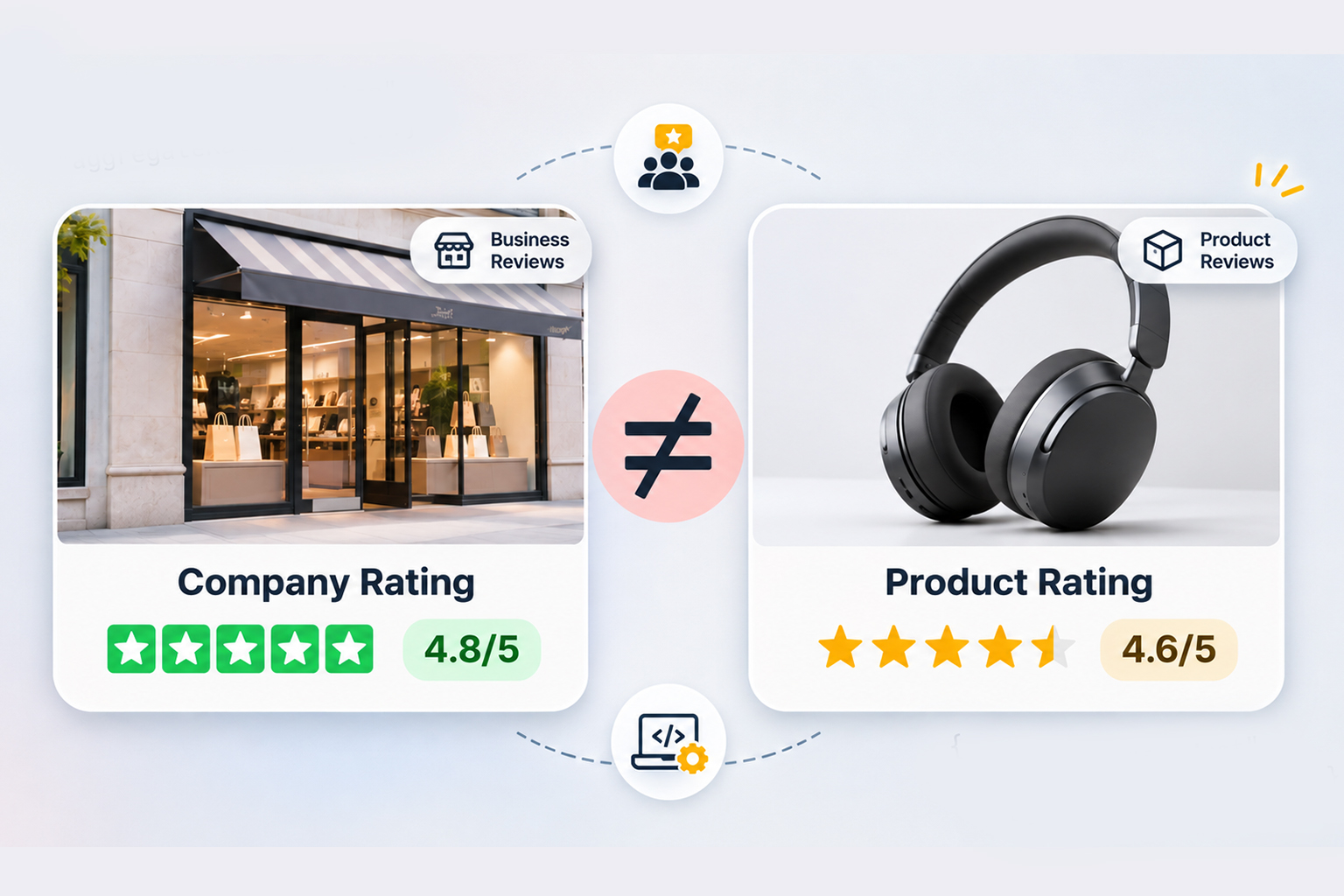
A store can have an impressive 4.8 Trustpilot rating and still have no valid product rating to put into its Product schema.
That distinction causes a common structured-data mistake: taking a business-level Trustpilot score and adding it to every product page as if customers rated each individual product 4.8 stars.
The problem isn’t the number 4.8. The problem is what that number represents.
Understanding the difference between a company rating vs product rating is essential if you want accurate structured data, compliant review markup, and a realistic chance of earning product review rich results.
Quick Comparison: Company Rating vs Product Rating
A 4.8 Trustpilot score usually reflects the overall business experience, not a specific product. It therefore shouldn’t be copied into a product’s aggregateRating or used to imply that every product has a 4.8-star rating.
| Factor | Company Rating | Product Rating |
|---|---|---|
| What it measures | Overall experience with the business | Experience with a specific product |
| Example | Trustpilot 4.8/5 | Product A 4.6/5 |
| Review source | Company/business reviews | Product-specific reviews |
| Schema context | Organization / business entity | Product entity |
| Can it be used as Product aggregateRating? | No | Yes, when compliant |
| Review count | Reviews about the company | Reviews about that specific product |
| Best use | Brand reputation and trust | Product ratings and rich results |
| Key rule | Don’t present it as a product rating | Rating must accurately represent the product |
Company Rating vs Product Rating: What’s the Difference?
The easiest way to understand the company rating vs product rating distinction is to ask one question:
What exactly did the customer rate?
A company rating reflects the customer’s experience with the business. That can include customer service, shipping, communication, returns, website experience, billing, or the overall buying experience.
A product rating is narrower. It answers questions such as:
- Was this particular product useful?
- Did the product meet expectations?
- How was its quality?
- Would the customer recommend this specific item?
For example, suppose an ecommerce store has a 4.8/5 Trustpilot score based on 8,000 reviews. That doesn’t mean every product sold by the store has a 4.8/5 rating.
A customer could give the company five stars because the delivery was fast and customer support was excellent while saying nothing about the quality of the product itself.
That is why company reviews vs product reviews are different datasets, even when they come from some of the same customers.
A Simple Example
| Rating | What it measures | Appropriate use |
|---|---|---|
| Trustpilot 4.8/5 | Overall business experience | Business/company context |
| Product A 4.6/5 | Reviews of Product A | Product page |
| Product B 4.2/5 | Reviews of Product B | Product page |
| Product C | No product reviews | Don’t invent a rating |
The distinction also applies to business rating vs product rating in structured data. Schema markup should describe the entity that the rating actually evaluates.
Why Your Trustpilot 4.8 Score Can’t Become Product aggregateRating
The technical issue becomes clearer when you look at what aggregateRating is supposed to represent.
For a product, the markup essentially tells search engines:
This specific product has an average rating of X based on Y ratings or reviews.
Google’s Product structured-data documentation supports aggregateRating as a property of a product, with ratingValue, ratingCount, and/or reviewCount describing the rating for that item.
So this would be misleading:
{
"@type": "Product",
"name": "Example Product",
"aggregateRating": {
"@type": "AggregateRating",
"ratingValue": 4.8,
"reviewCount": 8000
}
}
If those 8,000 reviews are actually reviews of the company on Trustpilot, rather than reviews of “Example Product.”
The markup technically describes a product rating, but the underlying evidence describes a business rating. That’s the core problem.
Google Doesn’t Allow Aggregating Ratings From Other Websites
This is the most important rule for Trustpilot product rating schema. Google’s current Review Snippet documentation explicitly states:
“Don’t aggregate reviews or ratings from other websites.”
Google also requires review content marked up for eligible review snippets to be available to users on the marked-up page. For an AggregateRating, users should be able to see that aggregate rating on the page.
That makes a simple Trustpilot-to-Product-schema workflow problematic:
Trustpilot company score → copy 4.8 → add to Product aggregateRating → expect Google stars
That’s not a compliant way to create product review markup. The same principle applies to other third-party ratings for Product schema. Whether the external source is Trustpilot or another review platform, an external company score doesn’t automatically become a valid product rating.
What About Trustpilot Product Reviews?
There is an important nuance here. Trustpilot isn’t limited to one type of review. Its current business guidance distinguishes between reviews about businesses and product-related reviews, and Trustpilot’s documentation recognizes product reviews separately.
That means you shouldn’t assume that every Trustpilot review is a company review. But the existence of a product review on Trustpilot doesn’t mean you can automatically take that external rating and use it as your site’s Product aggregateRating.
Google’s review snippet guidelines specifically prohibit aggregating reviews or ratings from other websites. So there are two separate questions:
Is the Trustpilot review about the product? It may be.
Can you simply use Trustpilot’s external rating as your Product schema aggregate rating for Google? No. Google’s review-snippet guidelines prohibit aggregating reviews or ratings from other websites.
This distinction is especially important when evaluating Trustpilot reviews Product schema implementations.
Can You Display Trustpilot Reviews on Product Pages?
Displaying third-party review content and using that content as Google’s Product review structured data are not the same thing.
You may have legitimate reasons to show Trustpilot information on your website, subject to Trustpilot’s own terms, permissions, and display requirements. Trustpilot warns businesses against misleading use of its TrustScore, ratings, and review designs, including displaying reviews or Trustpilot designs without permission.
However, showing a Trustpilot widget on a product page doesn’t automatically make the Trustpilot score a valid Product rating.
Think of the two layers separately:
User-facing layer:
“See what customers say about our business on Trustpilot.”
Structured-data layer:
“This product has a 4.6/5 rating based on 250 product reviews.”
Those statements can coexist, but they must describe different things accurately.
This is why company reviews on product pages should never be presented in a way that makes shoppers believe the company score is a rating for that specific product.
What Should Product Schema Use Instead?
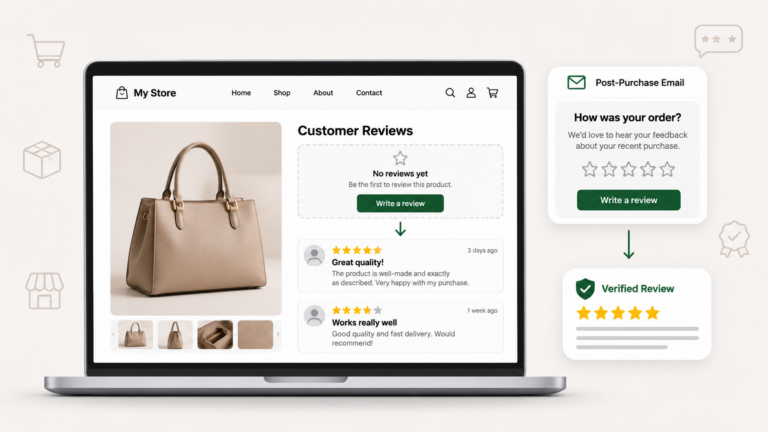
If you want an aggregate rating for products, the strongest approach is to collect genuine first-party product ratings and reviews and make them visible on the corresponding product pages.
For example:
{
"@context": "https://schema.org",
"@type": "Product",
"name": "Example Product",
"aggregateRating": {
"@type": "AggregateRating",
"ratingValue": 4.6,
"reviewCount": 127
}
}
Here, the 4.6 rating should actually represent the product and the 127 reviews should correspond to the product reviews represented on the page.
Google’s documentation says AggregateRating should describe the item being rated and requires at least one of ratingCount or reviewCount.
The important part isn’t simply producing valid JSON-LD. The data must be truthful and consistent with what shoppers can see.
Product Review Schema Trustpilot: Common Mistakes
Several implementation patterns repeatedly create problems.
Using the Company TrustScore on Every Product
This is the clearest example. If your store has a 4.8 Trustpilot score, adding "ratingValue": "4.8" to every Product entity implies that every product received the same average rating. Unless those products genuinely have those ratings, the markup is inaccurate.
Copying Trustpilot Review Counts Into Product Schema
A business may have thousands of Trustpilot reviews but only a fraction may relate to a particular product. Using the total company review count as the product’s reviewCount creates the same entity mismatch.
Assuming a Valid Schema Test Means Valid Review Eligibility
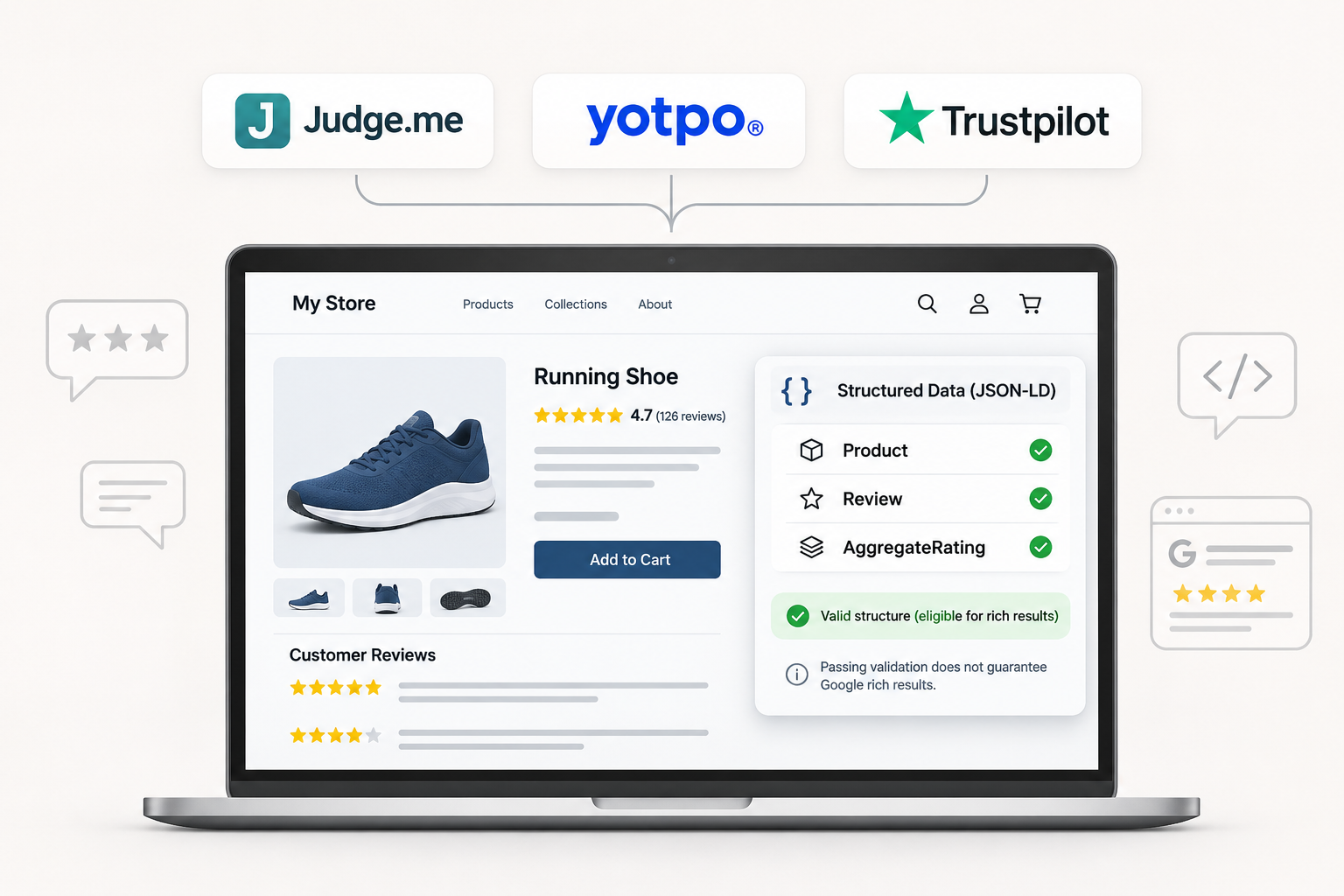
A structured-data validator can confirm that your JSON-LD has the expected syntax and properties. That doesn’t mean Google will consider the underlying review data eligible for a rich result.
Google recommends using the Rich Results Test to validate supported structured data, but eligibility still depends on Google’s guidelines and the actual page content.
Hiding the Rating From Users
Google says review content marked up for review snippets must be readily available to users on the marked-up page. For aggregate ratings, users should be able to see the aggregate rating. So don’t create a rating solely inside JSON-LD while keeping the corresponding information invisible to shoppers.
Trustpilot vs First-Party Product Reviews
| Factor | Trustpilot company rating | First-party product rating |
|---|---|---|
| Primary subject | Business | Specific product |
| Typical location | Trustpilot business profile | Product page |
| Represents product quality? | Not necessarily | Yes, when product-specific |
| Suitable as Product aggregateRating | No | Potentially, when compliant |
| Can support product stars? | Not by simply importing the score | Potentially |
| Review relationship | Company experience | Product experience |
This is the practical difference between external review ratings in Product schema and genuine product review data.
If your business has excellent company reviews but hasn’t collected product reviews yet, the correct answer isn’t to repurpose the company score. It’s to build a legitimate product review collection process.
For SaaS businesses, the same entity-level principle applies when deciding between business reviews and product/service ratings.
How to Handle Trustpilot and Product Ratings Correctly
A practical implementation starts by separating your review sources.
Step 1: Identify what the external rating represents.
Determine whether your 4.8 score represents the company, a specific product, or another entity.
Step 2: Keep company ratings attached to company context.
A Trustpilot business score can communicate overall customer sentiment, subject to Trustpilot’s display rules. It should not be relabeled as a product rating.
Step 3: Collect product-specific reviews separately.
Ask customers to review the products they purchased and associate each review with the correct product.
Step 4: Display those reviews on the relevant product page.
The rating, review count, and individual reviews should correspond to the product represented by the Product entity.
Step 5: Generate Product schema from the same source of truth.
Your aggregateRating should reflect the actual product rating shown to users.
Step 6: Validate the implementation.
Use Google’s Rich Results Test and check the rendered page, not just the JSON-LD. Google also recommends inspecting URLs to understand how Search sees the page.
For broader implementation decisions, this fits naturally into Can You Add Schema Markup to Testimonial Pages? What’s Allowed and What’s Risky, particularly when deciding which reviews belong to which structured-data entity.
Does This Mean Trustpilot Reviews Have No SEO Value?
No. That’s an important distinction.
A Trustpilot presence can still contribute to your brand’s overall reputation and provide customers with independent feedback about your business. Trustpilot itself describes its platform as a place where consumers can review businesses and share genuine experiences.
The issue is specifically about using the rating for the wrong entity in structured data.
A 4.8 company score can be valuable as a company score. It doesn’t need to become a product score to have value.
Likewise, a product page doesn’t need a fabricated 4.8 rating to be useful. Accurate product information and genuine product reviews are more defensible than borrowing a stronger rating from somewhere else.
Conclusion
The key to company rating vs product rating is simple: the rating must match the entity being described. A 4.8 Trustpilot company score should not be reused as a product rating.
For Product schema, use genuine product-specific reviews and ratings that are visible on the relevant product page. Keeping company and product ratings separate helps maintain accurate, compliant structured data.
FAQs
Q1: Can I use my Trustpilot rating on product pages?
You can potentially display Trustpilot information subject to Trustpilot’s applicable permissions and guidelines, but you should not present a company TrustScore as the rating of an individual product. Trustpilot also warns against misleading use of its ratings and review designs.
Q2: Can Trustpilot ratings be used for products?
Not by simply importing a Trustpilot company rating into a product’s aggregateRating. Google explicitly says not to aggregate reviews or ratings from other websites for review snippets.
Q3: Can a company rating be used in Product schema?
No. A company rating and a product rating describe different entities. Product schema should represent the rating of the specific product being marked up.
Q4: Can Trustpilot reviews generate Google product rich results?
A Trustpilot company score should not be repurposed as a Product rating. Google requires review information to relate to the specific item and explicitly prohibits aggregating ratings from other websites.
Q5: What should aggregateRating represent on a product page?
It should represent the aggregate rating for that specific product. Google requires ratingCount or reviewCount and expects the rating information to accurately describe the marked-up item.
Q6: What if my products don’t have reviews yet?
Don’t substitute your company rating. Leave the product’s review rating absent until you have genuine product-specific ratings or reviews that meet the applicable requirements. You can still provide complete Product information such as product name, offers, availability, and other relevant properties.







 Wix Schema
 Squarespace Schema
 BigCommerce Schema
 Shopify Schema
 Hubspot Schema
 Webflow Schema
 GoHighlevel Schema
 Duda Schema
 Weebly Schema
 ClickFunnel Schema