

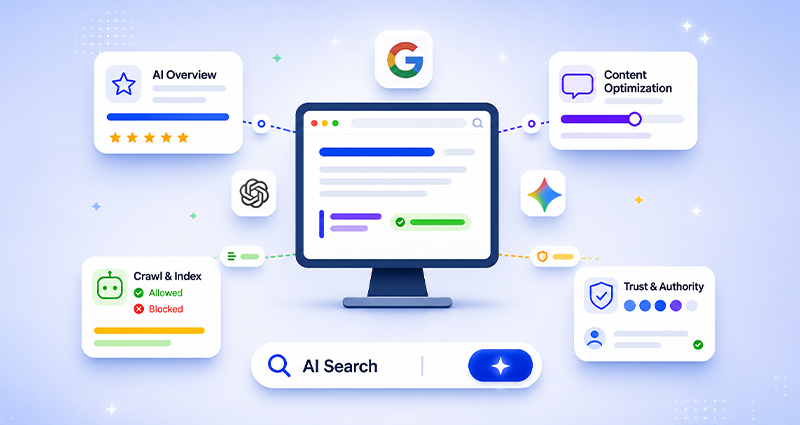
Search has changed more in the last two years. If someone is looking for a product recommendation, a quick how-to answer, or a local service provider, there’s a real chance they’re asking ChatGPT, Google’s AI Overviews, or Perplexity, not typing keywords into a search box. And when AI answers that question, it pulls from websites it understands, trusts, and can easily read. For any website owner or marketer focused solely on traditional SEO, this shift is hard to ignore. The challenge now is to optimize your website for AI search.
How to Optimize Your Website for AI Search (Quick Answer)
To optimize your website for AI search, focus on machine-readable structure, crawler access, content depth, and trust signals. Here’s how:
- Add structured data (JSON-LD schema) and llms.txt files
- Allow AI crawlers (GPTBot, ClaudeBot, PerplexityBot) in robots.txt
- Build topical authority with content clusters
- Write clear, extractable answers
- Use question-based headings and Q&A formatting
- Align title, H1, and meta with search intent
- Strengthen author and brand trust signals (focus on E-E-A-T)
- Improve page speed and Core Web Vitals
- Fix technical issues affecting crawlability
What Is AI Search and How Does It Work?
Traditional search engines matched keywords. AI search engines read content, understand context, and generate a direct answer pulling from multiple sources and synthesizing them into one response. Google AI Overviews, ChatGPT, Perplexity, and Microsoft Copilot all work this way.
The numbers tell the story clearly. AI-powered search now handles roughly 60% of all online queries, and AI Overviews appear in 57% of Google search results. At the same time, the traffic that does come from AI-referred visits converts at a meaningfully higher rate, and visitors spend 68% more time on-site compared to traditional organic traffic.
Why Structured Data Is the Most Important Step for AI Search
AI systems do not browse a website the way a human does. They send crawlers that read raw code, look for machine-readable signals, and try to understand what each page is about, its type, its purpose, its author, and its relationship to other content. Structured data, implemented through JSON-LD schema markup, gives AI platforms a direct, accurate map of that information.
Without structured data, an AI crawler has to guess. It might interpret a FAQ section as a regular paragraph. It might not recognize the author of an article as a credible expert. It might not understand that a product page has specific pricing, availability, or reviews. Structured data eliminates that guesswork.
Articles cited by AI Overviews cover 62% more verifiable facts than non-cited ones. Princeton research found that proper Generative Engine Optimization (GEO) implementation increases citation rates by 40% across AI platforms.
The Most Impactful Schema Types for AI Search Visibility
Not all schema types carry equal weight for AI search. These are the ones that directly influence how AI platforms understand, trust, and cite a website:
- FAQ Schema: Marks up question-and-answer content so AI can extract direct answers to common queries. One of the highest-impact schema types for AI Overview citations.
- Organization Schema: Verifies who is behind the website. Name, logo, contact details, and social profiles help AI systems confirm the brand is a real, trustworthy entity.
- Article Schema: Identifies content as a piece of editorial writing with an author, publish date, and topic signals that matter heavily for E-E-A-T.
- HowTo Schema: Structures step-by-step instructional content so AI can extract and display it as a clear, direct answer.
- Product Schema: For e-commerce and SaaS sites, this marks up pricing, availability, and reviews that AI actively looks for when answering commercial queries.
Here is what a basic FAQ schema looks like in JSON-LD format:
<script type="application/ld+json">
{
"@context": "https://schema.org",
"@type": "FAQPage",
"mainEntity": [{
"@type": "Question",
"name": "How do I optimize my website for AI search?",
"acceptedAnswer": {
"@type": "Answer",
"text": "Start with structured data (JSON-LD schema), build topical authority, strengthen E-E-A-T signals, and ensure your content is clearly structured with direct answers."
}
}]
}
</script>
How E-E-A-T Affects AI Search Visibility
Every major AI search platform built by companies like Google, Microsoft, or OpenAI is trying to pull answers from credible, trustworthy sources. Google’s Search Quality Rater Guidelines define the framework used to evaluate that credibility: E-E-A-T.
- Experience: Does the content creator have real, firsthand experience with the subject?
- Expertise: Is the content deep, accurate, and written by someone with genuine knowledge?
- Authoritativeness: Is the website and its authors respected and cited within the industry?
- Trustworthiness: Is the content accurate, the site secure, and the business clearly identifiable?
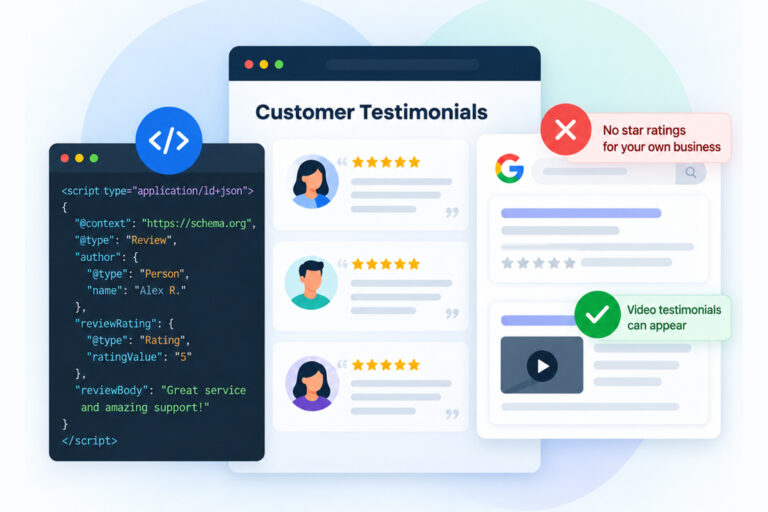
Structured data directly supports E-E-A-T. The organization schema establishes business identity. Article schema with author markup verifies expertise. Review schema builds trust through verifiable social proof. These are the exact signals AI platforms use to decide whether a source is worth citing.
How to Optimize Your Website for AI Search: Step-by-Step
1. Implement Structured Data Across Every Key Page
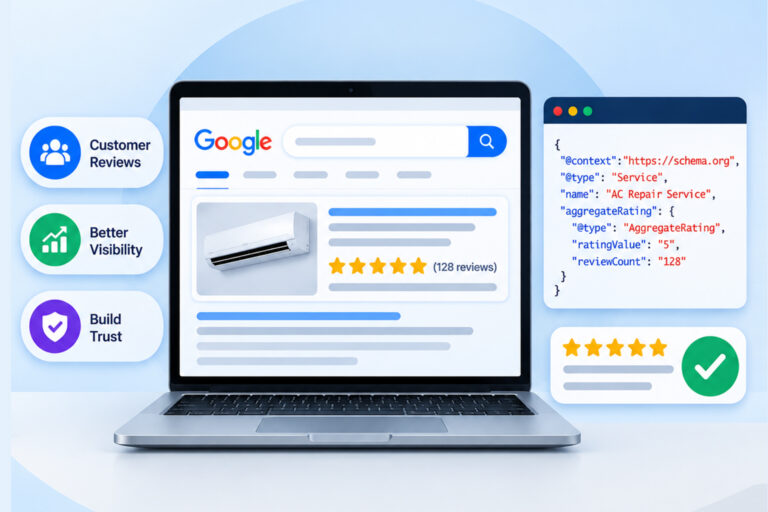
The single most actionable step is adding the right JSON-LD schema to every important page. Homepage and about pages should have the Organization schema. Blog posts need an Article schema with author markup. Product and service pages need the Product or Service schema. FAQ sections need the FAQ schema. Every schema type adds another layer of clarity for AI crawlers.
The challenge for most websites is not knowing what to add, it’s implementing it accurately and keeping it maintained as content changes. A single schema error (a missing required field, an outdated URL, a mismatched property) can prevent rich results from showing and reduce AI crawlability. Validation using Google’s Rich Results Test should be a standard part of any publishing workflow.
2. Allow AI Crawlers in robots.txt (GPTBot, ClaudeBot, PerplexityBot)
Many websites that were set up before AI crawlers existed have robots.txt configurations that either block all unknown bots by default or use wildcard rules that unintentionally prevent AI agents from accessing pages.
The major AI platforms use their own named crawlers. ChatGPT uses GPTBot. Claude uses ClaudeBot. Perplexity uses PerplexityBot. If any of these are blocked, even accidentally, that platform simply cannot read the site’s content and will not cite it in responses.
Checking robots.txt is a five-minute fix with significant upside. The correct configuration explicitly allows these bots rather than relying on a blanket allow-all rule. Here is what that looks like:
User-agent: GPTBot
Allow: /

User-agent: ClaudeBot
Allow: /

User-agent: PerplexityBot
Allow: /
After making changes, validate using Google Search Console’s robots.txt tester and re-submit the sitemap so AI crawlers pick up the updated configuration quickly.
3. Build Topical Authority with Content Clusters
AI platforms evaluate the overall knowledge footprint of a website. A site with one article on a topic is treated very differently from a site with a comprehensive, interlinked hub of content covering every angle of that subject. This is called topical authority, and it is one of the strongest signals an AI uses to determine whether a source is genuinely credible.
The practical approach is to build content clusters. A pillar page covers a broad topic in depth. Supporting pages cover subtopics in detail and link back to the pillar. The internal linking structure itself signals to AI crawlers that the site has a coherent, well-organized knowledge base rather than a disconnected collection of articles.
4. Write Clear, Extractable Answers
AI platforms are looking for clear, quotable answers. Content that buries its main point in the middle of a long paragraph, uses vague language, or never directly answers the question it implies will be skipped in favor of content that is cleaner and more direct.
Structurally, this means using descriptive headings that mirror the actual question being asked, starting each section with a direct answer, then supporting it with context and examples. Including specific data points, named examples, and verifiable facts gives AI more concrete material to work with.
5. Use Question-Based Headings and Q&A Formatting
Most people ask AI systems questions, not keywords. “What is the best way to add schema markup to a Wix site?” is a far more common AI query than “schema markup Wix.” Content headings that mirror the exact way questions are phrased in real conversations are far more likely to be matched and extracted by AI.
This means replacing generic heading phrases like “Schema Implementation” with question-based alternatives like “How Do You Add Schema Markup to a Wix Site?” The heading itself becomes the query match. Below it, the first sentence should answer the question directly.
6. Align Title, H1, and Meta Description With Search Intent
When a page’s title tag, H1 heading, and meta description all clearly reflect the same search intent, AI crawlers can immediately confirm what the page is about and whether it is a relevant match for a query. When these three elements contradict each other or when the title is keyword-stuffed while the H1 says something different, AI platforms get conflicting signals and are less likely to treat the page as a trusted source.
A quick audit: Open the page and check three things: the browser tab title (title tag), the main visible heading (H1), and the meta description (which often becomes the snippet in search results). If all three clearly reflect the same topic and intent, the alignment is good. If any one of them differs, it should be revised.
7. Strengthen Author and Brand Trust Signals (Focus on E-E-A-T)
AI platforms are increasingly verifying not just whether content is well-written, but whether the person or organization behind it can be confirmed as credible. Author bios should include professional credentials, relevant experience, links to LinkedIn profiles, and a publishing history. At the brand level, ensuring the business is accurately listed across authoritative third-party sources, industry publications, review platforms, and directories adds to the brand’s overall trust score in the eyes of AI search.
8. Improve Page Speed and Core Web Vitals
Page speed is not a direct crawlability signal, but it influences how efficiently search engines and AI crawlers can access your site. Slow pages can limit crawl efficiency and reduce the number of pages explored within a crawl budget. While crawlers don’t simply abandon slow pages, consistently poor performance may contribute to a perception of lower site quality over time.
Google’s Core Web Vitals thresholds are the clearest benchmarks to target: Largest Contentful Paint (LCP) under 2.5 seconds, Cumulative Layout Shift (CLS) under 0.1, and Interaction to Next Paint (INP) under 200 milliseconds. Pages that meet all three thresholds signal to AI platforms that the site is well-maintained and technically sound.
The most common speed issues are render-blocking JavaScript, unoptimized images, missing browser caching, and slow server response times. Running a page through Google PageSpeed Insights identifies exactly which issues are causing the most drag. To automate the fixing process rather than address each issue manually, tools like Website Speedy handle speed optimization automatically.
9. Fix Technical Issues Affecting Crawlability
Beyond robots.txt and page speed, several other technical issues directly prevent AI crawlers from successfully reading and indexing a page. These are worth auditing systematically rather than addressing reactively. HTTP errors are the most damaging. A 4XX error means the page does not exist or cannot be accessed. A 5XX error means the server failed. Either will cause an AI crawler to abandon the page and mark it as unreliable. Broken internal links that lead to 404 pages also waste crawl budget and reduce the site’s perceived reliability.
- CAPTCHAs and login walls: Any page that requires a user interaction before loading content is effectively invisible to AI crawlers.
- Redirect chains: Multiple consecutive redirects slow crawlers and sometimes cause them to stop following the chain entirely.
- Duplicate content: Multiple URLs serving the same content dilute authority and confuse AI systems about which version to cite.
- Missing canonical tags: Without canonical tags, AI crawlers cannot determine which version of a page is the authoritative one.
A monthly crawl using a tool like Screaming Frog surfaces all of these issues in one pass. Fixing them systematically keeps the site in good standing with both traditional search engines and AI crawlers.
Final Thoughts
AI search is already shaping how people discover and trust content online. With AI-driven results becoming more common, visibility now depends on how clearly a website is understood, not just how well it ranks.
Building that clarity comes down to structured data, strong topical authority, and credible signals like authorship and entity trust. Sites that focus on these now are far more likely to stay visible and relevant as search continues to evolve.
FAQs
Q1: What is the difference between traditional SEO and AI search optimization?
Traditional SEO focuses on ranking pages in search engine results. AI search optimization focuses on getting content cited within AI-generated answers on platforms like Google AI Overviews, ChatGPT, and Perplexity. Both require quality content and technical health, but AI search adds structured data, entity verification, and topical authority as critical signals.
Q2: Does structured data directly improve AI search visibility?
Yes. Structured data gives AI crawlers a machine-readable map of a page’s content, type, author, and context. Without it, AI platforms have to guess and often get it wrong. FAQ schema, Organization schema, and Article schema are among the most impactful types for AI search citation.
Q3: What is Generative Engine Optimization (GEO)?
GEO is the practice of optimizing a brand’s presence across the broader information ecosystem that AI platforms draw from. This includes third-party publications, review platforms, directories, and industry coverage.
Q4: How often should schema markup be updated?
The schema should be reviewed whenever content changes, new products, updated FAQs, changed business information, or revised pricing. An outdated or incorrect schema can prevent rich results and reduce AI crawlability. Continuous schema monitoring removes the manual burden of tracking these changes.
Q5: What technical issues most commonly block AI crawlers?
The most common issues are HTTP errors (4XX/5XX), slow page load times, CAPTCHAs, and robots.txt configurations that accidentally block AI bots. Meeting Core Web Vitals thresholds also directly affects whether AI agents can successfully crawl and index a page.
Q6: How do I know if my website is being cited in AI search results?
Monitor referral traffic from domains like ai.com (ChatGPT), perplexity.ai, and bing.com (Copilot) in analytics. Also track branded search volume trends and Google Search Console impressions for AI Overview appearances. Manually testing relevant queries in ChatGPT and Perplexity is a quick way to see current citation status.




 Wix Schema
 Squarespace Schema
 BigCommerce Schema
 Shopify Schema
 Hubspot Schema
 Webflow Schema
 GoHighlevel Schema
 Duda Schema
 Weebly Schema