


Search engines have become incredibly advanced, but they still rely on signals to fully understand your content. They can crawl your page, read your text, and analyze keywords, but without context, they often have to interpret meaning instead of knowing it with certainty.
This is where structured data changes the game.
If you’ve been trying to improve visibility, win rich results, or simply make your content more understandable to search engines, you’ve likely come across the question: what is schema markup, and why does it matter so much in modern SEO?
The answer lies in how search works today. It’s no longer just about ranking pages, it’s about presenting the best possible answer in the most useful format. Schema markup helps you do exactly that.
What is Schema Markup?
At a basic level, schema markup is structured data you add to your website’s code to help search engines understand your content more clearly.
Think of it as adding labels to your content instead of leaving Google to figure everything out on its own.
Most websites already have solid content, but search engines don’t always interpret it the way you intend. That’s where understanding what schema markup is becomes important.
Instead of relying only on text, headings, and keywords, schema markup gives your content clear meaning and structure. It adds context, so search engines don’t have to guess what your content represents.
When Google crawls a page, it looks at patterns and wording to make sense of things. It’s advanced, but still based on interpretation. Schema removes that uncertainty by clearly defining key elements, like:
- Whether a number is a price, rating, or statistic
- Whether a name refers to a person, brand, or product
- Whether a section is a question with a clear answer
This is usually implemented using JSON-LD schema markup, which sits in your code without affecting how your page looks to users.
And this clarity directly impacts how your content appears in search. When search engines fully understand your page, they can present it in richer ways, such as:
- Star ratings that build trust
- FAQ dropdowns that answer queries instantly
- Product details like pricing and availability
- Event listings with dates and locations
These enhanced results are called rich snippets, and they’re a direct outcome of effective schema markup for SEO.
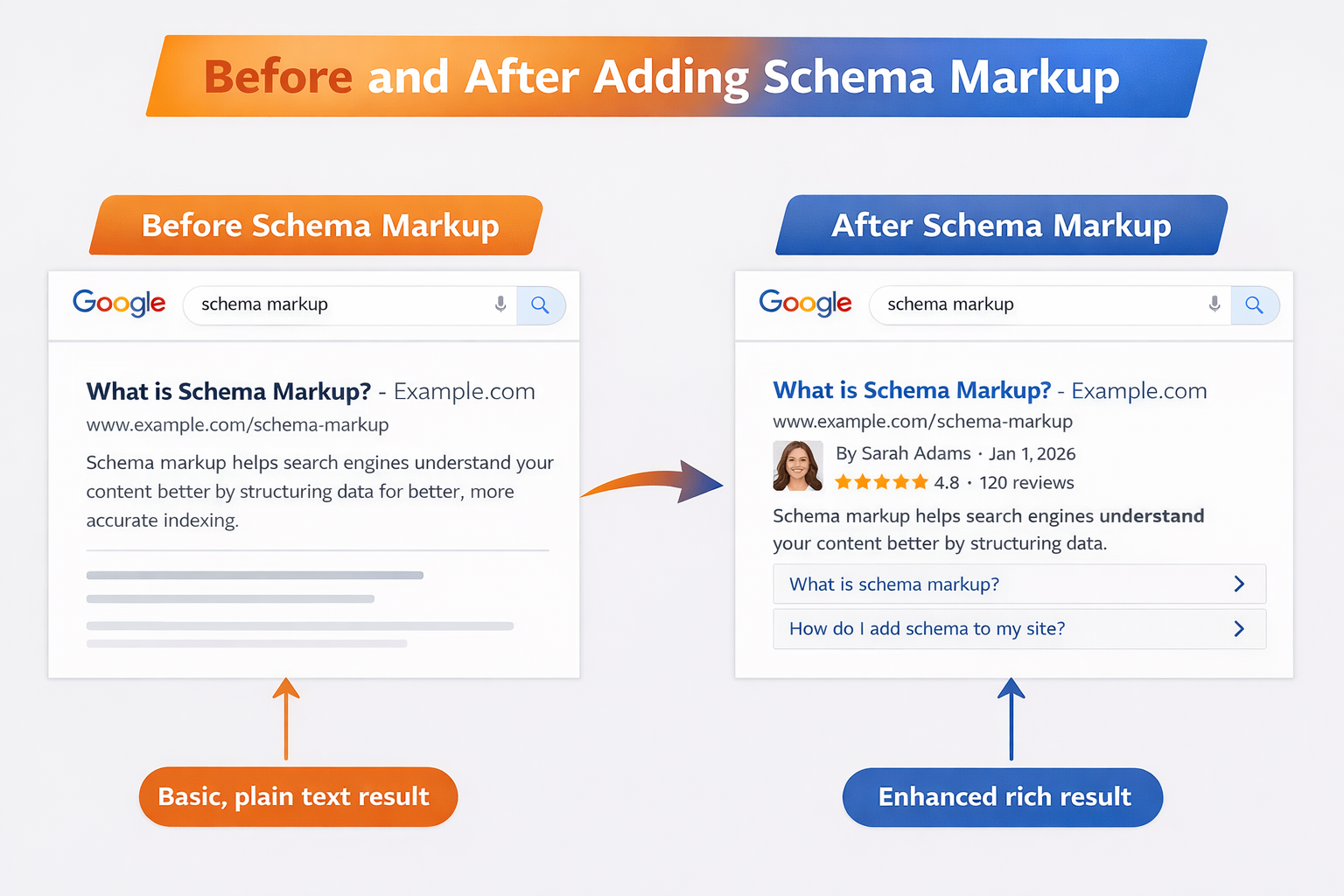
In simple terms, schema markup doesn’t change your content, it makes sure search engines understand it exactly the way you intended.
Why Schema Markup Matters for SEO Today
Understanding what schema markup is is just the starting point, its real value comes from how it fits into today’s search landscape.
Search engines are no longer just matching keywords. They’re focused on:
- Understanding meaning (semantic search)
- Connecting entities (people, brands, topics)
- Delivering AI-driven results
Schema markup supports all of this by giving search engines clearer, structured signals about your content.
Better Context = Better Search Performance
When you implement structured data for SEO, you’re not just adding code, you’re removing ambiguity. It helps search engines:
- Accurately categorize your content
- Match it with the right search intent
- Surface it in relevant search features
This clarity improves how your content is interpreted, which directly impacts visibility.
Increased Visibility Through Rich Results
Even without a ranking boost, schema can change how your listing appears. Results that include:
- Ratings
- FAQs
- Additional details
stand out more and tend to attract higher clicks than standard listings. This is where schema markup for SEO delivers real impact.
Alignment with AI and Voice Search
Modern search experiences, like voice assistants and AI summaries, depend heavily on structured data. When you use structured data for SEO, your content becomes easier for systems to extract, summarize, and present across:
- Voice search results
- AI-generated answers
- Conversational search interfaces
In short, schema markup helps your content stay relevant as search continues to evolve.
Key Benefits of Schema Markup for SEO
The benefits of schema markup for SEO go beyond just rankings, they directly influence how your content is understood, displayed, and clicked in search results.
Improved Click-Through Rates
Schema enables rich snippets, which make your listings more visually appealing. When users see ratings, FAQs, or additional details, your result naturally stands out, often leading to higher CTR even if your position doesn’t change.
Stronger Content Understanding
One of the biggest advantages of structured data for SEO is clarity. Schema removes ambiguity and helps search engines interpret your content exactly as intended, reducing the chances of misclassification.
Better Eligibility for Rich Snippets
Schema markup directly supports schema markup for rich snippets, making your content more likely to appear with enhancements like ratings, pricing, FAQs, and more. This not only improves visibility but also builds trust before users even click.
Supports Knowledge Graph and AI Search
Structured data helps search engines connect your content to entities, which can improve your presence in the Knowledge Graph. It also makes your content more accessible to generative AI systems and AI-powered search results, where structured, well-defined data is increasingly important.
Enhanced SERP Features
With proper schema markup implementation, your pages become eligible for enhanced search features like:
- Featured snippets
- FAQ dropdowns
- Review stars
These features increase visibility and improve how users interact with your result.
Competitive Advantage
Many websites still overlook schema or implement it incorrectly. By doing it right, you gain an edge in how your content appears and performs in search, especially in competitive niches.
Types of Schema Markup You Should Focus On
There are hundreds of schema types available, but you don’t need all of them. The key is to focus on the ones that align with your content and search intent.
Article Schema
Best suited for blogs and editorial content, Article schema helps search engines understand key details like the author, publish date, and topic, improving content visibility.
FAQ Schema
Highly effective for schema markup for rich snippets, as it allows your content to appear in expandable FAQ sections directly in search results, great for capturing informational queries.
Product Schema
Essential for eCommerce websites. It provides structured details such as:
- Price
- Availability
- Reviews
Product Schema makes your listings more informative and conversion-friendly.
Review Schema
Displays ratings in search results, adding credibility and helping users make quicker decisions.
Breadcrumb Schema
Improves how your page hierarchy appears in search results, making navigation clearer and enhancing user experience.
Organization Schema
Helps define your brand by providing structured business information, supporting a stronger knowledge graph presence and brand authority.
Choosing the right types of schema markup depends on your content, goals, and the kind of search features you want to target.
How Schema Markup Works (Behind the Scenes)
To really understand what schema markup is, it helps to look at how it works in the background.
Schema markup uses a shared vocabulary from Schema.org to label different elements on your page and define how they relate to each other. Instead of treating your content as unstructured text, search engines can read it as clearly defined data.
For example, a blog post isn’t just content on a page, it becomes a structured entity:
- An Article
- Written by a Person
- Published by an Organization
- On a specific date
You’re essentially turning your content into something closer to a structured dataset. This makes it easier for search engines to:
- Understand context and relationships
- Connect your content to relevant topics or entities
- Use it in enhanced search features
Most of this is implemented using JSON-LD schema markup, which sits in your code and provides these signals without affecting the visible page.
In simple terms, schema helps search engines move from just reading your content to actually understanding it. This is the core of structured data SEO.
JSON-LD Schema Markup: Why It’s Recommended
When learning how to implement schema markup, choosing the right format is important.
Google recommends JSON-LD schema markup because it lets you add structured data as a separate script, without modifying your HTML content. This keeps your code clean and easier to manage.
Key advantages:
- Easy to implement and update
- Doesn’t interfere with HTML structure
- Scales well across multiple pages
- Fully supported by Google’s rich results
Compared to formats like Microdata, JSON-LD is simpler, more flexible, and less prone to errors, making it the best choice for modern schema markup implementation.
How to Implement Schema Markup for SEO (Step-by-Step)
Now, let’s walk through how to implement schema markup in a practical, scalable way.
Step 1: Identify the Page Type
Start by understanding the purpose of your page:
- Blog → Article schema
- Landing page → WebPage schema
- Product page → Product schema
Choosing the right type ensures your schema markup implementation aligns with search intent and eligible SERP features.
Step 2: Generate Schema Code
You can either:
- Write the schema manually, or
- Use a schema markup tool to quickly generate accurate structured data
Using a tool reduces errors and speeds up implementation, especially for multiple pages.
Step 3: Add Schema Markup to Your Website
Here’s a basic JSON-LD schema markup example:
<script type="application/ld+json">
{
"@context": "https://schema.org",
"@type": "Article",
"headline": "What is Schema Markup?",
"author": {
"@type": "Person",
"name": "Author Name"
},
"datePublished": "2026-01-01"
}
</script>
Add this to your page’s head or body section. JSON-LD keeps your implementation clean without affecting visible content.
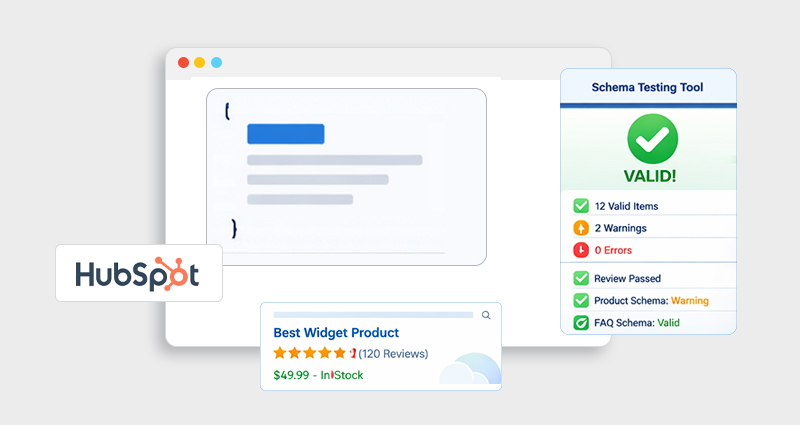
Step 4: Validate Your Schema
Always test your markup using:
This ensures your schema markup implementation is error-free and eligible for rich results.
Step 5: Monitor and Optimize
After implementation:
- Track performance in Google Search Console
- Identify new rich result opportunities
- Update the schema as your content changes
- Schema isn’t a one-time task, continuous optimization is key to getting the most out of schema markup for SEO.
Best Practices for Schema Markup Implementation
To get the most out of your schema markup implementation, follow these:
- Match schema with visible content: Everything marked up should exist on the page to maintain trust and avoid penalties
- Use the most specific schema type: A more precise schema improves how accurately search engines interpret your content
- Keep structured data updated: Outdated information (like prices or dates) can hurt credibility and performance
- Avoid spammy or misleading markup: Don’t add schema just to manipulate results, focus on accuracy and relevance
- Combine schema types when needed: For example, Article + FAQ can improve visibility across multiple SERP features
Common Mistakes to Avoid
Even small mistakes can reduce the effectiveness of your schema and prevent you from getting the full SEO benefit:
-
Adding a schema that isn’t on the page
If your structured data mentions content (like FAQs, ratings, or products) that users can’t actually see, search engines may ignore your markup or consider it misleading. Always keep your schema aligned with visible content.
-
Skipping validation
The Schema might look correct, but even a small syntax error can break it completely. If you don’t test your markup, it may never become eligible for rich results, without you even realizing it.
-
Overloading with too many schema types
Adding multiple or irrelevant schema types to a single page doesn’t improve performance. Instead, it can confuse search engines and reduce the clarity of your structured data.
-
Overloading with too many schema types
Adding multiple or irrelevant schema types to a single page doesn’t improve performance. Instead, it can confuse search engines and reduce the clarity of your structured data.
-
Using incorrect or generic schema types
Choosing a broad schema when a more specific one exists can limit how well search engines understand your content and reduce your chances of appearing in rich results.
-
Expecting quick ranking boosts
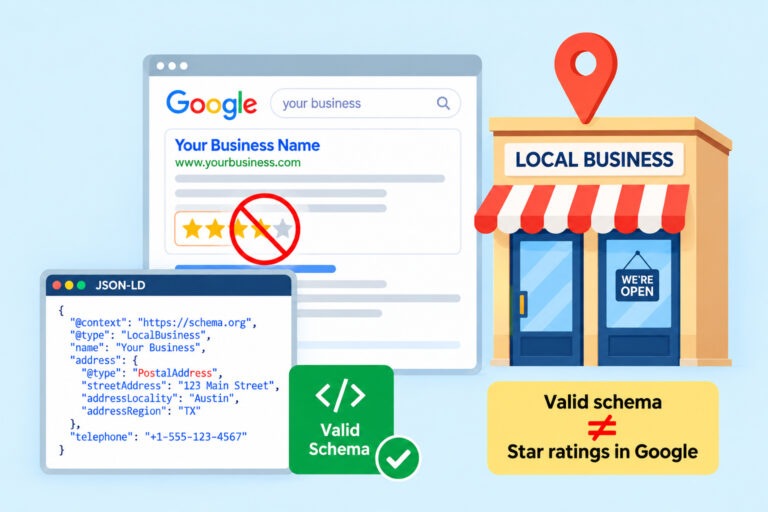
Schema markup doesn’t directly improve rankings. Its real impact is on visibility, click-through rates, and how your content appears in search, so results often take time to show.
Schema works best when implemented thoughtfully and treated as a long-term SEO investment rather than a quick win.
How to Use Structured Data for SEO Strategically
-
Enhance content clarity
Use schema to make your content clearer for search engines so they can easily understand context and intent.
-
Target SERP features
Implement schema types that help you appear in SERP features like FAQs, reviews, and rich snippets.
-
Support topical authority
Apply structured data consistently across your content to strengthen topical authority and relevance.
-
Improve user engagement
Improve how your listings appear in search to attract more clicks and user interaction.
This is how structured data SEO becomes a real competitive advantage rather than just a technical addition.
Conclusion
Understanding what is schema markup is fundamental to modern SEO. It transforms your content from something search engines can read into something they can truly understand.
When implemented correctly, schema markup for SEO enhances visibility, enables rich results, and aligns your content with the future of search. Instead of treating it as a one-time task, approach schema as an ongoing strategy, one that evolves with your content and the way search engines interpret information.
Over time, this structured approach can significantly improve how your content performs, appears, and connects with users in search.
FAQs
Q1. What is schema markup in SEO?
Schema markup is structured data that helps search engines understand and display content more effectively in search results.
Q2. How to implement schema markup?
To implement schema markup, choose the right schema type, generate JSON-LD code, add it to your website, and validate it using testing tools.
Q3. Does schema markup improve SEO rankings?
Schema markup does not directly improve rankings but enhances visibility and click-through rates.
Q4. What is JSON-LD schema markup?
JSON-LD is a recommended format for adding structured data to websites in a clean and scalable way.
Q5. What are rich snippets?
Rich snippets are enhanced search results that display additional information like ratings, FAQs, and product details.
Q6. What types of schema markup are most useful?
Article, FAQ, Product, Review, and Organization schema are among the most impactful types.
Q7. How do I add schema markup to my website?
You can add schema by inserting JSON-LD code into your page’s HTML.
Q8. Is schema markup necessary for SEO?
While not mandatory, it is highly recommended for improving search visibility and staying competitive.







 Wix Schema
 Squarespace Schema
 BigCommerce Schema
 Shopify Schema
 Hubspot Schema
 Webflow Schema
 GoHighlevel Schema
 Duda Schema
 Weebly Schema