
TL;DR: Getting visibility in AI search is a combination of faster pages, proper schema markup, and tools that help monitor and improve how AI platforms read your content. Focusing on the right setup and tools together makes it easier for AI engines to understand, access, and surface your website in results.
SEO in 2026 is not what it was two years ago. Half your potential customers are now getting answers from ChatGPT, Perplexity, or Google’s AI Overviews. If your content isn’t structured in a way AI platforms can read, trust, and cite, you’re simply not in the conversation. The right tools fix this. Here are the top 11 best AI search optimization tools worth your time this year, picked from an AEO (Answer Engine Optimization) standpoint.
Best AI Search Optimization Tools in 2026 (Quick Comparison & Overview)
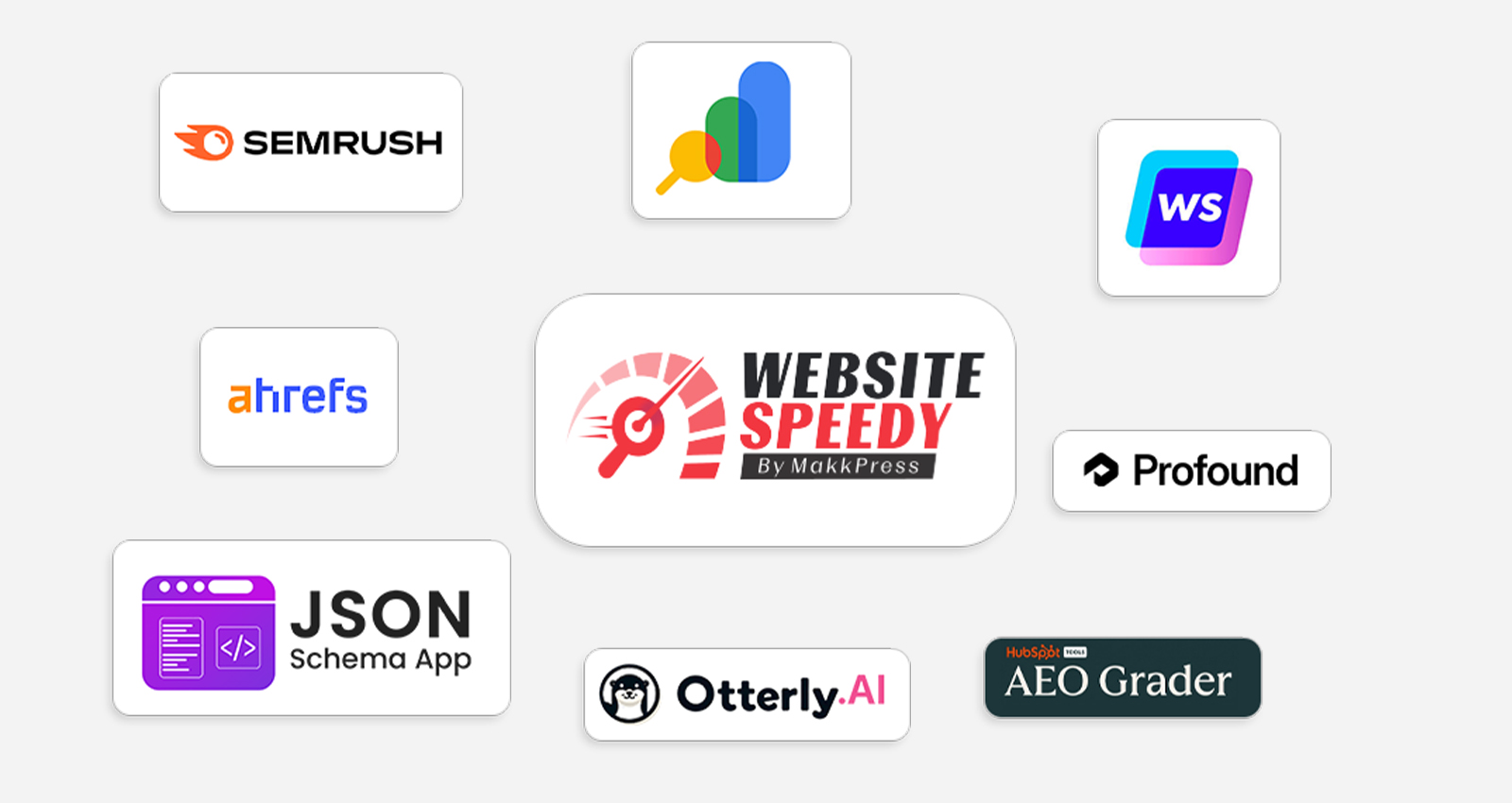
From an AEO perspective, here’s what the stack looks like:
- Website Speedy: Fixes Core Web Vitals so AI crawlers can actually reach your content
- Semrush One: Tracks where your brand appears across AI engines
- Profound: Enterprise-level AI crawler data
- JSON Schema App: Automates JSON-LD so AI engines understand your pages
- WP SEO AI: AI Search Optimization for WordPress
- Otterly.AI: Mid-market monitoring with schema audit built in
- Ahrefs Brand Radar: AI crawler traffic visibility
- HubSpot AEO Grader: Free audit to check your baseline AI readiness
- Google Search Console + Rich Results Test: Catch schema errors before they cost you
- Writesonic: AI content built for GEO extraction from the first draft
- Screaming Frog: Site-wide schema crawl for large or technical sites
Quick Comparison
Here’s a quick side-by-side comparison to evaluate these tools faster:
| Tool | AEO Role | Price |
|---|---|---|
| Website Speedy | Core Web Vitals & speed | From $20/mo |
| Semrush One | Brand visibility across AI engines | $139.95+/mo |
| Profound | Enterprise AI crawler analytics | Custom |
| JSON Schema App | Automated JSON-LD markup | Free + paid |
| WP SEO AI | WordPress teams that want to turn AI visibility insights into ongoing SEO and GEO improvements | Custom |
| Otterly.AI | Monitoring + schema audit | ~$29/mo |
| Ahrefs Brand Radar | AI crawler traffic data | Free tier+ |
| HubSpot AEO Grader | Free AEO baseline audit | Free |
| Google Search Console | Schema error tracking | Free |
| Writesonic | GEO-optimized content | $99/mo |
| Screaming Frog | Site-wide schema crawl | Free / $279/yr |
How to Choose the Right AI Search Optimization Tool
It comes down to where you’re starting from. If your site is slow, fix speed first, everything else depends on crawlers actually reaching your pages. If speed is fine but you’re not showing up in AI answers, structured data is usually the gap. Once the technical foundation is solid, layer in a monitoring tool to track brand visibility and a content tool to fill the gaps you find.
Start small, fix what’s broken, then scale.
With that in mind, here’s a breakdown of the top 11 best tools available right now.
1. Website Speedy: Speed Optimization for AI Search
| Best for: | Wix, Shopify, Squarespace, BigCommerce, Webflow, or any platform with speed issues |
| Pricing: | From $20/month; 7-day free trial |
AI crawlers can’t cite pages they struggle to load. Slow sites and render-blocking scripts directly limit how thoroughly AI platforms index your content. Website Speedy fixes this with a single script added to your site header. No developer, no theme changes. It reorganizes how JavaScript and CSS load, implements lazy loading, and eliminates render-blocking issues automatically. It supports Shopify, Wix, Squarespace, BigCommerce, Webflow, Magento, and more, and uses Google PageSpeed Insights API to show you the before/after, so results are verifiable.
For anyone investing in structured data and content optimization, speed is the prerequisite that makes the rest of it reachable.
2. Semrush One: AI Search Visibility Tracking Tool
| Best for: | Teams that want traditional SEO and AI visibility in one place |
| Pricing: | Starts at $139.95/month (Pro); Semrush One tier starts higher |
Semrush rebuilt its platform around AI search in 2026 with the new Semrush One tier. The standout feature is Brand Radar, which shows how your brand appears in ChatGPT, Gemini, Perplexity, and Google AI Overviews, and more importantly, which prompts are sending users to competitors instead of you.
The workflow is straightforward: find those prompt gaps, publish content that answers them directly, add schema markup, and recheck in 30 days. It’s a feedback loop that actually works.
3. Profound: Enterprise AI Search Analytics Tool
| Best for: | Enterprise teams with multilingual campaigns and compliance needs |
| Pricing: | Custom |
Profound instead of just showing what appears in AI responses, it pulls actual AI crawler log data, what systems are crawling from your site, how often, and how they’re interpreting it. It tracks GPT-5.2 responses, integrates with GA4, and is SOC 2 compliant.
Named G2’s AEO Leader for Winter 2026. For enterprise brands where AI citation directly connects to revenue across multiple markets, it’s the gold standard.
4. JSON Schema App: Automated Structured Data for AI Search
| Best for: | Small businesses and non-technical teams |
| Pricing: | Free plan available; paid plans for full automation |
Speed gets AI crawlers to your page. Schema tells them what it actually means. Without proper JSON-LD markup, AI platforms guess your content structure, and wrong guesses lead to missed citations even when the content itself is strong.
JSON Schema App deploys standards-compliant JSON-LD across your entire site automatically, product pages, blogs, FAQs, and local business info, and keeps it updated as your content changes. No developer required.
5. WP SEO AI: AI Search Optimization for WordPress
| Best for: | SEO and GEO improvements |
| Pricing: | Custom |
WP SEO AI combines AI search visibility tracking with the actual work needed to improve it. The platform monitors how brands appear across AI search platforms, identifies content and visibility gaps, and then helps optimize the WordPress website through content creation, technical SEO, internal linking, page optimization, and ongoing performance analysis.
Unlike tools focused mainly on monitoring mentions or prompts, WP SEO AI connects measurement directly to execution. Its AI-powered WP SEO Agent works alongside human SEO specialists to continuously research opportunities, create and optimize content, publish improvements, and measure the impact across both traditional Google Search and AI-driven search.
For WordPress businesses looking for a managed approach to SEO, GEO, and AI visibility in one workflow, WP SEO AI is built to move from “where are we missing?” to “what should we improve next?” without adding another disconnected tool to the stack.
6. Otterly.AI: AI Search Monitoring and Audit Tool
| Best for: | Marketing teams and agencies |
| Pricing: | ~$29/month |
Covers ChatGPT, Google AI Overviews, Gemini, Perplexity, and Copilot. Beyond basic tracking, the GEO audit feature analyzes your schema usage, content structure, and page clarity, then hands you a prioritized list of what to fix. So instead of just knowing your AI visibility is low, you know exactly where to start. The only real gap is attribution: no native GA4 integration means connecting visibility gains to revenue requires manual work.
7. Ahrefs Brand Radar: AI Crawler Visibility Insights
| Best for: | Teams already using Ahrefs for SEO |
| Pricing: | Free tier available; paid from $129/month |
Brand Radar tracks which pages on your site AI crawlers are visiting and how often – a different signal than what shows up in AI responses. High crawler traffic on a page that rarely gets cited tells you the content is accessible but not citation-worthy, which is useful to know. It works best as a supplementary layer rather than a standalone AEO platform, but the free tier makes it worth checking before committing to anything paid.
8. HubSpot AEO Grader: Free AI Search Readiness Tool
| Best for: | Getting a quick baseline before spending anything |
| Pricing: | Free, no login needed |
Takes about two minutes per page and checks five things: structured data completeness, FAQ schema, content clarity, E-E-A-T signals, and heading structure. A score below 50 on structured data is a reliable sign that the page won’t get cited by AI platforms regardless of content quality. Run your most important pages through it before touching anything else, it often tells you exactly what the actual problem is.
9. Google Search Console + Rich Results Test: Essential Schema Tools
| Best for: | Every website |
| Pricing: | Free |
Search Console’s Enhancements tab shows which structured data errors are blocking rich results, and since Google confirmed that schema gives sites an AI Overview advantage, those errors now affect AI citations too, not just traditional snippets. The Rich Results Test lets you validate markup before it goes live. Neither tool is exciting, but skipping them is how markup problems go undetected for months.
10. Writesonic: AI Content Optimization for GEO
| Best for: | Content teams who want AEO-structured drafts from the start |
| Pricing: | From ~$99/month; full GEO features at higher tiers |
Writesonic pulls live data from Semrush, Ahrefs, and Search Console before it starts writing, so drafts are shaped by real search behavior rather than just a prompt. The output tends to follow AEO structure naturally – direct answer upfront, supporting detail below, FAQ sections ready for schema markup.
11. Screaming Frog: Technical SEO and Schema Audit Tool
| Best for: | Technical SEOs managing sites with hundreds or thousands of pages |
| Pricing: | Free up to 500 URLs; $279/year for full version |
At scale, a single broken template can mean hundreds of pages with silent markup failures, missing required fields, broken @id references, and deprecated properties that produce nothing in search. Screaming Frog crawls your entire site and surfaces all of it in one pass. Running it quarterly catches schema drift before it turns into a rankings problem, especially on eCommerce sites where catalogs change constantly.
Final Thoughts
Most AEO conversations focus on monitoring, tracking where you appear and how often. That matters, but the teams actually gaining ground in AI search are fixing the foundation first: page speed so crawlers can reach the content, structured data so they can understand it, and then building content strategy and monitoring on top. The order matters more than most people realize.
FAQ
Q1: What is the difference between SEO and AI search optimization?
Traditional SEO gets you ranked in Google’s blue links. AI search optimization gets your content cited inside answers generated by ChatGPT, Perplexity, and Google AI Overviews. In 2026, both matter but AI visibility is the faster-growing priority.
Q2: Which tool should I start with if I have a limited budget?
Start with the HubSpot AEO Grader to audit your baseline, then fix speed issues with Website Speedy and structured data gaps with JSON Schema App. These three together cover the most impactful ground without a large upfront spend.
Q3: Does page speed really affect AI search visibility?
Yes. AI crawlers can’t properly index slow or render-blocked pages, which means your content may never get evaluated in the first place. Tools like Website Speedy fix this at the script level without any developer help.
Q4: Do I need to know coding to implement schema markup?
No. JSON Schema App handles the entire process automatically, it deploys and maintains JSON-LD across your site without any manual coding. It’s built specifically for non-technical users.
Q5: How do I know if my brand is showing up in AI answers?
Tools like Semrush One’s Brand Radar and Otterly.AI track your brand mentions across ChatGPT, Gemini, Perplexity, and Google AI Overviews. They also show which prompts are sending users to competitors instead of you.
Q6: How long before I see results from these tools?
Speed improvements from Website Speedy can show up in PageSpeed scores within days. Schema and content changes typically take 30 to 90 days before you see a meaningful lift in AI citation rates.



 Wix Schema
 Squarespace Schema
 BigCommerce Schema
 Shopify Schema
 Hubspot Schema
 Webflow Schema
 GoHighlevel Schema
 Duda Schema
 Weebly Schema