

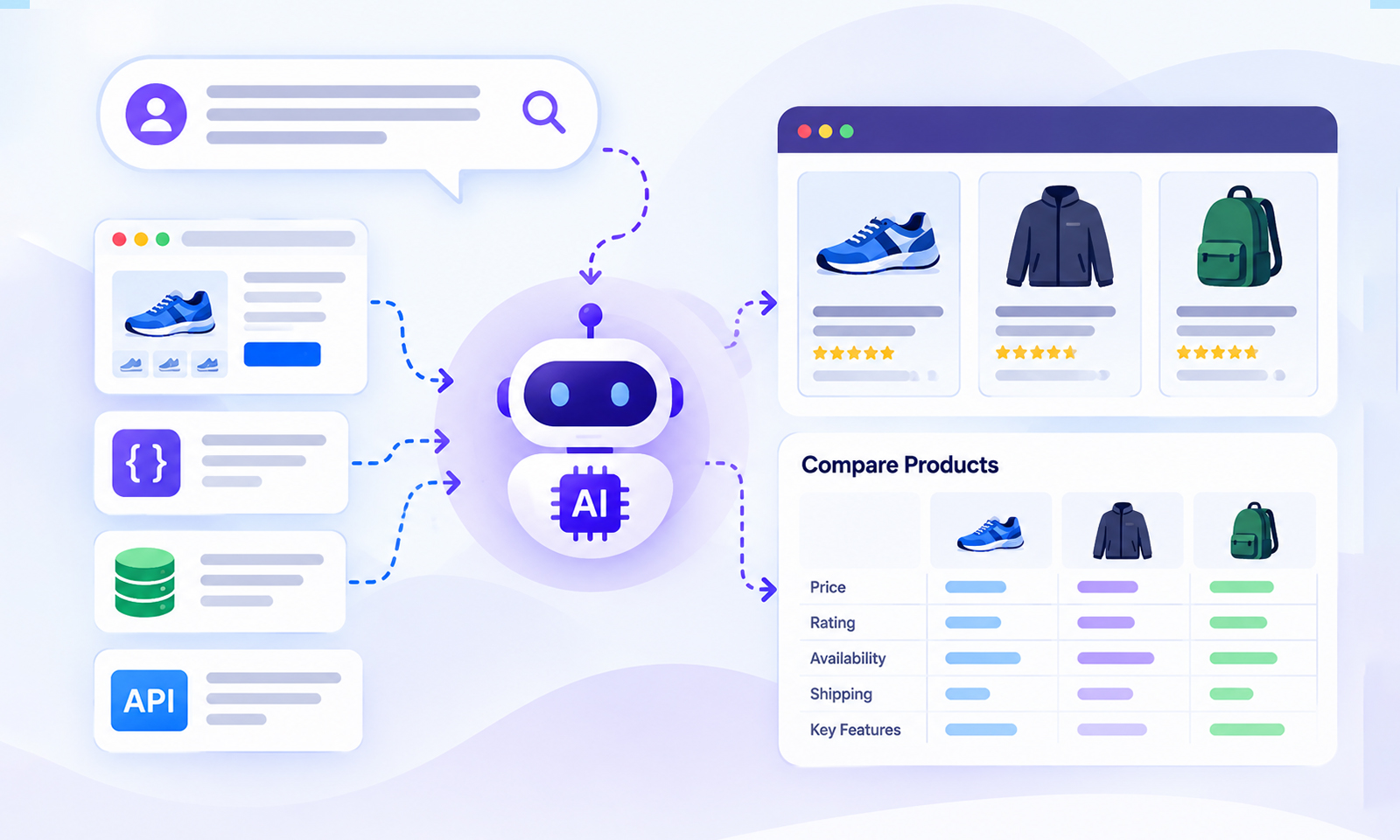
Online shopping usually requires shoppers to search, open multiple product pages, compare specifications and prices, check availability, and decide which option fits their needs.
AI shopping agents can automate parts of this process. Instead of simply returning search results, they can interpret a shopper’s requirements, find relevant products, filter unsuitable options, and compare the information available about each product.
So, how do AI agents find and compare products online?
The answer largely comes down to product information. AI agents need reliable data to understand what a product is, what it offers, whether it meets specific requirements, and how it compares with alternatives.
How AI Agents Make Product Discovery Decisions: Quick Overview
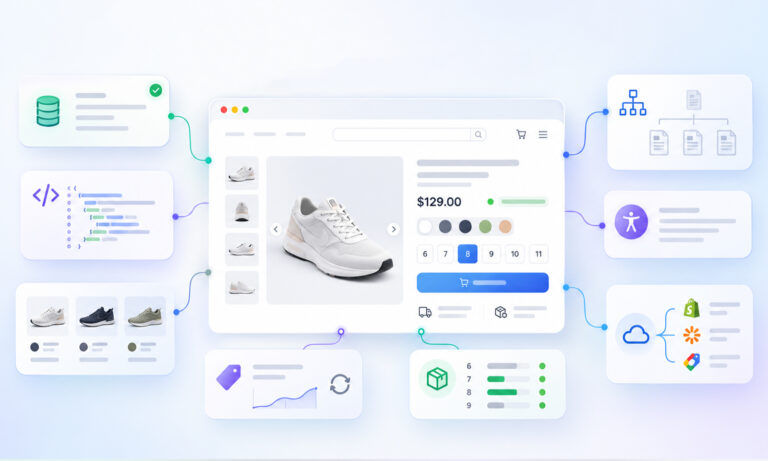
AI agents make product discovery decisions by matching a shopper’s requirements with product data such as attributes, price, availability, variants, shipping, and reviews. They combine information from product pages, structured data, feeds, catalogs, and APIs to identify and evaluate relevant options.
| Stage | What happens | What ecommerce sites need |
|---|---|---|
| Understand | Interprets the shopper’s request | Clear product descriptions and attributes |
| Discover | Finds relevant products | Accessible pages and ecommerce product data |
| Interpret | Understands product details | Accurate structured and visible data |
| Filter | Removes products that don’t meet requirements | Complete attributes, price, and availability |
| Compare | Evaluates suitable products | Consistent specifications, offers, shipping, etc. |
| Present | Summarizes relevant options | Accurate, up-to-date product information |
AI agents do not necessarily rely on one signal. Depending on the system, product pages, structured data, catalogs, feeds, APIs, and other sources can contribute to product discovery and comparison.
What Are AI Shopping Agents?
AI shopping agents are AI systems that can assist with shopping-related tasks such as product discovery, research, comparison, and, in some cases, purchasing.
Consider a request such as:
“Find me a waterproof jacket under $150, available in medium, that can arrive within a week.”
An agent needs to turn that request into specific requirements: product type, waterproofing, maximum price, size, availability, and potentially delivery information.
This is where AI product discovery differs from simply matching keywords. The system needs to understand the relationship between the shopper’s requirements and the information associated with each product.
How Do AI Agents Find Products Online?
The exact process varies between AI systems, but several steps are important.
1. They interpret the shopper’s requirements
First, the agent translates natural language into product attributes. For example:
| Shopper requirement | Information needed |
|---|---|
| Running shoes | Product type |
| Long-distance training | Intended use and features |
| Under $130 | Current price |
| Size 10 | Variant availability |
| Good cushioning | Product specifications |
This is why ecommerce product descriptions should clearly state meaningful attributes instead of relying entirely on promotional language.
2. They discover relevant products
The agent then needs to locate products that could satisfy the request. Depending on the system, this may involve search results, ecommerce websites, product catalogs, merchant feeds, APIs, or other accessible sources. Some systems can browse product pages, while others may rely on product data supplied through supported feeds or integrations.
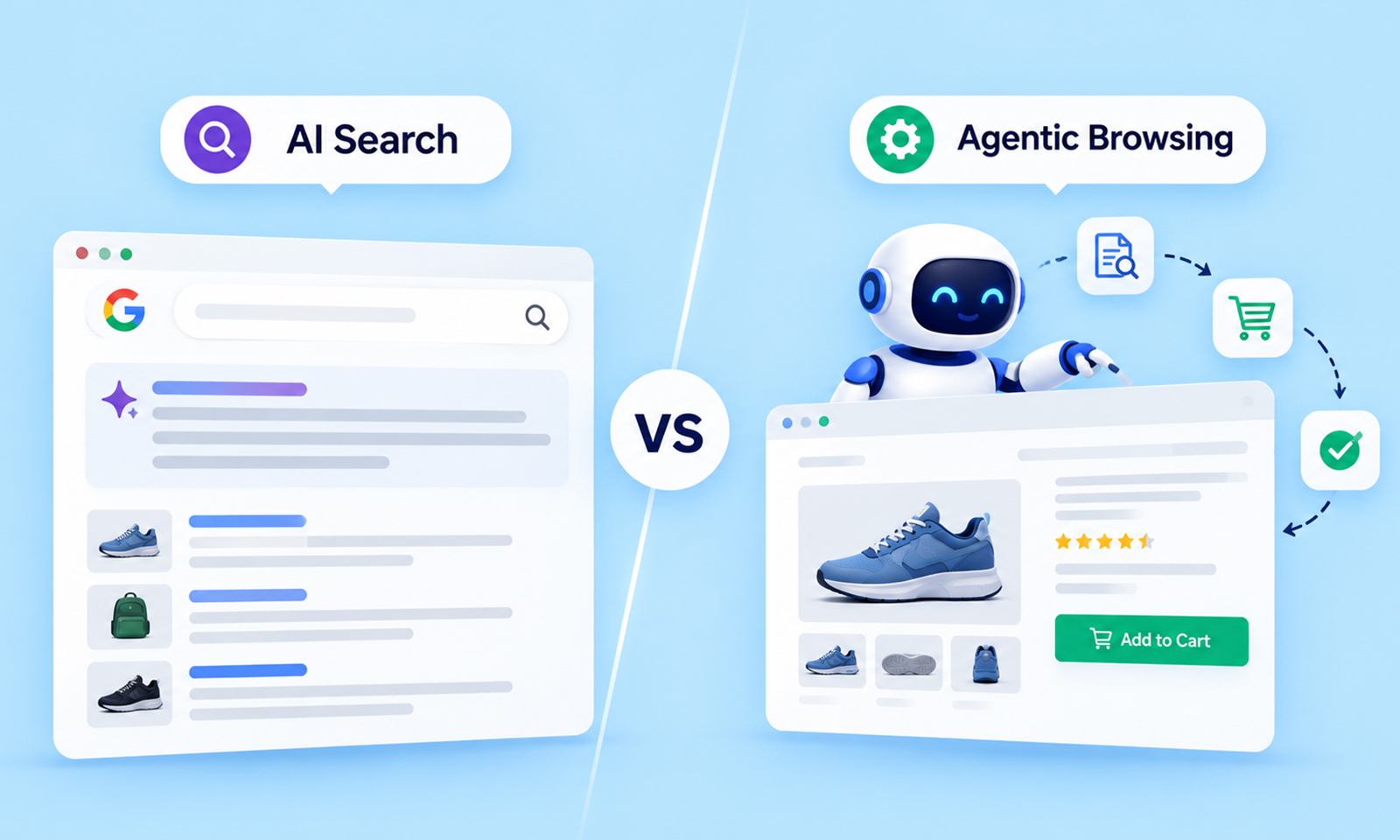
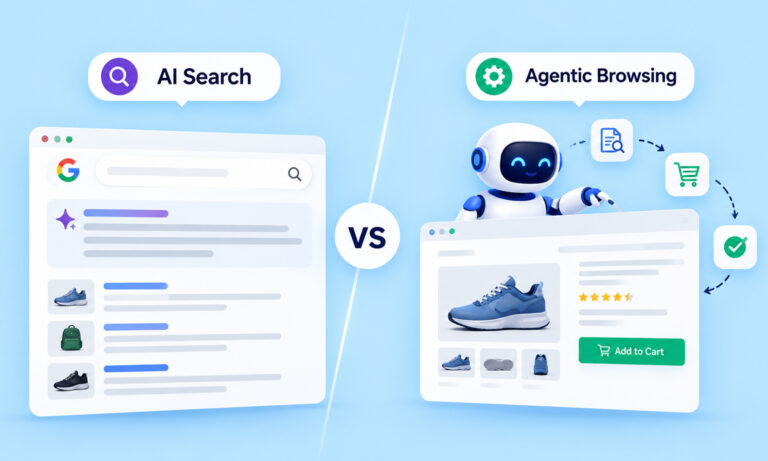
This is particularly relevant to agentic browsing for ecommerce, where an AI system may navigate webpages and inspect product information instead of simply returning a conventional list of search results.
For merchants, the practical requirement is simple: important product information needs to be accessible and understandable.
3. They interpret product information
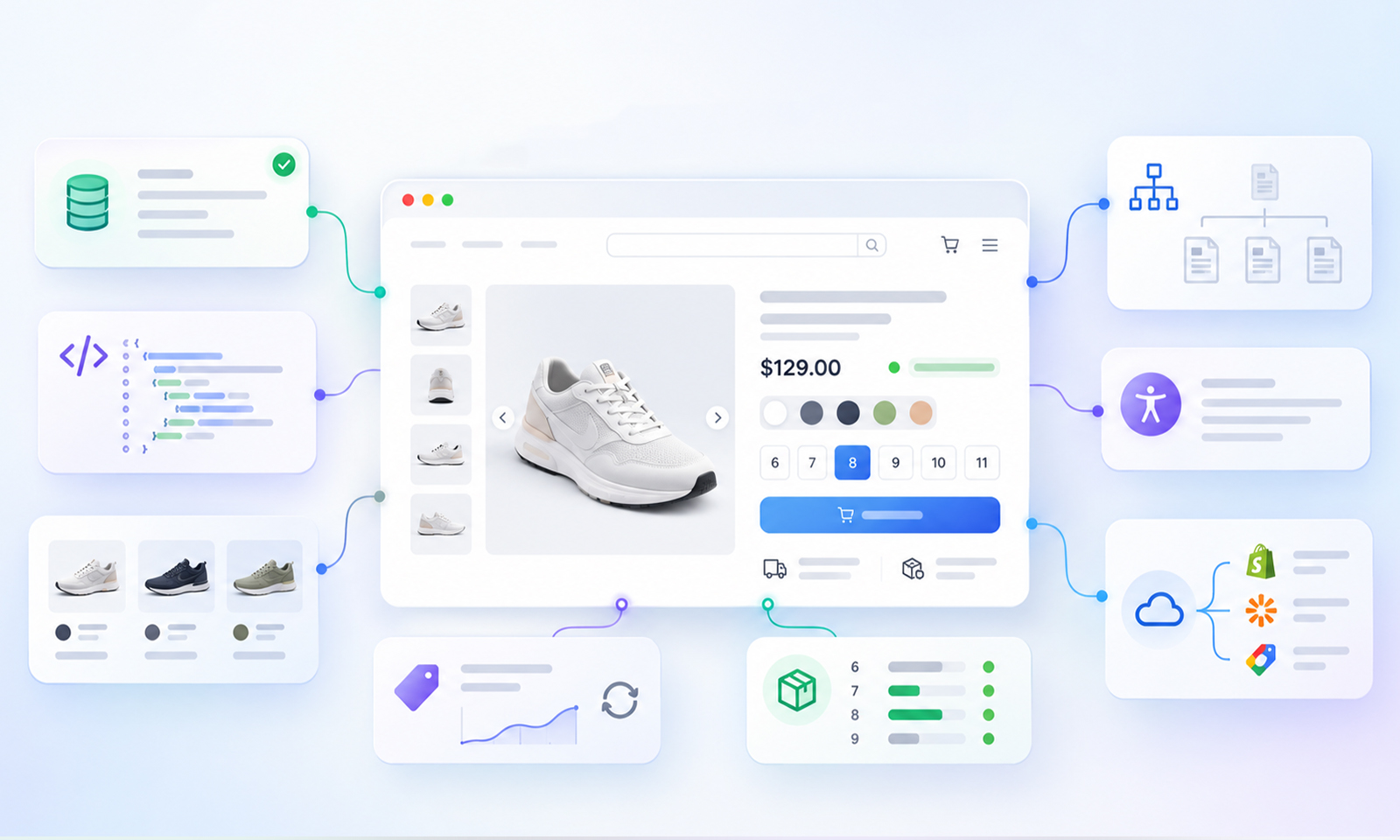
Finding a product page is only the beginning. The agent needs to understand information such as:
- Product name and brand
- Description and category
- Product identifiers
- Specifications and attributes
- Variants
- Price
- Availability
- Reviews and ratings
- Shipping and returns
This is where product structured data can help provide a standardized, machine-readable representation of product information.
Schema.org’s Product vocabulary supports properties for describing products and offers, while Google’s ecommerce documentation covers structured information such as price, availability, shipping, returns, and product variants.
How Do AI Shopping Agents Compare Products?
Once relevant products are identified, an AI agent can compare their attributes against the shopper’s requirements. Suppose three laptops are available:
| Product | Price | RAM | Storage | Weight | Availability |
|---|---|---|---|---|---|
| Laptop A | $899 | 16 GB | 512 GB | 3.2 lb | In stock |
| Laptop B | $999 | 32 GB | 1 TB | 3.5 lb | In stock |
| Laptop C | $799 | 16 GB | 512 GB | 2.8 lb | Out of stock |
If the shopper asks for a laptop under $900 that is lightweight and currently available, price alone does not determine the relevant options. Availability and weight also matter.
This illustrates how AI shopping agents compare products: they can evaluate multiple attributes together rather than treating the lowest price as the only deciding factor.
Depending on the request, comparison can involve price, specifications, variants, availability, shipping, reviews, return policies, brand, or other requirements.
Why Product Schema Matters
Product schema markup provides structured information about a product that search engines and other systems can process more consistently.
A simplified example of JSON-LD for ecommerce is:
{
"@context": "https://schema.org",
"@type": "Product",
"name": "Waterproof Trail Jacket",
"brand": {
"@type": "Brand",
"name": "Example Brand"
},
"sku": "JKT-1001",
"offers": {
"@type": "Offer",
"price": "129.99",
"priceCurrency": "USD",
"availability": "https://schema.org/InStock"
}
}
Structured data does not guarantee that an AI agent will select or recommend a product. Its value is that it explicitly describes relationships between information such as a product, its price, currency, and availability.
Google also recommends that structured data accurately represent the visible content on the page.
Accurate Ecommerce Product Data Matters More Than Markup Alone
Adding schema once is not enough for a changing ecommerce catalog. Imagine a product’s price changes from $129 to $99, but its structured data still contains $129. Or a product becomes unavailable while the markup continues to show InStock.
The result is inconsistent product information.
The same principle applies to product feeds and APIs. If a product page, structured data, and catalog feed contain different prices or availability information, systems processing that data may receive conflicting signals.
For ecommerce businesses, the goal should therefore be consistent product information across every important data source, not simply having schema markup present.
Google’s Merchant Center documentation provides guidance on product data, while its structured-data documentation covers supported product information such as price, availability, shipping, and returns.
How Ecommerce Sites Can Prepare for AI Product Discovery
The fundamentals are relatively straightforward.
Keep important product attributes explicit
State meaningful product facts clearly. If a jacket is waterproof, specify that. If it is water-resistant rather than waterproof, make that distinction clear.
The same applies to dimensions, materials, compatibility, technical specifications, sizes, and other attributes that could affect a purchasing decision.
Keep price and availability current
Price and inventory can change quickly. Make sure the visible product page and machine-readable data reflect the current offer.
Represent variants correctly
Size, color, storage capacity, and other variants can determine whether a product actually satisfies a shopper’s request.
Google provides specific guidance for representing product variants using ProductGroup and related structured-data properties.
Use accurate product identifiers
SKUs, GTINs, brands, and other identifiers can help distinguish similar products and variants within a large catalog.
Make shipping and returns clear
For many shopping decisions, the product price is only part of the offer. Shipping costs, delivery information, and return conditions can also affect whether a product meets a shopper’s requirements.
Validate structured data
Check for missing properties, incorrect values, duplicate markup, and differences between structured data and visible content. Google’s Rich Results Test can be used to test supported structured-data implementations.
What This Means for BigCommerce Stores
This is particularly important for large BigCommerce catalogs.
A store with hundreds or thousands of products may have constantly changing prices, inventory, variants, and product attributes. Maintaining every piece of structured data manually is difficult and increases the possibility of outdated or conflicting information.
The goal should be a consistent product-data layer across product pages, structured data, feeds, and relevant integrations.
This connects directly with the broader question of how to make a BigCommerce store ready for agentic browsing. The foundation is not a special “AI markup.” It is accurate, accessible, well-structured ecommerce information that different systems can reliably interpret.
Common Product Data Problems
A product can have a technically valid schema and still provide poor information for automated product understanding.
Common issues include:
- Product price in JSON-LD differs from the visible price
InStockremains after a product or variant sells out- Important product attributes are missing
- Variants are represented incorrectly
- Multiple systems generate duplicate Product markup
- Product feeds contain outdated information
- Descriptions do not clearly explain important specifications
The practical standard is simple: machine-readable product information should accurately describe what a shopper can actually buy.
Conclusion
How AI agents find and compare products online ultimately comes down to the quality and accessibility of ecommerce product information.
AI shopping agents need to understand what a product is, identify its attributes, determine whether it matches a shopper’s requirements, and compare it with alternatives.
For ecommerce businesses, the practical priority is therefore clear: maintain accurate product content, current prices and availability, correctly implemented Product schema, well-defined variants, accessible pages, and consistent feeds or APIs.
As AI agents become more involved in product discovery and comparison, a reliable product-data foundation will remain one of the most important requirements for participating in AI-driven shopping experiences.
FAQs
Q1: How do AI agents find products online?
AI agents can discover products through search results, ecommerce websites, catalogs, feeds, APIs, and other accessible sources. The exact process depends on the AI system and the tools available to it.
Q2: How do AI shopping agents compare products?
They can compare product attributes against a shopper’s requirements, including price, specifications, availability, variants, shipping, reviews, and return policies.
Q3: Does Product schema help AI agents understand products?
Product schema provides standardized, machine-readable information about products and offers. It can improve how supported systems interpret product information, but it does not guarantee AI recommendations or selection.
Q4: Do AI shopping agents only use structured data?
No. Structured data is one possible source. AI systems can also process visible page content, feeds, APIs, catalogs, and other available information.
Q5: Why are price and availability important for AI product comparison?
They can determine whether a product meets a shopper’s requirements. Outdated or conflicting price and availability information can make product comparison less reliable.
Q6: How can ecommerce websites prepare for AI shopping agents?
Keep product information accurate and accessible, use appropriate Product structured data, represent variants correctly, maintain current prices and availability, and keep feeds and other product-data sources consistent.





 Wix Schema
 Squarespace Schema
 BigCommerce Schema
 Shopify Schema
 Hubspot Schema
 Webflow Schema
 GoHighlevel Schema
 Duda Schema
 Weebly Schema
 ClickFunnel Schema