

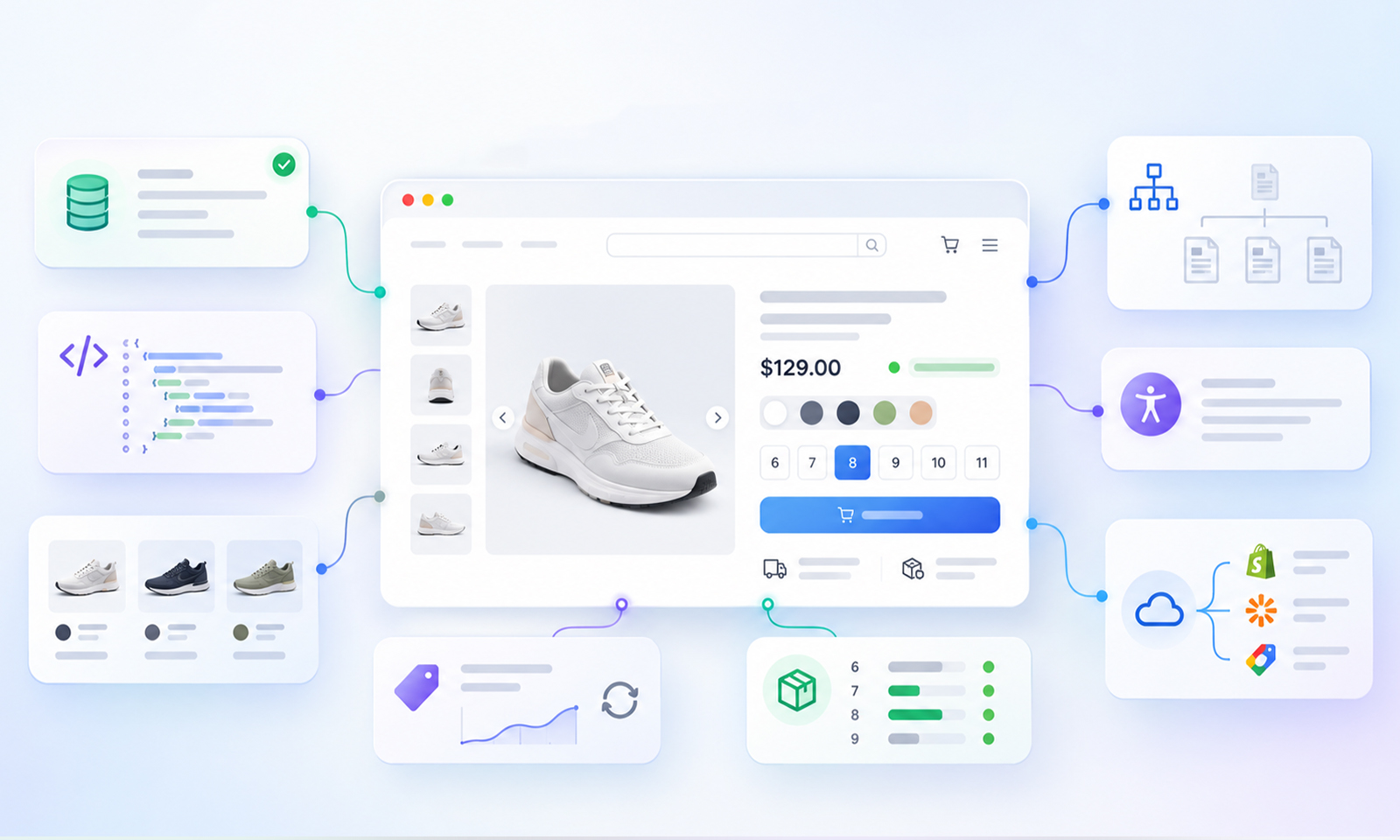
Ecommerce is moving toward a model where AI systems can help shoppers discover and evaluate products based on specific requirements. That means a store needs to communicate more than a product name and price.
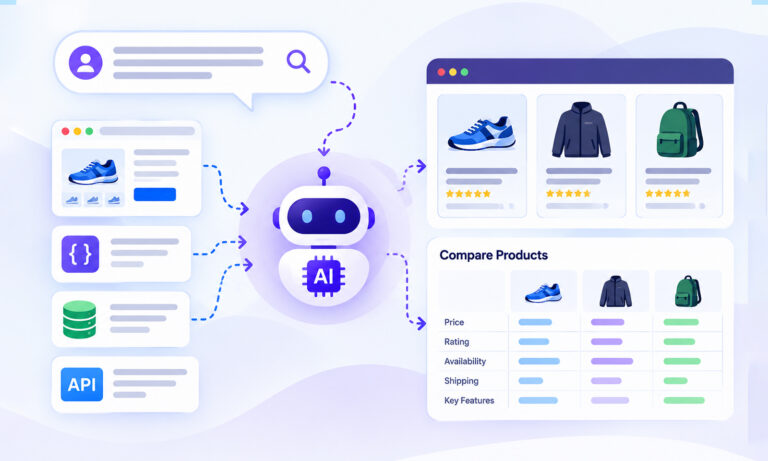
An agent-ready ecommerce website makes important information easy for automated systems to identify and interpret, including product attributes, variants, pricing, availability, shipping, and policies.
The goal is not to build a separate website for AI. It is to make the existing ecommerce experience more structured, accessible, and dependable for both people and machines.
Ecommerce Readiness for AI Agents: Quick Overview
For an ecommerce website to work well with AI agents, product information needs to be accurate, accessible, and easy to interpret. The key requirements include structured data, clear product details, consistent pricing and availability, and reliable technical infrastructure.
| Factor | What an agent-ready website provides |
|---|---|
| Accurate product data | Current product details, attributes, prices, and availability |
| Machine-readable information | Relevant structured data and other structured sources |
| Clear variants | Understandable relationships between products and options |
| Crawlable content | Important information that can be accessed and interpreted |
| Consistent data | Product pages, feeds, APIs, and other sources agree |
| Commercial context | Shipping, returns, warranties, and other purchase details |
| Usable functionality | Clear controls and shopping actions where applicable |
What Does “Agent-Ready” Mean for an Ecommerce Website?
An agent-ready ecommerce website provides reliable product and commercial information in formats that automated systems can access and interpret.
Consider a request such as:
“Find a waterproof running jacket under $150, available in medium, with free returns.”
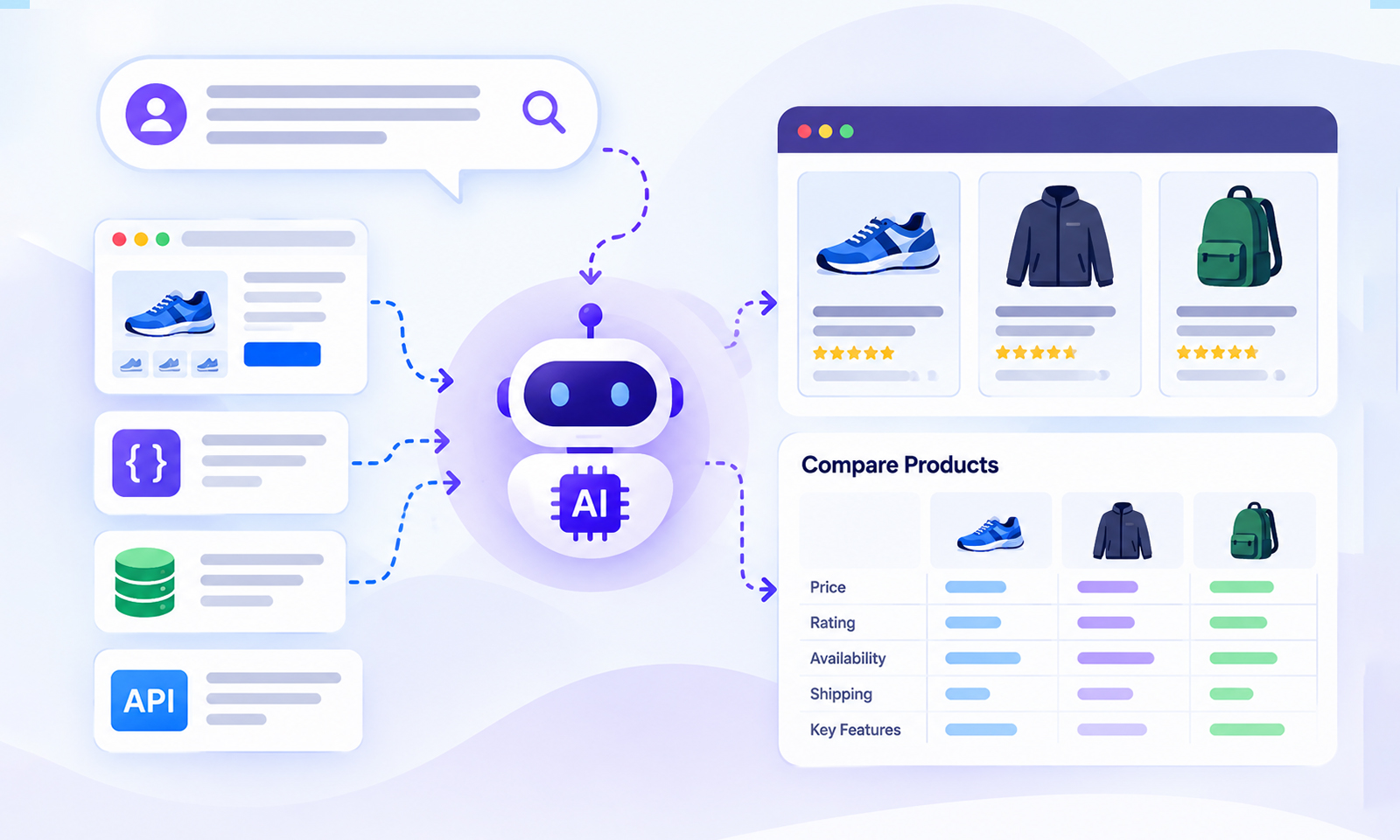
To evaluate products against that request, an AI system needs more than a keyword match. It needs to establish which products are jackets, whether they are waterproof, which variants are available, what they cost, and what the return conditions are.
That is the core of ecommerce agent readiness. It is also important to avoid treating “agent-ready” as a single technical requirement.
There is no universal markup that guarantees compatibility with every AI shopping agent. Instead, readiness comes from the combination of accurate data, structured information, accessibility, crawlability, and functional ecommerce infrastructure.
What Does an AI-Ready Ecommerce Website Need?
An AI-ready ecommerce website needs accurate product data, machine-readable information, clear product relationships, accessible pages, and consistent ecommerce systems that AI agents can interpret reliably.
1. Keep Product Data Accurate and Current
Accurate product information is the foundation of an agent-ready ecommerce website.
Product names, descriptions, attributes, variants, prices, and availability should reflect what shoppers can actually purchase.
This becomes especially important when information changes frequently. For example, if a product page shows a price of $79 while another connected source reports $99, an automated system has conflicting information to reconcile.
Pay particular attention to:
- Product names and descriptions
- Brand and product identifiers
- Product attributes and specifications
- Size, color, and other variants
- Price and currency
- Availability and inventory
- Shipping and return information
The more important a piece of information is to a purchasing decision, the more important it is to keep that information accurate and synchronized.
2. Make Product Information Machine-Readable
Machine-readable product information helps automated systems identify important ecommerce entities and relationships more explicitly.
This is where ecommerce structured data and ecommerce schema markup become useful.
For example, Product and Offer structured data can communicate information such as product identity, price, currency, and availability.
A simplified example is:
<script type="application/ld+json">
{
"@context": "https://schema.org",
"@type": "Product",
"name": "Waterproof Running Jacket",
"offers": {
"@type": "Offer",
"price": "129.00",
"priceCurrency": "USD",
"availability": "https://schema.org/InStock"
}
}
</script>
This does not mean every AI agent will consume this exact markup. Its value is that Schema.org provides a standardized vocabulary for describing entities and commercial information.
For ecommerce stores managing structured data across many product pages, JSON Schema App can help implement and maintain relevant Schema.org markup at scale. This is particularly useful when product information changes frequently and structured data needs to stay aligned with the underlying product content.
Google supports Product structured data for eligible search experiences. Providing product information through both structured data and Google Merchant Center can help Google understand and verify product details.
3. Make Product Variants and Relationships Clear
An AI system needs to distinguish the main product from its individual variants.
A shopper asking for “black running shoes in size 9” is not looking for the general product; they are looking for a particular purchasable option. Your product architecture should therefore make relationships between the main product, variants, identifiers, prices, and availability clear.
This matters particularly for large catalogs where the same product can have dozens of combinations. Clear variant information also reduces ambiguity when product data is reused across feeds, structured data, marketplaces, or other commerce systems.
4. Keep Prices, Inventory, Shipping, and Returns Consistent
Commercial information should remain consistent wherever an AI system may encounter it. An agent comparing two products may need to consider more than the listed product price.
For example:
| Product A | Product B | |
|---|---|---|
| Price | $120 | $110 |
| Availability | In stock | In stock |
| Shipping | Free | $20 |
| Returns | 30 days | 14 days |
Product B may appear cheaper initially, but the additional commercial information changes the comparison. For this reason, AI-ready product data should include relevant purchasing context, not just basic product descriptions.
Schema.org provides standardized properties for products and offers, including information related to pricing, availability, shipping, and returns.
5. Make Important Ecommerce Pages Crawlable
AI systems cannot reliably use information they cannot access. An ecommerce website for AI agents should make important product and commercial information discoverable without unnecessary technical barriers.
This means maintaining crawlable product URLs, logical internal linking, accessible content, and sound technical foundations.
Modern ecommerce websites can still use JavaScript, dynamic interfaces, filters, and interactive elements. The issue is not whether a website is dynamic; it is whether important information remains accessible and understandable.
A useful test is simple:
Can a system determine what the product is, what it costs, whether it is available, and what conditions apply without navigating unnecessary technical obstacles?
If not, the site may need technical improvements before additional AI-focused optimization becomes useful.
6. Provide Complete Product Context
Agent-ready product pages should provide the information a shopper would reasonably need to evaluate a product. What counts as important information depends on the product category.
- For a laptop, this might include processor, RAM, storage, screen size, and compatibility.
- For clothing, it could include material, fit, sizing, color, and care instructions.
- For furniture, dimensions, materials, assembly requirements, delivery, and warranty information may matter.
The objective is not to create content specifically for AI. It is to make important product facts explicit, specific, and easy to verify. This is also useful for human shoppers, search engines, and other systems consuming your product information.
7. Support Feeds, APIs, and Connected Data Sources
Large ecommerce websites may need structured feeds or APIs to keep product information available and synchronized across systems.
Consider a simplified data flow:
Inventory system → Ecommerce platform → Product page → Structured data/feed/API
When inventory or pricing changes, connected systems can update the information rather than relying on manual edits across hundreds or thousands of pages. This becomes particularly valuable for stores with frequently changing catalogs.
However, having an API does not automatically make a site agent-ready. The API needs to expose useful, accurate information and be available to systems that are authorized to use it.
8. Make the Interface Clear and Accessible
Clear and accessible interfaces make important ecommerce information and actions easier for both people and automated systems to interpret.
Descriptive labels, logical navigation, meaningful headings, and properly structured controls can help users understand a page and interact with it.
For example, a product selector labelled “Choose size” communicates more clearly than an unlabeled control whose meaning is apparent only visually.
Accessibility should not be treated as an “AI ranking trick.” It is a fundamental quality of a usable website, and many of the same principles make ecommerce interfaces easier to interpret programmatically.
How Can You Prepare an Ecommerce Website for AI Agents?
To prepare an ecommerce website for AI agents, start by improving the quality and accessibility of the information your store already provides.
1. Audit your product data
Check product names, descriptions, attributes, variants, prices, inventory, shipping, and returns for accuracy.
2. Check for conflicting information
Compare your product pages with structured data, feeds, APIs, and other important sources.
3. Implement relevant structured data
Use appropriate Schema.org types and properties for products and offers, then validate the implementation and ensure it reflects the page.
4. Improve crawlability
Make important product information and URLs discoverable, accessible, and technically sound.
5. Keep dynamic data synchronized
Ensure changes to price, inventory, variants, and other frequently changing information are reflected consistently.
6. Test real shopping questions
Don’t stop at checking whether structured data is valid. Test whether your website can clearly answer questions such as:
- “Which products are available in size M?”
- “Which options cost less than $100?”
- “Does this product have free returns?”
- “Which product is compatible with X?”
These tests reveal information gaps that a markup validator alone cannot identify.
What Is the Role of Structured Data in Ecommerce Agent Readiness?
Structured data is an important component of ecommerce agent readiness, but it is not the entire solution.
It provides an explicit way to describe products, offers, ratings, and other entities. But an AI-ready ecommerce website also needs accurate visible content, crawlable pages, current inventory, clear variants, and reliable data sources.
Think of it this way:
Structured data describes the information.
Ecommerce architecture keeps the information accurate and accessible.
That distinction is important because a valid schema does not guarantee that an AI system will use, surface, or recommend the information.
Agent-Ready Ecommerce Website vs. Traditional Ecommerce Optimization
Traditional ecommerce optimization focuses heavily on helping shoppers discover, understand, and purchase products; agent readiness adds an emphasis on making the same information explicit and machine-interpretable.
| Traditional ecommerce focus | Agent-ready focus |
|---|---|
| Product descriptions | Explicit product attributes |
| Search-friendly pages | Machine-readable information |
| Product categories | Clear product relationships |
| Current pricing | Synchronized pricing across sources |
| Variant selection | Clearly defined variant relationships |
| User-friendly checkout | Clear, accessible functionality |
These approaches are complementary rather than separate strategies. A well-structured ecommerce website can support shoppers, search engines, and emerging AI shopping agents without creating a separate “AI version” of the store.
What Should Ecommerce Businesses Focus on Now?
The most practical approach to ecommerce optimization for AI is to improve the reliability of your existing product information.
Before adopting new AI-specific technologies, check whether your store can consistently answer five basic questions:
- What is the product?
- What are its important attributes and variants?
- How much does it cost?
- Is the relevant option available?
- What purchasing conditions apply?
If those answers are accurate, accessible, and consistent across your website and relevant data sources, you have established much of the foundation needed for an agent-ready ecommerce website.
Conclusion
An agent-ready ecommerce website does not require a single new technology or special “AI markup.” It requires a strong information foundation.
Keep product data accurate, make important facts machine-readable, define variants clearly, synchronize prices and inventory, maintain crawlable pages, and provide useful commercial context such as shipping and returns.
As ecommerce AI agents become more capable, websites that already provide clear, structured, accessible, and reliable information will have a stronger technical foundation for emerging AI shopping experiences.
FAQs
Q1: What is an agent-ready ecommerce website?
An agent-ready ecommerce website provides accurate, accessible, and machine-readable information that automated systems can use to understand products, offers, availability, and purchasing conditions.
Q2: How do I make my ecommerce website ready for AI agents?
Start with accurate product information, clear variants, current pricing and inventory, relevant structured data, crawlable pages, accessible interfaces, and consistent feeds or APIs where appropriate.
Q3: Does schema markup make an ecommerce website agent-ready?
No. Schema markup can make product information more explicit and machine-readable, but agent readiness also depends on data accuracy, crawlability, accessibility, and the consistency of your ecommerce systems.
Q4: What product information should AI agents be able to understand?
Important information includes product identity, descriptions, attributes, variants, price, availability, shipping, returns, and category-specific specifications that affect purchasing decisions.
Q5: Do AI agents need APIs to understand ecommerce websites?
Not necessarily. AI systems can obtain information through different sources, including webpages, structured data, feeds, and APIs. APIs can become particularly useful for large catalogs and frequently changing information.
Q6: Is ecommerce agent readiness the same as AI SEO?
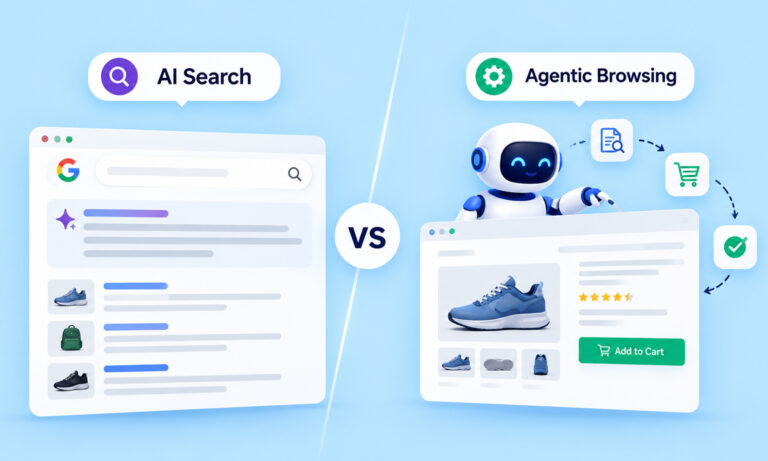
No. AI visibility and agent readiness overlap, but they are not identical. AI SEO generally concerns how information can be discovered and surfaced in AI-powered search experiences, while agent readiness also considers whether an AI system can reliably interpret and interact with ecommerce information and functionality.





 Wix Schema
 Squarespace Schema
 BigCommerce Schema
 Shopify Schema
 Hubspot Schema
 Webflow Schema
 GoHighlevel Schema
 Duda Schema
 Weebly Schema
 ClickFunnel Schema