

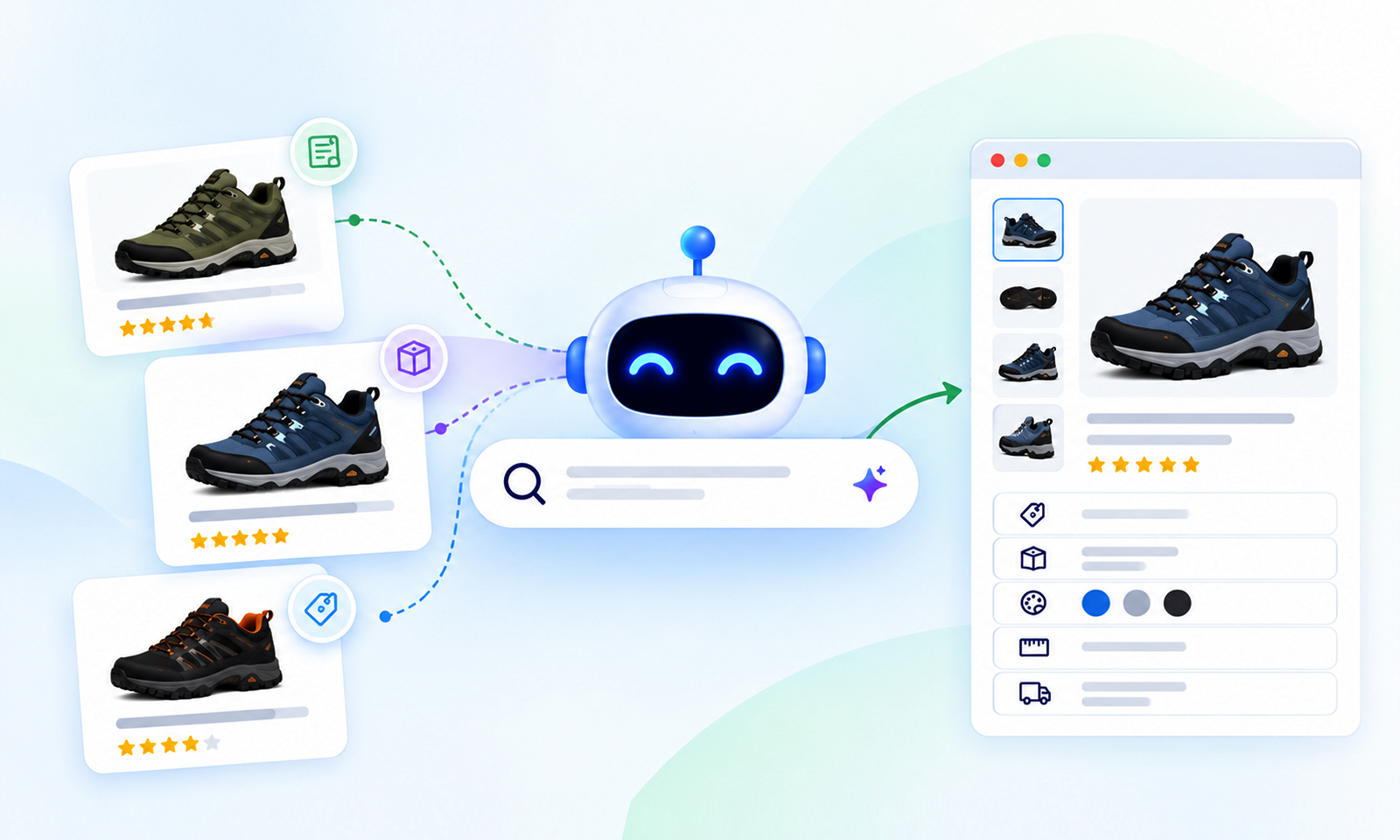
AI search is adding a new layer to product discovery. Shoppers can now use conversational queries to find products, compare options, and evaluate product information without relying solely on traditional search results.
For ecommerce brands, this makes product data increasingly important. Product pages need to provide clear, accurate, structured, and accessible information that search engines and AI systems can interpret.
That is the foundation of ecommerce AI search visibility.
Key Factors That Make an Ecommerce Product AI-Search Ready
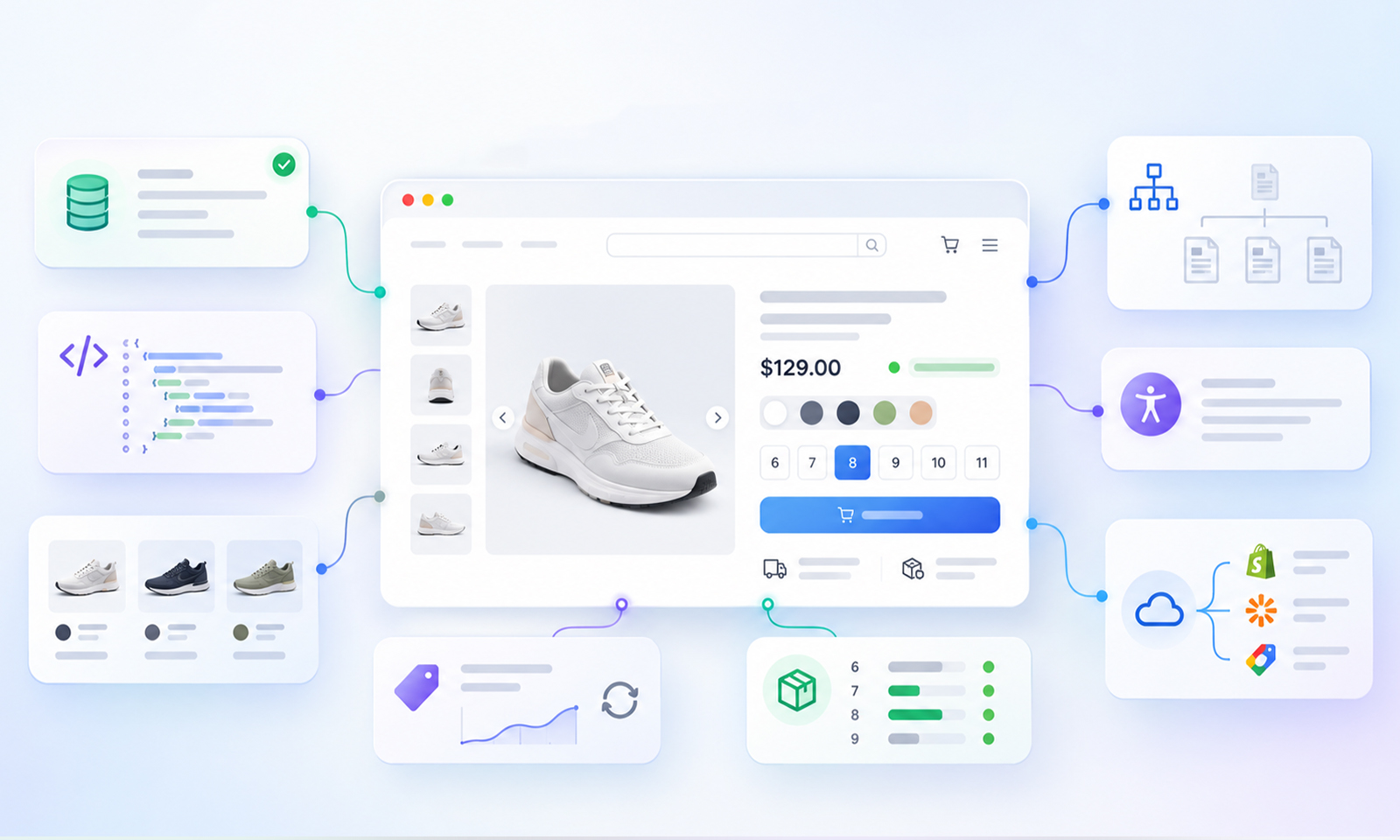
Ecommerce brands can improve product visibility in AI search by making product information complete, crawlable, structured, accurate, and consistent across product pages and relevant product-data sources.
| Action | Why it matters |
|---|---|
| Keep product pages crawlable | Makes product information accessible |
| Provide complete product data | Helps systems understand and compare products |
| Use Product structured data | Describes product information explicitly |
| Keep price and availability current | Reduces conflicting information |
| Use relevant product feeds | Provides structured catalog information where supported |
| Write useful product content | Helps match products with specific shopping needs |
These practices do not guarantee that a product will appear in an AI-generated answer. Different AI search engines and shopping experiences use different retrieval and ranking systems. The goal is to give them reliable information to work with.
What Is Ecommerce AI Search Visibility?
Ecommerce AI search visibility is the ability of an ecommerce brand’s products and product information to be discovered, understood, and potentially surfaced through AI-powered search and shopping experiences.
Consider a shopper asking:
“Find waterproof hiking shoes under $150 that are available in size 10.”
An AI system needs to understand product category, price, features, size, and availability to provide a useful answer. This means product visibility in AI search depends on more than keywords. Product data needs to clearly communicate the facts that matter to the shopper.
Key Strategies to Improve Ecommerce AI Search Visibility
The focus is not on optimizing for a single AI platform, but on strengthening the product signals that support discovery and understanding across AI-driven search experiences. Here are the key areas ecommerce brands should address.
1. Make Product Information Complete and Accurate
The starting point for AI search optimization for ecommerce is reliable product information. Product pages should clearly communicate details such as:
- Product name and brand
- Description and key specifications
- Price and currency
- Availability
- Variants such as size and color
- Product identifiers where applicable
- Images
- Reviews and ratings where relevant
- Shipping and return information
Compare:
“Premium running shoes with advanced cushioning.”
with:
“Lightweight men’s road running shoes with neutral cushioning, a 10 mm heel-to-toe drop, sizes 8 -13, and a price of $129.”
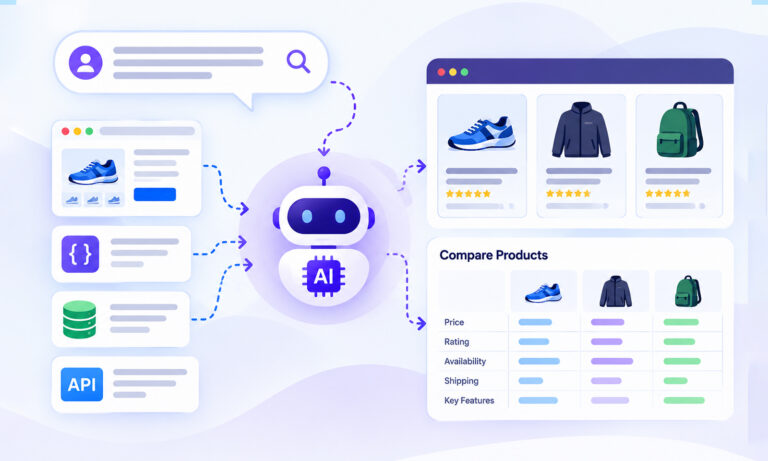
The second description gives shoppers and automated systems substantially more explicit information to interpret. AI shopping experiences can use product information to help users research and compare products, making accurate catalog data increasingly important.
2. Keep Product Pages Crawlable
Even excellent product information cannot help if important content is difficult to discover. Make sure product pages provide reliable access to:
- Product names and descriptions
- Prices and availability
- Variant information
- Product specifications
- Reviews
- Internal links
JavaScript-heavy ecommerce sites deserve particular attention. JavaScript itself is not a problem, but important product information should be reliably available to crawlers rather than being dependent on complex interactions.
Use Google Search Console’s URL Inspection tool to check important product URLs and review the rendered page. Confirm that product information is accessible and that technical issues are not preventing Google from crawling or indexing the page.
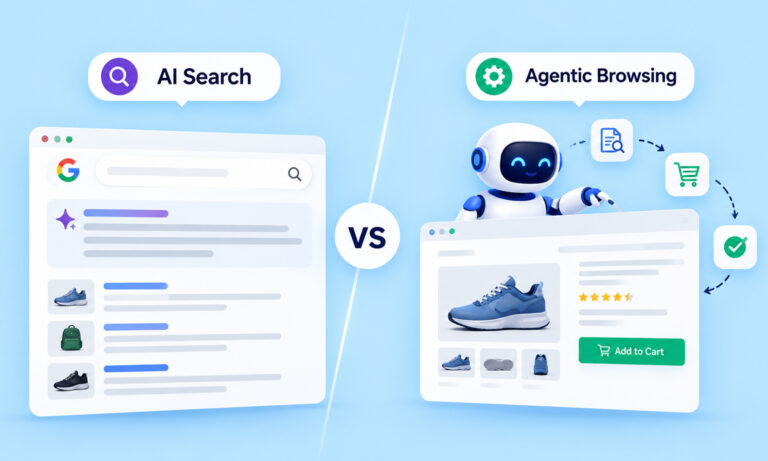
This is especially relevant for stores preparing for AI shopping agents, which may navigate and interpret ecommerce websites differently from traditional search crawlers. For BigCommerce merchants, this also means considering crawlability, accessibility, structured data, APIs, and other factors that support agentic browsing.
3. Use Product Structured Data
A practical part of ecommerce optimization for AI search is implementing relevant Product structured data.
Schema.org’s Product vocabulary provides a standardized way to describe products, while properties such as offers, aggregateRating, and product identifiers can communicate additional information.
A simplified example looks like this:
<script type="application/ld+json">
{
"@context": "https://schema.org",
"@type": "Product",
"name": "Trail Running Shoes",
"brand": {
"@type": "Brand",
"name": "Example Brand"
},
"offers": {
"@type": "Offer",
"price": "129.00",
"priceCurrency": "USD",
"availability": "https://schema.org/InStock"
}
}
</script>
Before publishing, test your markup with Google’s Rich Results Test and check the requirements for the product search feature you want to qualify for. Ensure that the structured data matches the product information visible on the page.
The important part is accuracy. Structured data should represent the product information actually available on the page.
Google documents Product structured data for communicating information such as price, availability, shipping, and returns in eligible search experiences.
For large catalogs, maintaining this markup manually can become difficult. JSON Schema App can help ecommerce teams manage and deploy relevant Schema.org markup across product pages while keeping structured data aligned with catalog information.
4. Keep Prices, Inventory, and Variants Synchronized
One of the easiest ways to create confusing product signals is to let different sources contain different information.
For example:
| Source | Price | Availability |
|---|---|---|
| Product page | $79 | In stock |
| Structured data | $89 | In stock |
| Product feed | $79 | Out of stock |
For shoppers, this creates confusion. For automated systems comparing product information, it creates conflicting signals.
Keep the following synchronized wherever they are published:
- Price and sale price
- Inventory and availability
- Product variants
- Shipping information
- Product URLs
- Promotions
This becomes particularly important for stores with hundreds or thousands of products. AI shopping experiences can draw on merchant-provided and publicly available product information, but product details such as prices and availability can change.
5. Use Product Feeds Where Supported
Structured data should not be viewed as the only way to communicate product information.
Some AI shopping environments and search ecosystems also use merchant-provided product catalogs or feeds. For example, OpenAI describes merchant product feeds as part of its commerce infrastructure, while Google provides a Merchant Center for submitting ecommerce product information.
The practical approach is to use the product-data channels relevant to the platforms where you want your products to be discoverable. Your product page, structured data, and feed should reinforce the same core facts.
6. Create Content Around Real Shopping Questions
AI search optimization is not only a technical task. Product pages should answer the questions shoppers might actually ask an AI system.
For example, instead of simply saying:
“High-quality travel backpack.”
Explain:
- How much does it hold?
- What laptop size does it fit?
- Is it waterproof?
- How much does it weigh?
- Is it suitable for carry-on travel?
- What materials is it made from?
This gives AI systems more context for matching products with conversational searches.
It also supports AI product discovery, where shoppers may describe their requirements instead of using the exact terminology found in a product catalog.
7. Make Important Product Attributes Explicit
AI shopping agents need more than a product category.
Suppose someone asks:
“I need a lightweight black carry-on suitcase under $200 with four wheels.”
A product catalog is easier to interpret when attributes such as color, weight, luggage size, wheel type, and price are explicitly represented.
Use clear product attributes across your page content, structured data, and relevant feeds.
The objective is not to add every possible attribute. Focus on information that genuinely describes the product and helps shoppers evaluate it.
8. Keep Information Consistent Across Your Ecommerce Ecosystem
A strong AI visibility for ecommerce brands strategy depends on consistency. Your product page, structured data, feed, and other relevant product sources should agree on fundamental facts.
At a minimum, check:
| Product fact | Page | Structured data | Feed |
|---|---|---|---|
| Product name | ✓ | ✓ | ✓ |
| Price | ✓ | ✓ | ✓ |
| Availability | ✓ | ✓ | ✓ |
| Brand | ✓ | ✓ | ✓ |
| Product ID | ✓ | ✓ | ✓ |
| Variants | ✓ | ✓ | ✓ |
This is particularly important when products, prices, and inventory change frequently.
Does Product Schema Guarantee Visibility in AI Search?
No. Product schema does not guarantee that a product will appear in AI search results or AI-generated recommendations.
Structured data helps describe information in a standardized format, but AI systems can use multiple sources and their own retrieval and ranking mechanisms.
Google explicitly notes that valid structured data does not guarantee a particular search appearance.
Therefore, Product schema should be treated as one component of a broader strategy that includes accurate product data, crawlability, useful content, and synchronized catalogs.
Conclusion
Improving ecommerce AI search visibility starts with making product information easy to discover, understand, verify, and compare.
For most ecommerce brands, that means getting the fundamentals right: crawlable product pages, accurate product data, relevant Product structured data, synchronized prices and inventory, useful product attributes, and appropriate product feeds.
As AI shopping agents and AI search for ecommerce continue to develop, brands that maintain clear and consistent product information will be better positioned to participate in emerging product-discovery experiences, without relying on keyword stuffing or assuming that any single optimization guarantees visibility.
Frequently Asked Questions
Q1: How can ecommerce brands appear in AI search?
Brands can improve their chances by keeping product pages crawlable and informative, maintaining accurate product data, implementing relevant structured data, using supported product feeds, and providing detailed information about products, variants, prices, and availability.
Q2: How do I optimize products for AI search?
Start with accurate product information. Make product names, descriptions, specifications, prices, availability, variants, and identifiers explicit and consistent. Then support that information with relevant structured data and product feeds where applicable.
Q3: Does AI search use product structured data?
AI systems use different information sources and methods. Structured data provides standardized information about products and offers, making it useful as part of a broader ecommerce AI visibility strategy. However, brands should not assume every AI system uses structured data in exactly the same way.
Q4: What information is important for AI shopping agents?
Important information can include product identity, category, attributes, price, availability, variants, reviews, and other details needed to determine whether a product matches a shopper’s requirements. The exact signals vary between AI systems.
Q5: Can structured data improve ecommerce AI visibility?
Accurate structured data can make product information more explicit and machine-readable and can support eligibility for certain search experiences. It does not guarantee AI visibility or placement.
Q6: How is AI search different from traditional ecommerce search?
Traditional ecommerce search generally matches queries against a store’s catalog and ranking system. AI-powered product discovery can interpret conversational requirements, compare multiple attributes, and potentially combine information from different sources. The exact process varies by platform.






 Wix Schema
 Squarespace Schema
 BigCommerce Schema
 Shopify Schema
 Hubspot Schema
 Webflow Schema
 GoHighlevel Schema
 Duda Schema
 Weebly Schema
 ClickFunnel Schema