

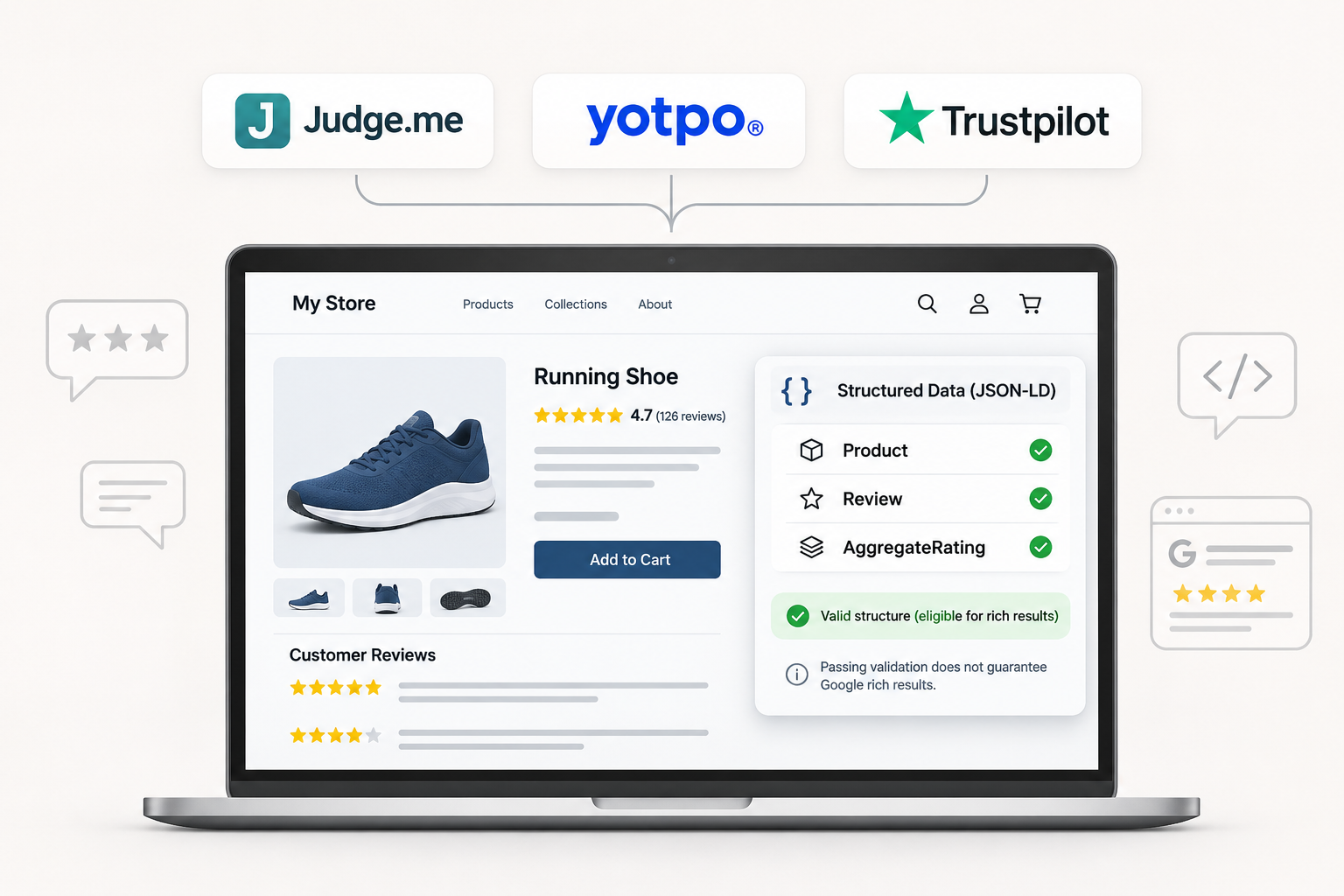
Review apps can collect customer ratings and display them on product pages, but do they also generate valid product review schema? That depends on how the app outputs structured data and how it is implemented on your site.
Judge.me, Yotpo, and Trustpilot can support review-related schemas, but simply installing one does not guarantee valid markup or Google review rich results. This guide explains what each platform generates, what to check, and how to avoid common schema issues.
Do These Product Review Schema Apps Generate Valid Markup?
These review apps can generate valid product review markup, but validity depends on accurate Product, Review, and AggregateRating data, proper implementation, and avoiding duplicate schema.
| App | Can support review-related structured data? | What to verify |
|---|---|---|
| Judge.me | Yes, depending on implementation and settings | Product, Review, and AggregateRating markup on the live page |
| Yotpo | Yes, depending on product and integration | Whether product-page review data is correctly connected to the product |
| Trustpilot | Yes for supported product-review implementations | Whether product reviews, rather than general business ratings, are being marked up appropriately |
- Valid JSON-LD is only the first requirement. The markup must also match Google’s structured data policies.
- Product review schema should represent the actual product and reviews visible or otherwise available to users.
- Duplicate or conflicting Product schema is a common problem when a review app, theme, SEO app, and schema tool all generate markup.
- Passing a validator does not guarantee Google will show review rich results.
What Makes Product Review Schema Valid?
A common misconception is that a review app is either “Google-approved” or “not Google-approved.” Google does not evaluate review apps as a single category. It evaluates the structured data and content on the pages it crawls.
For a product page, a typical implementation may contain:
Productto identify the item being sold or describedAggregateRatingto summarize ratings from multiple usersReviewfor individual customer reviews
Google’s product documentation allows review and aggregateRating to be nested within Product markup, while its review snippet documentation explains the requirements for rating and review data. A valid implementation also has to follow Google’s general structured data guidelines and accurately represent the page’s content.
Another important requirement is review origin. Google does not allow websites to aggregate ratings or reviews from other websites for review snippets. Even if a review platform supports importing third-party reviews, do not assume that all imported ratings can be included in Google’s Product review structured data. Check Google’s review snippet policies before marking up consolidated review data.
For example, a simplified JSON-LD review schema structure might look like this:
{
"@context": "https://schema.org",
"@type": "Product",
"name": "Example Running Shoe",
"aggregateRating": {
"@type": "AggregateRating",
"ratingValue": "4.7",
"reviewCount": "126"
},
"review": {
"@type": "Review",
"reviewRating": {
"@type": "Rating",
"ratingValue": "5",
"bestRating": "5"
},
"author": {
"@type": "Person",
"name": "Jane Smith"
}
}
}
The code is not useful merely because it is syntactically valid. The rating must actually relate to the product, the counts should reflect real data, and the markup should not misrepresent what users can access on the page.
That distinction is central to evaluating product review schema apps.
How Review Apps Add Schema to Ecommerce Product Pages
Most review apps do not replace your entire Product schema. Instead, they usually add or populate review-related properties. A typical ecommerce page may already receive Product structured data from:
- The Shopify theme or ecommerce platform
- An SEO or schema app
- A review application
- Custom developer code
The review app may then add aggregateRating, individual Review entities, or a separate Product JSON-LD block.
This is where checking structured data generated by multiple apps can become complicated. Multiple pieces of markup are not automatically wrong, but conflicting or duplicate product data can make the implementation harder to interpret and maintain.
For example, imagine that a theme says a product has:
4.8 rating from 150 reviews
while a review app outputs:
4.6 rating from 92 reviews
Both blocks may technically contain valid JSON. But together, they create inconsistent structured data for the same product.
In practice, the better approach is to establish one reliable source of truth for product and review data, then ensure the relevant entities are connected correctly. This is particularly important for stores using multiple review apps and SEO tools that generate structured data.
Judge.me Schema: Does Judge.me Generate Valid Product Review Markup?
Short answer: Yes, Judge.me can generate review-related structured data for product pages, but the store configuration still needs validation.
Judge.me’s SEO Rich Snippets feature automatically adds JSON-LD structured data to product pages, including the average rating and review count. Individual review content, including reviewer names and ratings, requires the Awesome plan and the new Review Widget. Judge.me also allows merchants to disable its JSON-LD and Microdata output when another SEO or schema tool already generates review markup, helping prevent duplicate structured data.
This makes Judge.me schema one of the more configurable implementations among common Shopify review apps.
What Judge.me review schema can include
Depending on settings and implementation, Judge.me can provide:
- Product-level rating data, including
AggregateRating - Rating and review counts
- Individual review content
- Reviewer information
- JSON-LD or microdata options
The main risk with Judge.me
The most common issue is not that Judge.me review schema is inherently invalid, but that it can duplicate structured data generated by other tools.
For example, a Shopify store might have:
- Product schema from the theme
- Product schema from a schema app
- Review markup from Judge.me
- Additional markup from an SEO plugin
Judge.me explicitly provides an option to disable its JSON-LD and microdata snippets if another system already supplies the review schema. That is a useful feature, but store owners still need to check the final rendered page.
Yotpo Schema: Does Yotpo Generate Valid Product Review Markup?
Short answer: Yes, Yotpo provides an automated JSON-LD-based rich-snippet implementation for supported integrations and plans.
According to Yotpo’s documentation, its Reviews product can automatically add structured data to product pages without manual markup. The implementation can include product information along with the review count and average rating. Yotpo recommends validating the resulting structured data with Google’s Rich Results Test. The availability of review-related properties depends on the product’s review data and the implementation on the live product page.
What Yotpo schema typically contributes
Yotpo documents automated data such as:
- Product name
- Product description
- Product image
- Price and currency
- Number of reviews
- Average star rating
Its approach is particularly relevant for stores looking for Product schema with reviews without manually writing JSON-LD.
The important limitation
Automated markup is still not a guarantee of a review-rich result. Yotpo itself notes that Google must crawl and index the updated page and ultimately determines the final search appearance. Google also states that correctly implemented structured data does not guarantee that a rich result will be shown.
This means Yotpo schema should be treated as a structured-data implementation that can make a page eligible, not as a promise of star ratings in search.
Trustpilot Schema: Is It the Same as Judge.me and Yotpo?
Not exactly.
Trustpilot is different because many businesses primarily use it for company-level reviews, while its Product Reviews offering is specifically designed for reviews tied to individual products. That distinction matters for Trustpilot review schema.
A general Trustpilot business rating is different from customer reviews associated with an individual product. If a page is about a specific product, the structured data should accurately describe reviews of that specific product rather than simply attaching a business-wide TrustScore to every product page.
Trustpilot’s Product Reviews offering is designed to collect and display product-specific reviews and is promoted for use across individual product pages, including search-result visibility.
What to check with Trustpilot schema?
Trustpilot offers a Product Review SEO TrustBox that includes structured data markup for product-specific reviews. However, not every TrustBox widget serves the same purpose. Merchants should use the product-review SEO widget on the corresponding product page and verify its actual output rather than assuming that any visible Trustpilot widget automatically generates Product review schema.
Check the live product URL and confirm:
- A
Productentity exists - The review or
aggregateRatingdata refers to that product - The rating and count match the actual product-review data
- The markup does not accidentally use a general business rating as a product rating
- Another app or theme is not generating conflicting Product schema
This is the biggest practical difference between evaluating Trustpilot schema and simply checking whether a Trustpilot widget is visible.
Judge.me vs. Yotpo vs. Trustpilot for Product Review Schema
Judge.me, Yotpo, and Trustpilot can add review-related structured data, but their implementations differ. Here’s what to check before relying on their markup for product rich results.
| Review Platform | Product review data support | Structured-data focus | Main schema check |
|---|---|---|---|
| Judge.me | Product-level reviews | Configurable JSON-LD and microdata options | Avoid duplicate schema and verify the selected output |
| Yotpo | Product-level reviews | Automated JSON-LD rich snippets | Confirm review count and AggregateRating are detected |
| Trustpilot Product Reviews | Product-level reviews | Product-review implementation may vary by integration | Confirm ratings refer to the individual product, not the overall business |
The important takeaway is that all three can be part of a valid ecommerce review schema setup. However, none should be evaluated based solely on the app name. The live markup is what matters.
The Biggest Problem With Product Review Schema Apps: Duplicate Product Markup
In our experience reviewing ecommerce schema implementations, the issue that appears repeatedly is not missing schema. It is too much schema generated by different systems without coordination.
Consider this setup:
- Shopify theme generates
Product - Review app generates another
Product - SEO app generates another
Product - A custom developer script adds
AggregateRating
The result may contain multiple Product entities with slightly different prices, IDs, ratings, or review counts.
Google can process multiple structured-data items, but conflicting information is avoidable technical debt. Google requires structured data to be representative and accurate, and its product documentation recommends ensuring that the markup correctly represents the product page.
A better approach
Choose how the data will be divided:
- Theme or schema system: core Product data
- Review app: current review and rating data
- One connected implementation: final Product entity with consistent review properties
Where possible, use consistent identifiers such as @id to connect related entities instead of creating disconnected versions of the same product.
How to Check Whether Your Review App Generates Valid Schema
1. Test the live product URL
Use Google’s Rich Results Test on an actual product page with published reviews.
Look for:
- Product detection
aggregateRatingreviewCountorratingCount- Review-related errors
- Missing required fields
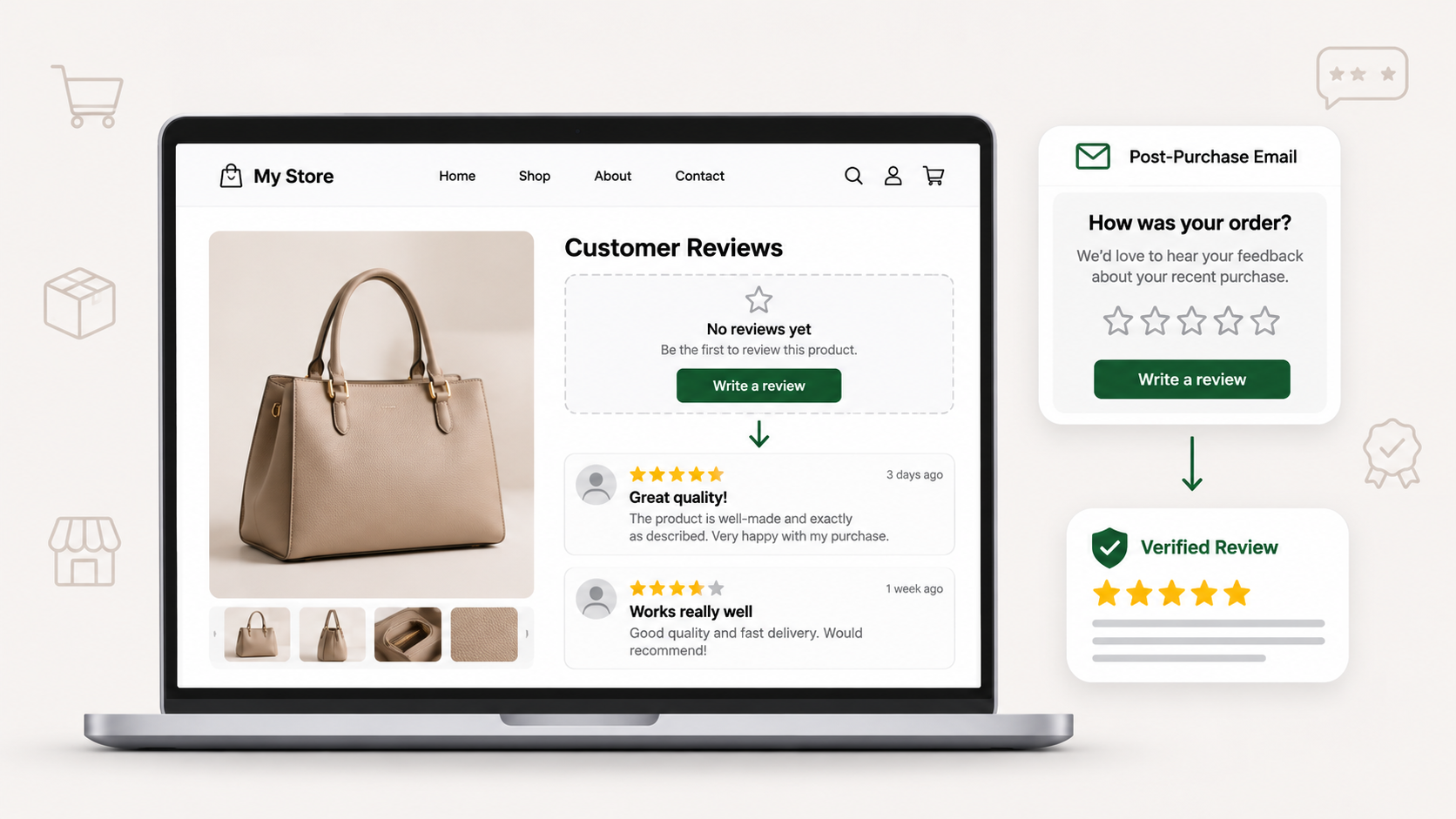
A page with no published reviews will not have genuine review data to support an aggregate rating, so test a product that already has customer feedback. The structured data should reflect the actual review information available for that product.
2. Compare schema with the visible page
If the page displays:
4.7 from 89 reviews
the structured data should not claim:
4.9 from 312 reviews
The same principle applies to individual review text and authors. Google’s guidelines emphasize that structured data should accurately represent the page and should not be misleading or hidden from users.
3. Check for multiple Product entities
View the page source or inspect all detected structured data in a validator. Then ask:
Are these multiple Product objects describing the same item, and if so, do they agree?
If they do not, determine which application should be responsible for the review properties.
4. Validate after every major app or theme change
Review apps can update, themes can change their JSON-LD, and new SEO apps can add additional markup. Schema validation should therefore be treated as an ongoing quality check, not a one-time setup task.
Does Valid Review App Schema Automatically Produce Google Star Ratings?
No. This is one of the most important distinctions in Google review schema. A page may have:
- Valid JSON-LD
- Correct Product markup
- A valid
AggregateRating - Genuine reviews
- No Rich Results Test errors
and still not display stars in Google Search.
Google explicitly states that valid structured data does not guarantee a rich result. Eligibility simply gives Google the information it needs to consider the feature. The final presentation can vary based on the query, page, device, and other search-result factors.
This is why the better question is not:
“Does this app guarantee stars?”
It is:
“Does this app help generate accurate, valid, and eligible structured data on my product page?”
Conclusion
Judge.me, Yotpo, and Trustpilot can all support product-level review data, but the app name alone does not determine whether your schema is valid.
The real test is what appears on the product page: a correctly identified Product, accurate AggregateRating or Review data, consistent values, and no conflicting markup generated by other tools. Product review schema apps are useful automation tools, but they still need validation after installation and whenever your ecommerce stack changes.
When review data, product schema, and visible page content all describe the same thing, you have a much stronger foundation for review-rich result eligibility, without relying on assumptions about what a review widget is doing behind the scenes.
FAQs
Q1: Does Judge.me generate Product review schema?
Judge.me can generate review-related structured data for product pages. Its settings can include aggregate ratings and, depending on configuration, review content and reviewer information. You should still validate the live page and avoid duplicate schema generated by other apps or themes.
Q2: Does Yotpo add an AggregateRating schema?
Yotpo documents an automated JSON-LD rich-snippet implementation that can add product review counts and average ratings to supported product pages. The product must have review data, and the final markup should be tested with Google’s Rich Results Test.
Q3: Does Trustpilot generate Product review schema?
Trustpilot offers product-specific reviews, but you should verify the actual structured data produced by your particular integration. Do not assume that a general Trustpilot business rating is automatically valid as an aggregate rating for every individual product page.
Q4: Can I use multiple product review schema apps?
You can technically use multiple apps, but allowing several tools to generate overlapping Product, Review, or AggregateRating markup can create duplicate or conflicting data. A cleaner implementation usually assigns one source of truth to each type of product information.
Q5: Why does my review app show stars on my website but not in Google?
A visible review widget and structured data are different things. The app may not be outputting valid review markup, the markup may conflict with other Product schema, Google may not have recrawled the page, or Google may simply choose not to show a rich result even when the markup is valid.
Q6: Is JSON-LD better than microdata for product review markup?
Google supports JSON-LD, Microdata, and RDFa for structured data, but recommends JSON-LD. For most modern ecommerce implementations, JSON-LD is generally easier to maintain because it separates structured data from the visible HTML structure.







 Wix Schema
 Squarespace Schema
 BigCommerce Schema
 Shopify Schema
 Hubspot Schema
 Webflow Schema
 GoHighlevel Schema
 Duda Schema
 Weebly Schema
 ClickFunnel Schema