

Structured data plays a critical role in helping search engines understand your content, but implementing schema markup isn’t just about choosing what data to mark up, it’s also about choosing the right format.
Whether you’re adding schema to a blog, ecommerce store, or a business website, understanding the differences between JSON-LD, Microdata, and RDFa can save time, reduce implementation errors, and make ongoing SEO maintenance much easier. This guide explains how each format works and which one makes the most sense for modern SEO.
Which Schema Markup Format Should You Choose?
For most websites, JSON-LD is the best choice for modern SEO because:
- Google officially recommends JSON-LD for structured data implementation.
- It is easier to implement, maintain, and validate than Microdata or RDFa.
- Schema markup remains separate from HTML, reducing the risk of implementation errors.
- It scales better for large websites, ecommerce stores, and content-heavy platforms.
- It works seamlessly with modern CMSs, JavaScript frameworks, and SEO tools.
- Its clean, machine-readable structure helps search engines and AI systems understand entities and relationships more effectively.
Why Structured Data Formats Matter for SEO
Structured data helps search engines understand the entities, relationships, and context behind your content. Instead of simply reading text, search engines can identify products, organizations, authors, events, reviews, FAQs, recipes, and hundreds of other content types.
This understanding can contribute to eligibility for rich results and enhanced search features. More importantly, structured data is increasingly becoming part of how search engines and AI-powered search systems interpret web content and entities.
As search continues shifting toward entity-based understanding, structured data helps search engines connect brands, products, people, organizations, and other entities within broader knowledge graphs. This added context can improve how content is interpreted across both traditional search results and emerging AI-powered search experiences.
When implementing schema markup, website owners generally choose among three supported formats:
- JSON-LD
- Microdata
- RDFa
The schema vocabulary remains the same. The difference lies in how the markup is written and embedded into the page.
JSON-LD vs Microdata vs RDFa at a Glance
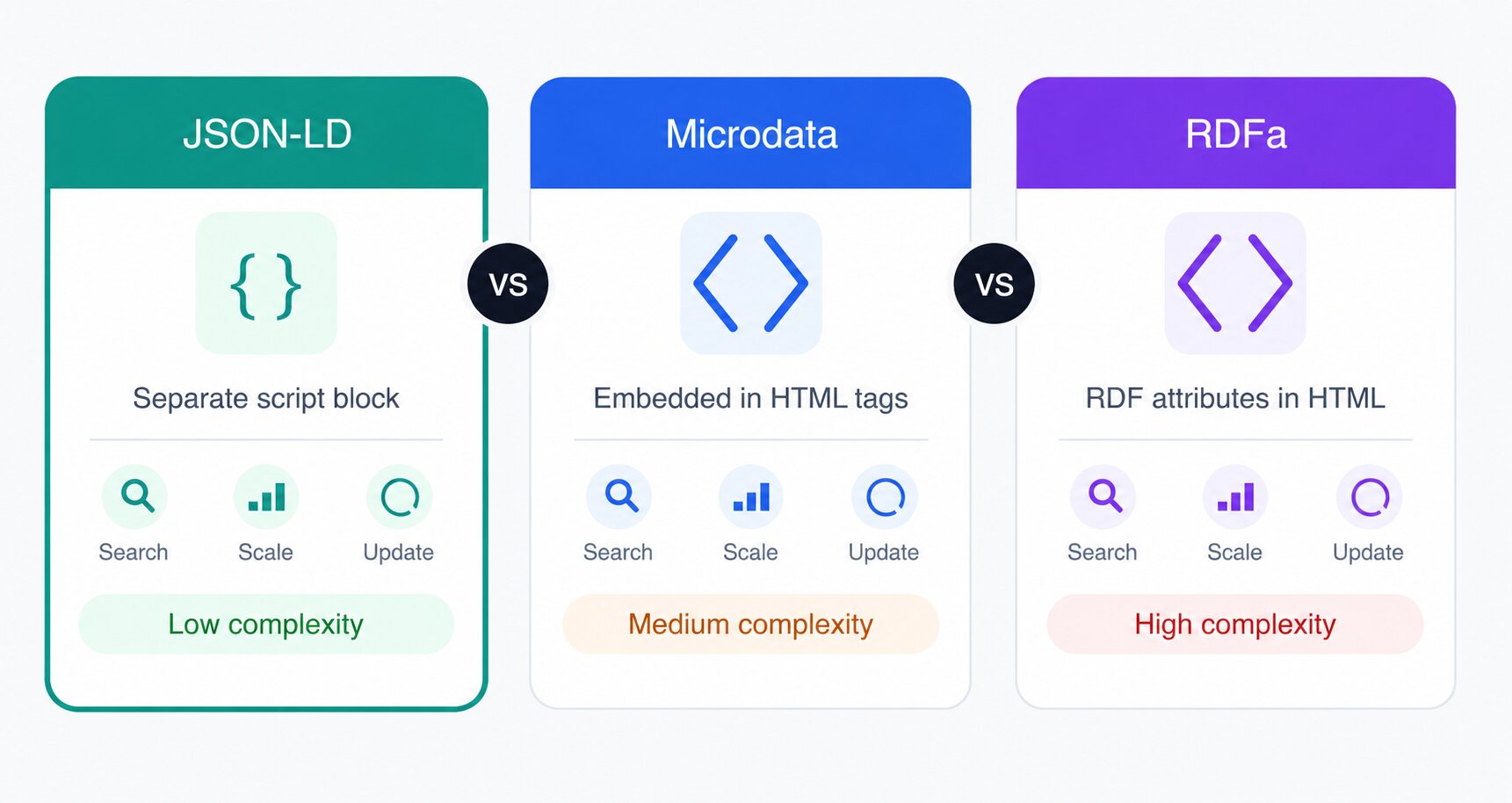
Although all three formats use the same Schema.org vocabulary and are supported by major search engines, they differ in how structured data is implemented on a page. The biggest distinction is where the markup lives, either in a separate script block or directly within the HTML itself.
| Format | How It Works |
|---|---|
| JSON-LD | Stored separately in a script block |
| Microdata | Embedded directly within HTML elements |
| RDFa | Embedded in HTML using RDF attributes |
What Is JSON-LD?
JSON-LD (JavaScript Object Notation for Linked Data) is a structured data format that places schema markup inside a separate script block rather than mixing it into the HTML.
Example of JSON-LD
<script type="application/ld+json">
{
  "@context": "https://schema.org",
  "@type": "Article",
  "headline": "JSON-LD vs Microdata vs RDFa",
  "author": {
    "@type": "Person",
    "name": "John Smith"
  }
}
</script>
Because JSON-LD exists independently from visible page content, developers can update design elements without accidentally breaking structured data. Google explicitly recommends JSON-LD whenever possible because it is easier to implement and maintain.
Advantages of JSON-LD for SEO
- Cleaner code structure
- Easier implementation across CMS platforms
- Simplified maintenance and debugging
- Better scalability for large websites
- Supports complex entity relationships more easily
- Google’s preferred format for structured data implementation
What Is Microdata?
Microdata is an HTML-based structured data format that embeds schema attributes directly within page elements.
Example of Microdata
<article itemscope itemtype="https://schema.org/Article">
  <h1 itemprop="headline">
    JSON-LD vs Microdata vs RDFa
  </h1>
</article>
Unlike JSON-LD, Microdata is tightly connected to the visible HTML content. Every property must be inserted into the markup where the content appears. This approach works well for small projects but can become difficult to manage on larger websites with complex templates.
Advantages of Microdata for SEO
- Direct connection between content and schema
- No separate schema block required
- Works well on static HTML sites
- Supported by Google and other search engines
Limitations
As websites grow, Microdata can clutter HTML code and increase maintenance complexity. Template changes can also unintentionally remove important schema attributes.
What Is RDFa?
RDFa (Resource Description Framework in Attributes) is another method for embedding structured data within HTML. RDFa is more flexible than Microdata and supports broader linked data applications. Historically, it has seen adoption in government, academic, and semantic web projects.
Example of RDFa
<div typeof="Article">
  <h1 property="headline">
    JSON-LD vs Microdata vs RDFa
  </h1>
</div>
Advantages of RDFa Structured Data
- Strong support for linked data ecosystems
- Flexible metadata relationships
- Useful in semantic publishing environments
Limitations
For standard SEO implementations, RDFa often introduces unnecessary complexity. Most modern websites rarely need RDFa’s advanced linked data capabilities.
JSON-LD vs Microdata vs RDFa: Key Differences
| Feature | JSON-LD | Microdata | RDFa |
|---|---|---|---|
| Google Support | Yes | Yes | Yes |
| Google Recommendation | Yes | No | No |
| Implementation Complexity | Low | Medium | High |
| Code Readability | Excellent | Moderate | Moderate |
| Maintenance | Easy | Moderate | Difficult |
| Scalability | Excellent | Fair | Fair |
| Modern CMS Compatibility | Excellent | Good | Limited |
| Linked Data Capabilities | Good | Limited | Excellent |
Google states that all three formats are supported and can qualify for rich results when implemented correctly. However, Google consistently recommends JSON-LD because it is generally easier to implement and maintain.
JSON-LD vs Microdata: Which One Should You Choose?
The JSON-LD vs. Microdata debate often comes down to maintenance. Across ecommerce, SaaS, publishing, and local SEO websites, JSON-LD typically reduces implementation complexity because structured data remains centralized rather than distributed throughout templates.
With Microdata, the schema becomes scattered across templates. A developer updating a product page layout can unknowingly remove critical schema properties.
With JSON-LD, all structured data remains centralized and easier to validate. For modern SEO workflows involving WordPress, Shopify, Webflow, headless CMS platforms, and JavaScript frameworks, JSON-LD is usually the more efficient choice.
RDFa vs JSON-LD: Which Performs Better?
A common misconception is that RDFa vs. JSON-LD affects rankings differently. It doesn’t. Google has clarified that valid implementations of JSON-LD, Microdata, and RDFa are all processed similarly for structured data purposes. The format itself does not provide a ranking advantage.
The real difference lies in implementation quality. JSON-LD often leads to fewer errors because it is easier to manage. As a result, many SEO teams achieve more consistent structured data coverage using JSON-LD.
So while RDFa can technically perform just as well, JSON-LD often wins in practical SEO environments.
Why JSON-LD Is the Preferred Schema Markup Format Today
Modern SEO is no longer limited to traditional search engines. AI-powered search experiences, entity-based indexing, knowledge graphs, and retrieval systems increasingly rely on structured information to understand content.
Structured data helps communicate entities and relationships more clearly across the web ecosystem. JSON-LD aligns particularly well with this shift because:
- It separates content from presentation.
- It supports complex entity relationships.
- It works across modern frameworks and CMS platforms.
- It scales efficiently for enterprise websites.
- It simplifies schema management across thousands of pages.
This is why JSON-LD has become the preferred implementation method among SEO professionals and technical teams.
When Should You Use Microdata or RDFa?
Although JSON-LD is typically the best schema markup format, there are scenarios where alternatives make sense.
Use Microdata When:
- Working with legacy websites
- Maintaining existing Microdata implementations
- Managing static HTML environments where schema and content should remain tightly coupled
Use RDFa When:
- Operating within semantic web projects
- Publishing linked data ecosystems
- Working with government, academic, or research platforms that already support RDFa
For new SEO projects, however, neither Microdata nor RDFa is usually the first choice.
Best Practices for Modern Schema Markup
Regardless of which structured data format you choose:
- Use Schema.org vocabulary.
- Follow Google’s structured data guidelines.
- Ensure schema matches visible content.
- Validate markup using Google’s Rich Results Test.
- Keep structured data up to date as content changes.
- Prioritize accuracy over quantity.
Conclusion
When evaluating JSON-LD vs Microdata vs RDFa, the technical reality is that all three structured data formats are supported by Google and can help search engines understand your content. However, modern SEO is not just about support, it is about implementation efficiency, scalability, and long-term maintenance.
For nearly all new websites, JSON-LD is the best schema markup format. It keeps code cleaner, simplifies schema management, supports complex entity relationships, and aligns with Google’s recommendations. Microdata and RDFa still have valid use cases, but for modern SEO, AI search readiness, and sustainable technical workflows, JSON-LD remains the clear winner.
FAQs
Q1: Is JSON-LD required for schema markup?
No. Google supports JSON-LD, Microdata, and RDFa for many structured data implementations. However, JSON-LD is generally recommended because it is easier to manage, maintain, and validate on modern websites.
Q2: Is JSON-LD better than Microdata for SEO?
For most websites, yes. JSON-LD is easier to implement, maintain, and scale, which reduces the likelihood of schema errors. Google also recommends JSON-LD as its preferred format.
Q3: Does Google support RDFa?
Yes. Google supports RDFa, Microdata, and JSON-LD. Proper implementation matters more than the format itself.
Q4: Which structured data format is recommended by Google?
Google recommends JSON-LD whenever possible because it is easier to implement and maintain.
Q5: Can I use multiple schema markup formats on the same page?
Technically, yes, but it is generally unnecessary and can increase implementation complexity. Consistency is usually the better approach.
Q6: Is Microdata outdated?
No. Microdata is still supported and functional. However, most new SEO implementations favor JSON-LD because it is easier to manage.
Q7: Does schema format impact rankings?
No direct ranking advantage exists between JSON-LD, Microdata, and RDFa. Correct implementation and content quality matter far more.
Q8: Is JSON-LD better for AI search engines?
JSON-LD provides a clean, machine-readable structure that helps communicate entities and relationships. This makes it particularly suitable for modern search ecosystems and AI-driven content understanding.
Q9: What is the best schema markup format for ecommerce websites?
For most ecommerce websites, JSON-LD is the preferred choice due to its scalability, ease of maintenance, and compatibility with major ecommerce platforms.









 Wix Schema
 Squarespace Schema
 BigCommerce Schema
 Shopify Schema
 Hubspot Schema
 Webflow Schema
 GoHighlevel Schema
 Duda Schema
 Weebly Schema
 ClickFunnel Schema