

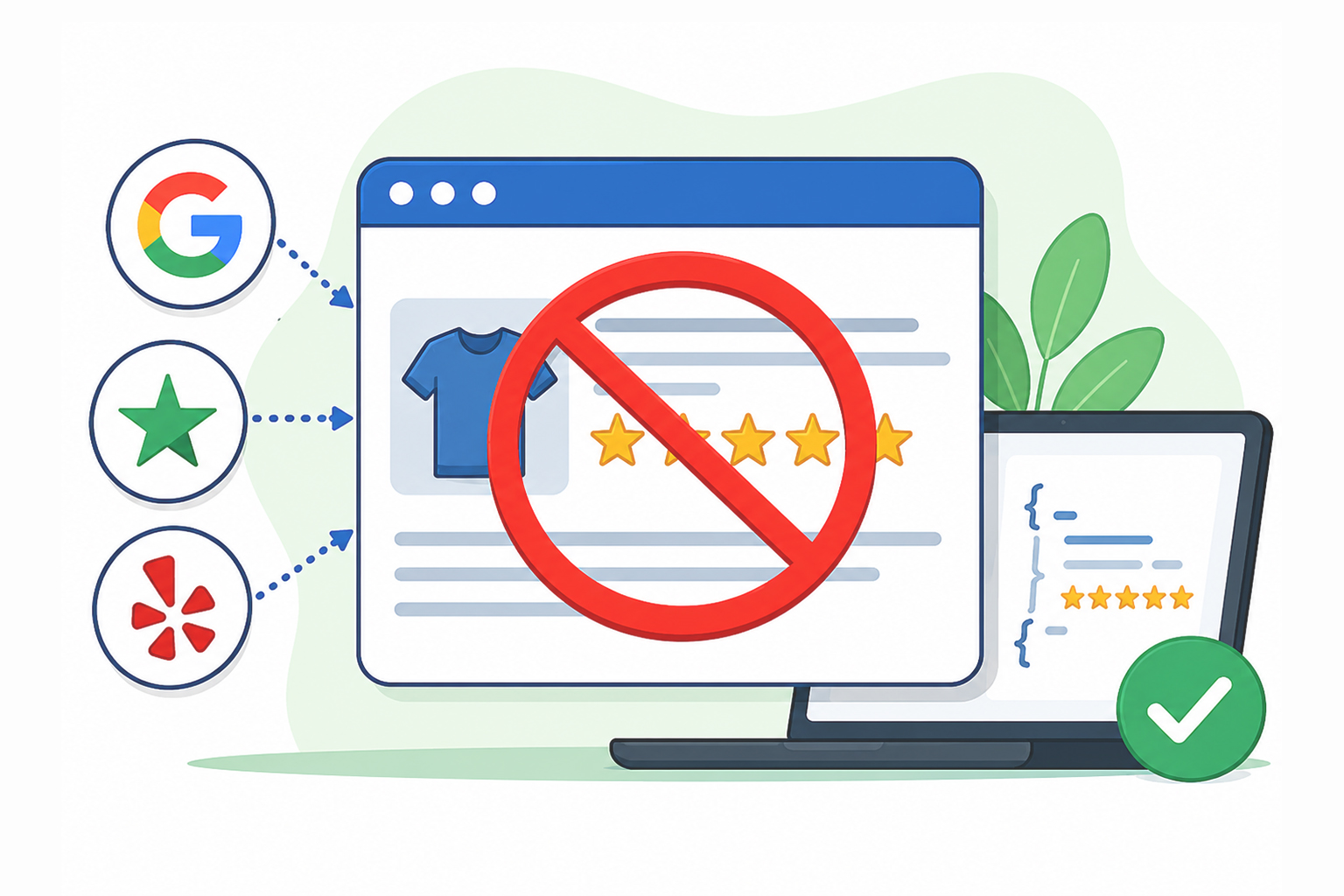
Many businesses collect reviews on Google Business Profile, Trustpilot, Yelp, G2, or Capterra, and at some point, almost every one of them asks the same question: can those ratings be added to schema markup so review stars show up in organic search? It seems like a reasonable shortcut. The reviews are real, the ratings are earned, and the stars would clearly help click-through rate.
The short answer is no, and the reason comes down to where the reviews come from, how they’re displayed, and a specific Google policy most site owners have never read. This article walks through the rules for third-party reviews schema markup, platform by platform, so you know exactly what’s allowed, what gets ignored, and what to do instead.
Which Review Ratings Can You Use in Schema Markup?
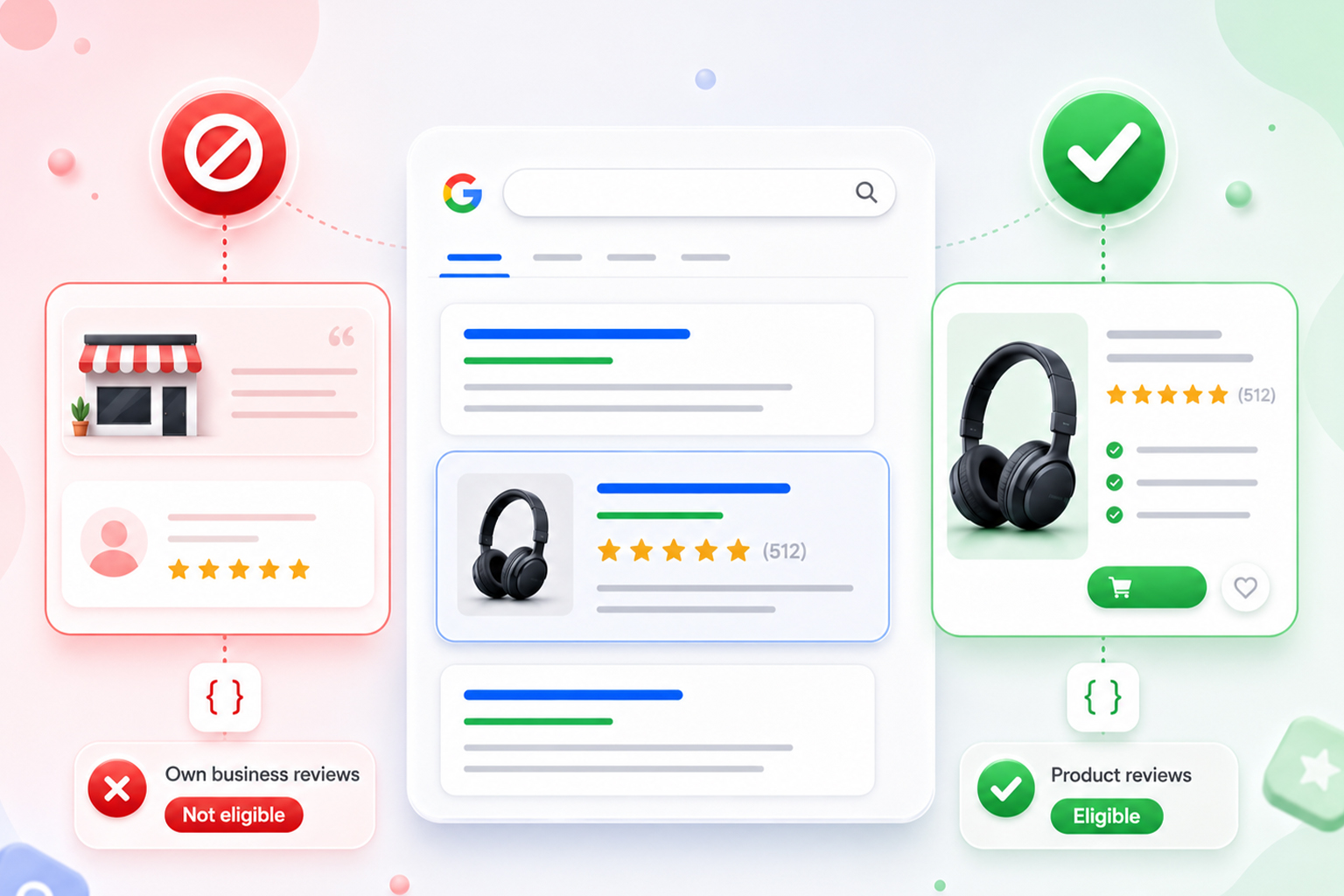
Not every rating can be added to schema markup. Business ratings from external platforms generally don’t qualify, while eligible product reviews can be marked up when they appear on the relevant product page.
| Review Source | Can You Use It in Schema? | Important Notes |
|---|---|---|
| Google Business Profile | No | Marking up your GBP rating on your own site violates the self-serving reviews rule |
| Trustpilot (TrustScore) | No | Company-level scores can’t be copied into your markup; stars appear on Trustpilot’s own pages |
| Trustpilot (product reviews) | Partially | Product reviews collected via Trustpilot and displayed on the matching product page may be eligible when marked up with Product schema. |
| Yelp | No | Blocked by Google’s guidelines and Yelp’s own content licensing terms |
| First-party reviews | Yes | Eligible on supported schema types like Product, with reviews visible on the page |
What Does Google Allow in Review Schema?
Review schema markup exists to describe reviews shown on that specific page, not to import your reputation from around the web. Google’s review snippet documentation draws the boundary with two rules.
Google requires the review information to be available on the marked-up page and says not to aggregate reviews or ratings from other websites. For local businesses and organizations, there is an additional restriction when the entity being reviewed controls the reviews about itself.
That means a genuine 4.8 rating on Trustpilot doesn’t automatically become eligible just because you copy the number into aggregateRating. The source, the item being reviewed, the schema type, and how the review is presented on the page all matter.
Second, your structured data must accurately represent visible content. The reviews you mark up need to appear on the page, with real author names and a rating that matches what visitors see. Markup that misleads Google, inflated counts, invisible reviews, and copied ratings get ignored at best and erode trust in your site’s structured data at worst.
Can You Use Google Business Profile Reviews?
This is the most common version of the question – “can I use Google reviews on my website schema”, and it’s where Google’s self-serving reviews policy applies directly.
In September 2019, Google announced it would stop showing review rich results for LocalBusiness and Organization schema types whenever the entity being reviewed controls the reviews, whether they sit directly in the markup or arrive through an embedded third-party widget, with Google Business review widgets named as an example.
Because Google treats reviews about a business that are placed on that business’s own site as self-serving for this purpose, adding your Google Business Profile rating to your site’s LocalBusiness or Organization markup won’t make those reviews eligible for Google review rich results.
Here’s the distinction that trips people up: displaying Google reviews on your site is fine. Testimonial sections and embedded widgets are legitimate conversion tools. The line is crossed when you wrap that content in Review or aggregateRating schema expecting stars.
Can You Use Trustpilot Reviews?
The answer depends on the review type.
Company-level TrustScore:
No. Adding your Trustpilot company score to Organization or LocalBusiness markup won’t make it eligible for Google review rich results. The rating comes from another website, and the review is about the business using the markup, which falls under Google’s restrictions on self-serving reviews.
Trustpilot confirmed after the 2019 update that company review markup is no longer eligible for review-rich results, even though a third-party platform collected the reviews. Trustpilot ratings earn stars only on Trustpilot’s own profile pages, which often rank for “[brand] reviews” searches.
Trustpilot itself doesn’t make a page eligible; eligibility comes from using valid Product review markup that follows Google’s guidelines.
Product reviews:
Conditionally yes. Product reviews may be eligible when they review the specific product, appear on its page, and follow Google’s review snippet guidelines. Trustpilot alone doesn’t guarantee eligibility.
The self-serving restriction described for LocalBusiness and Organization doesn’t apply in the same way to eligible product review markup. Even with valid implementation, Google decides whether a review rich result appears.
Can You Use Yelp Ratings?
Yelp ratings generally shouldn’t be used as the basis for review rich results for your own business. Google’s self-serving review guidelines are the primary SEO issue. Separately, if you reproduce Yelp review content on your website, you also need to consider Yelp’s current terms and content-use restrictions.
In most cases, the smart move with Yelp is to let its pages do the work. Yelp profiles rank well and display their own stars, so visibility benefits you without any markup on your end.
Can You Use G2, Capterra, Reviews.io, or Yotpo Reviews in Schema?
The pattern that decides eligibility isn’t the platform’s name, it’s whether the platform collects first-party reviews on your behalf or hosts third-party reviews about you.
| Platform | General situation |
|---|---|
| Google Business Profile | Business-level ratings generally aren’t eligible for self-serving review rich results |
| Trustpilot | Company TrustScore isn’t a shortcut to review rich results; product reviews require separate eligibility |
| Yelp | Business ratings generally aren’t a route to self-serving review rich results |
| G2 | Company-level ratings shouldn’t be treated as eligible simply because G2 collected them |
| Capterra | Same principle for company-level ratings |
| Reviews.io | Product reviews may be eligible when Google’s requirements are met |
| Feefo | Product reviews may be eligible when Google’s requirements are met |
| Judge.me | Product reviews may be eligible when Google’s requirements are met |
| Yotpo | Product reviews may be eligible when Google’s requirements are met |
For company-level reviews on a business’s own website, the self-serving restriction is the key limitation. The review platform itself doesn’t override Google’s eligibility rules.
Why Isn’t Google Showing My Review Stars?
Even technically valid markup can produce zero stars. The common reasons, roughly in order of frequency:
- Self-serving reviews: Review markup on Organization or LocalBusiness types where the business controls the reviews about itself.
- Unsupported schema types: Review markup placed on types Google doesn’t recognize for review snippets.
- Invisible reviews: Reviews present in the markup but not actually displayed on the page.
- Inaccurate data: A reviewCount or rating value that doesn’t match the content visitors see.
- Copied ratings: Scores aggregated from Google, Trustpilot, Yelp, or other websites.
- Missing author names: Reviews without a genuine person or profile attached.
- Google’s discretion: Review snippet structured data makes a page eligible, never entitled; the final display call is always Google’s.
If your stars disappeared, work through this list before rewriting anything. For larger sites, continuous schema monitoring catches drift between markup and on-page content before it costs you rich results.
Best Practices for Using Third-Party Reviews in Schema Markup
The compliant playbook is shorter than most guides suggest:
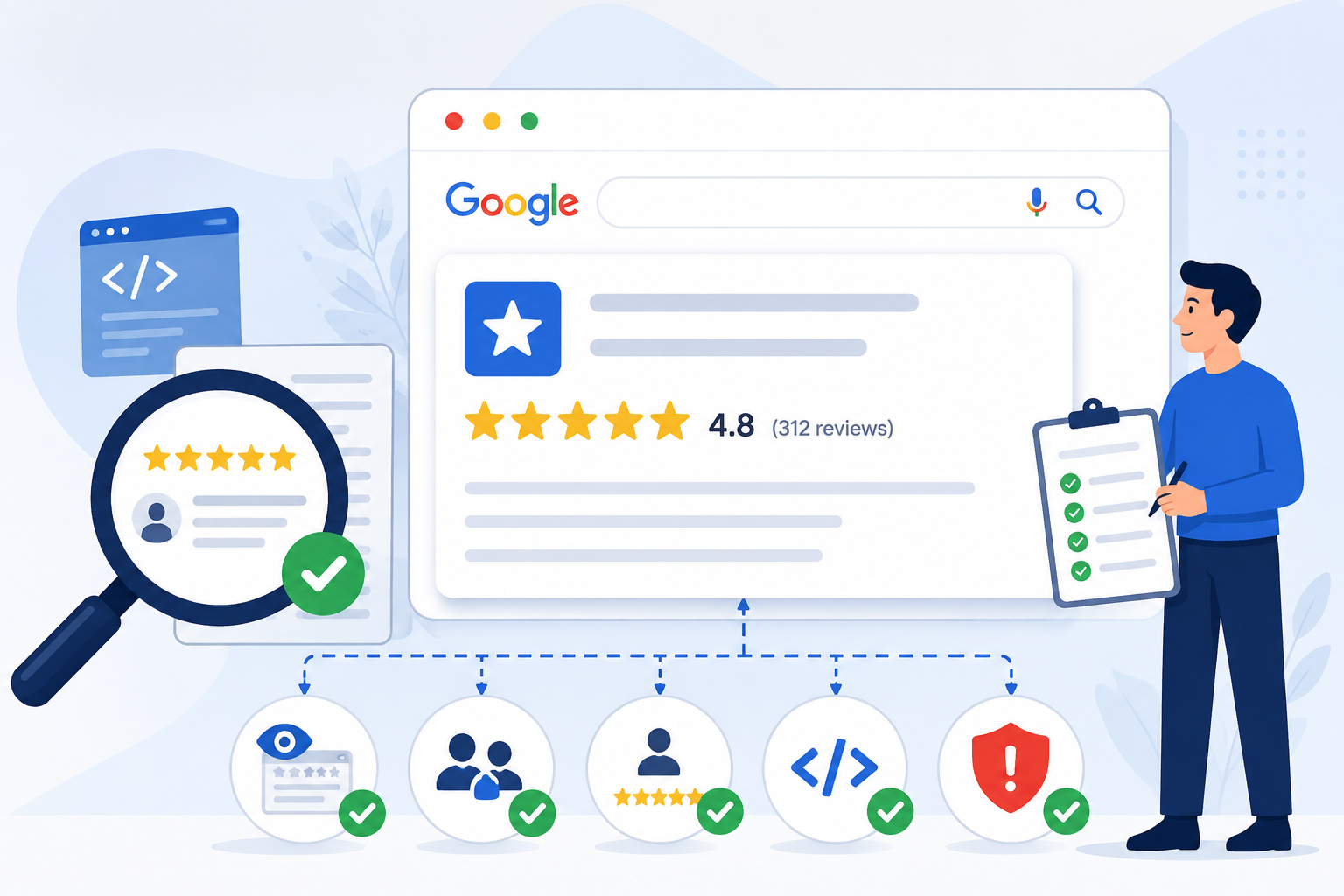
- Show reviews on the page: Mark up only what visitors can actually see, exactly as it’s displayed.
- Collect ratings from your own customers: For ecommerce stores, an eCommerce schema markup tool can generate compliant Product and aggregateRating schema across a full catalog.
- Match markup to your business model: Schema types for SaaS companies differ from what an ecommerce catalog or a service page needs, so use the types built for your pages.
- Keep ratings updated: Refresh values as new reviews accumulate so markup never drifts from reality.
- Use only supported schema types: Use a schema type that is eligible for review snippets and appropriate for the item being reviewed.
LocalBusinessandOrganizationhave additional restrictions when the entity controls the reviews about itself. - Keep up with Google’s latest review guidelines: Google added guidance in July 2026 covering fake and undisclosed incentivized reviews, so review markup should always reflect genuine customer experiences.
- Never fabricate or round up: A 4.6 stays a 4.6.
- Validate after every change: Run updated pages through the Rich Results Test before assuming eligibility.
- Defer to Google’s Review Snippet guidelines: They override any review platform’s marketing claims.
Follow Google’s latest review snippet guidelines, including its requirements around authentic reviews and disclosure of incentivized reviews.
Conclusion
Not every review source works the same way in schema markup. You can’t simply copy a rating from another review platform and expect Google to treat it as eligible review markup. The source matters, but so do the item being reviewed, where the reviews appear, the schema type carrying the markup, and Google’s review snippet guidelines.
Google Business Profile, Trustpilot company scores, and Yelp ratings belong on their own platforms, where they already earn stars. Your markup’s job is narrower and more valuable: accurately represent eligible reviews for the specific item on supported schema types. Get that right, and you’ve done everything within your control, the final display decision always rests with Google.
FAQ
Can I copy my Google Business Profile rating into a schema?
No. That’s the textbook case of self-serving reviews Google’s 2019 update targeted. Your page won’t be eligible for review stars from that markup.
Can I use Trustpilot stars in JSON-LD?
Not your company TrustScore. Product reviews collected through Trustpilot may be eligible for Product markup when they genuinely review the specific product, are displayed on the corresponding product page, and follow Google’s review snippet guidelines.
Will embedding a Trustpilot widget automatically create review rich snippets?
No. An embedded widget showing reviews about your business is still self-serving under Google’s definition, so no company-level stars will appear from it.
Can I use Yelp ratings in Product schema?
Generally, no, for your own business rating. Yelp ratings about your business aren’t a route to review rich results through your site’s self-serving business markup. If you want to reproduce Yelp’s review content on your site, also check Yelp’s current terms before doing so.
Does Google verify review sources?
Google can evaluate whether structured data follows its documented guidelines and whether the marked-up information accurately represents the page. Even valid markup doesn’t guarantee that review stars will appear in Search.
Why aren’t my review stars showing?
Usually one of three things: the markup sits on an ineligible type (Organization/LocalBusiness with self-serving reviews), the marked-up reviews aren’t visible on the page, or the data has drifted from what’s displayed. Validate first, then check eligibility.








 Wix Schema
 Squarespace Schema
 BigCommerce Schema
 Shopify Schema
 Hubspot Schema
 Webflow Schema
 GoHighlevel Schema
 Duda Schema
 Weebly Schema
 ClickFunnel Schema