


Your testimonials are marked up correctly. The Rich Results Test shows zero errors. And Google still refuses to show your review stars. In most cases, this comes down to a single guideline: Google’s self-serving reviews rule.
Since 2019, Google has declined to display star ratings in search results when the entity being reviewed controls the reviews itself. In this guide, we’ll break down exactly what the rule bans, what it leaves untouched, why Google introduced it, and how to earn review stars the compliant way.
Quick Glance at The Self-Serving Reviews Rule
Before we get into the details, here’s the short version of what Google’s self-serving reviews rule covers, who it affects, and what it leaves alone.
| Question | Answer |
|---|---|
| What does it restrict? | Review rich results for reviews about your own business on your own site |
| Which schema types are affected? | LocalBusiness and Organization (and all subtypes) |
| Do third-party review widgets bypass it? | No, embedded widgets count as self-serving too |
| Is Product review schema affected? | No, product reviews remain fully eligible |
| Is it a penalty? | No, the markup is simply ineligible for stars |
| Since when? | September 2019 |
| Why does the rule exist? | To stop businesses from supplying their own star ratings, which made stars unreliable |
| Can I mark up reviews of other businesses? | Yes, the rule only blocks reviews about your own entity |
What Is Google’s Self-Serving Reviews Rule?
Google treats a review as “self-serving” when the business being reviewed is also the one hosting the review on its own website. Picture a plumbing company that gathers glowing testimonials from customers, then adds review markup about itself to its homepage, from Google’s perspective, that markup qualifies as self-serving, no matter how genuine those testimonials are.
The rule arrived in a September 2019 update to review rich results , where Google narrowed the pool of schema types eligible for review snippets and announced that self-serving reviews would no longer trigger star ratings in search results for LocalBusiness and Organization schema types, including all of their subtypes.
What this means is that the restriction isn’t about whether your reviews are real. Your customers may genuinely love you. The rule is about who controls the page the markup lives on. When the reviewed entity controls the reviews on its own site, Google considers the reviews self-serving and does not make that page eligible for review rich results.
What Google’s Self-Serving Reviews Rule Actually Restricts
The Google self-serving reviews rule blocks review stars in one specific scenario: review or AggregateRating markup about your own business, placed on your own website, using LocalBusiness or Organization schema.
That covers more ground than most site owners expect. It includes:
- Testimonials you collected through a form on your own site and marked up with review schema
- An aggregate rating of your business added directly to your homepage’s Organization schema
- Reviews originally gathered on external platforms, then displayed and marked up on your own pages
Separately, Google also requires that ratings come directly from users, editorially compiled or curated ratings for local businesses don’t qualify either.
Do Embedded Review Widgets Count as Self-Serving?
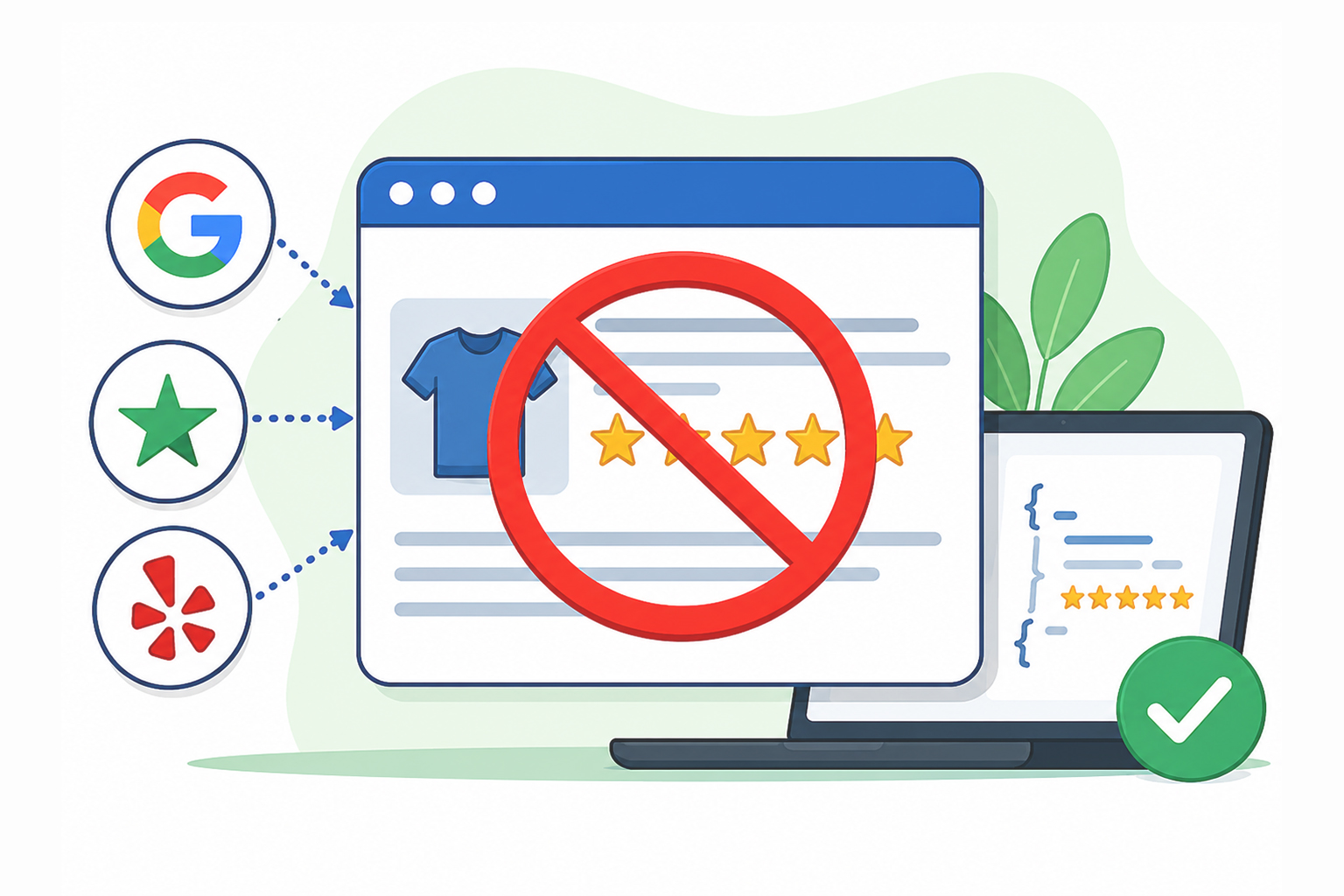
Yes, they do, and this is the misconception that trips up most people. Google’s review snippet documentation is explicit that reviews embedded through third-party widgets, such as a Google Business reviews widget or a Facebook reviews widget, still count as self-serving.
When the rule launched, John Mueller confirmed the same point publicly: it doesn’t matter how the reviews reach your page. If they’re about your business and they’re on your site, the review markup is ineligible for stars.
The reasoning is straightforward. You chose which widget to embed and where. That’s still the entity controlling reviews about itself.
What the Self-Serving Review Rule Doesn’t Ban
Here’s the part many guides bury: the self-serving reviews rule is narrower than it sounds. So if you’re wondering “can I add a review schema to my own website?”, the answer is yes, in the right contexts.
Product Reviews Can Still Qualify
The restriction applies to reviews of your business entity, not reviews of the products you sell. An online store can mark up customer ratings on its product pages, and those pages can still be eligible for review rich results when they meet Google’s review snippet guidelines. The compliant pattern is nesting AggregateRating inside Product schema:
{
"@context": "https://schema.org",
"@type": "Product",
"name": "Organic Green Tea — 50 Bags",
"aggregateRating": {
"@type": "AggregateRating",
"ratingValue": "4.7",
"reviewCount": "132"
}
}
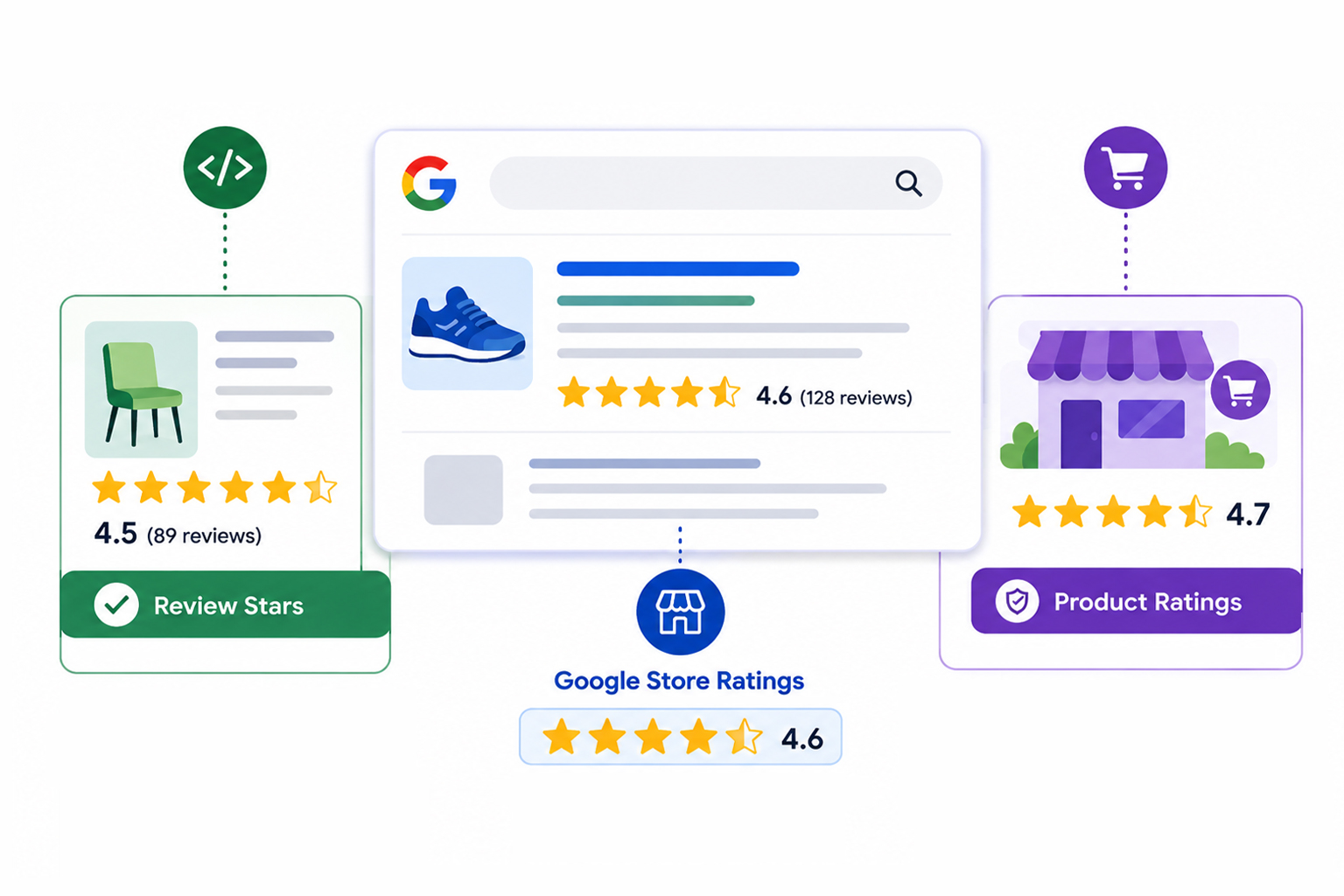
This is exactly how e-commerce stores continue earning star ratings in search results. Implementing product schema markup for e-commerce websites correctly, with valid ratings nested inside each product, is what keeps those stars appearing on store pages after the 2019 change.
Reviews About Other Businesses
The rule targets entity A, reviewing entity A. If your site publishes reviews about other businesses or organizations, such as a directory, comparison site, or review platform, LocalBusiness and Organization review markup can still qualify for review rich results because the reviewed entities don’t control the reviews on your site.
Other Eligible Schema Types
Google still supports review snippets for several eligible types, including Product, Recipe, Movie, Book, Course, SoftwareApplication, and Event, along with other supported schema.org types. You can explore the supported schema types to see which ones fit your pages. The key idea is that review markup didn’t die in 2019, it was scoped.
Why Does the Self-Serving Reviews Rule Exist?
Before 2019, any business could add a hand-picked 5.0 rating to its homepage markup and often watch the stars appear in search. The result was predictable: star ratings in search results stopped meaning much, because the entities being rated were also the ones supplying the ratings.
Google’s position was that self-serving reviews aren’t in the best interest of users, so it removed the incentive entirely. Seen that way, the rule is less a restriction and more a trust filter, stars only appear where an independent party stands between the business and the rating.
What to Do Instead: Compliant Ways to Earn Review Stars
If the self-serving reviews rule applies to your markup, here’s the compliant path forward.
Remove the self-serving review schema
Leaving ineligible markup in place earns nothing, and Google’s structured data guidelines treat markup that misrepresents eligibility as a quality problem. Clean removal is the right call.
Let Google Business Profile carry your business-level reputation
Stars for local businesses still appear in Maps, the local pack, and your Business Profile through Google’s own review system. That pipeline doesn’t depend on schema on your website at all, so it’s the compliant home for ratings about your business.
Mark up what’s still eligible
Product pages, courses, software, events, move your review markup to the entity types Google actually rewards. Keep each review pointed at one clear target; Google clarified in late 2025 that a single review or rating should describe a single “thing,” not several at once.
Validate and monitor
Run your pages through the Rich Results Test and watch the review snippets report in Search Console for invalid items. If you manage schema across many pages, automated schema error detection and auto-fix keep ineligible or broken review markup from lingering.
The payoff justifies the cleanup. Research from Milestone analyzing 4.5 million queries found that rich results attract clicks around 58% of the time versus roughly 41% for standard listings, which is why earning stars the compliant way is worth the effort.
And keep in mind that the self-serving rule is only one possible cause when review stars disappear from your listings, other markup, content, and quality issues can produce the same symptom.
Is There a Self-Serving Review Google Penalty?
Not in the way most people mean. Self-serving review schema doesn’t lower your rankings, Google simply ignores the markup, so your pages are ineligible for the star feature.
That said, structured data that misleads users, such as fake reviews or markup for content that doesn’t exist on the page, can escalate to a manual action against rich results. In most cases, the practical risk of self-serving review markup is wasted effort, not punishment. The clean move is still to remove it.
Conclusion
Google’s self-serving reviews rule draws one clear line: businesses can’t supply the star ratings for their own entity pages. Everything on the other side of that line still works, including product review schema, reviews about other businesses, and the full set of eligible content types.
The practical path forward is to remove self-serving review markup, let Google Business Profile carry your business-level reputation, and point your review schema at the pages where Google still rewards it. Review stars didn’t vanish from search; they moved to where the trust signal holds up.
FAQs
Q1: What are self-serving reviews in SEO?
Self-serving reviews are reviews about a business or organization that appear on that same entity’s website, either directly in its review markup or through an embedded third-party widget. Google makes pages using LocalBusiness or Organization structured data ineligible for review rich-result stars when the reviewed entity controls the reviews.
Q2: Can I still use the review schema on my own website?
Yes. You can use review markup when the content and reviewed entity meet Google’s guidelines. You can mark up eligible reviews of products, courses, software, or other businesses and organizations. What you can’t do is use reviews about your own business or organization to qualify for review rich-result stars.
Q3: Do review stars still show anywhere for local businesses?
Yes. Ratings for local businesses continue to appear in Google Maps, the local pack, and Knowledge Panels through Google Business Profile reviews. That system runs independently of any schema on your website, which is why it remains the primary star surface for local businesses.
Q4: Does embedding a Trustpilot or Google reviews widget make my reviews eligible?
No. Google treats widget-embedded reviews about your own business the same as reviews you collected yourself. The deciding factor is that the reviewed entity controls the page, not where the reviews were originally gathered.
Q5: Will self-serving review markup get my site penalized?
Ineligible review markup on its own doesn’t trigger a ranking penalty; Google just won’t display the stars. Deceptive markup, however, such as fabricated ratings, can lead to a manual action that strips rich results from your site.
Q6: How do I check if my review markup is eligible?
Test the page in Google’s Rich Results Test, then confirm the reviewed entity type. If the target is LocalBusiness or Organization and the reviews are about your own business, the markup is ineligible regardless of what the validator shows, because validators check syntax, not policy.








 Wix Schema
 Squarespace Schema
 BigCommerce Schema
 Shopify Schema
 Hubspot Schema
 Webflow Schema
 GoHighlevel Schema
 Duda Schema
 Weebly Schema
 ClickFunnel Schema