

Search is changing faster than most marketers expected. For years, SEO followed a familiar formula: do your keyword research, build quality backlinks, optimize your title tags, and publish content that actually helps people.
That approach still works. But today, AI-powered platforms like Perplexity and ChatGPT decide what gets shown, cited, and clicked. And at the center of that shift is a debate that’s becoming impossible to ignore: schema markup vs traditional SEO.
Is structured data becoming more important than keyword optimization? Or does traditional SEO still drive rankings? The reality is simple and more important. It’s not about choosing one over the other. It’s about understanding how both work together to shape visibility, clicks, and AI-driven search results in 2026.
What Is Schema Markup, and Why Does It Matter Now?
Before we get into the debate, let’s quickly define what schema markup actually is for anyone newer to the concept.
Schema markup is structured data code, most commonly implemented as JSON-LD structured data, that you add to your website’s HTML to tell search engines what your content means, not just what it says. It’s maintained by Schema.org, a collaborative project founded by Google, Bing, Yahoo, and Yandex. When a search engine reads your page, your words give it raw material. Your schema markup gives it a map.
The payoff? Rich results. Those visually enhanced search listings with star ratings, FAQ dropdowns, product prices, event dates, and review counts. They aren’t magic, they’re the direct output of properly implemented structured data.
For the longest time, schema was a “nice to have”, a small technical edge that made your listings look better. In 2026, that framing is outdated.
The Traditional SEO Foundation: Still Essential, Still Non-Negotiable
Let’s be clear about something before we start comparing. Traditional SEO is not dead. Not even close.
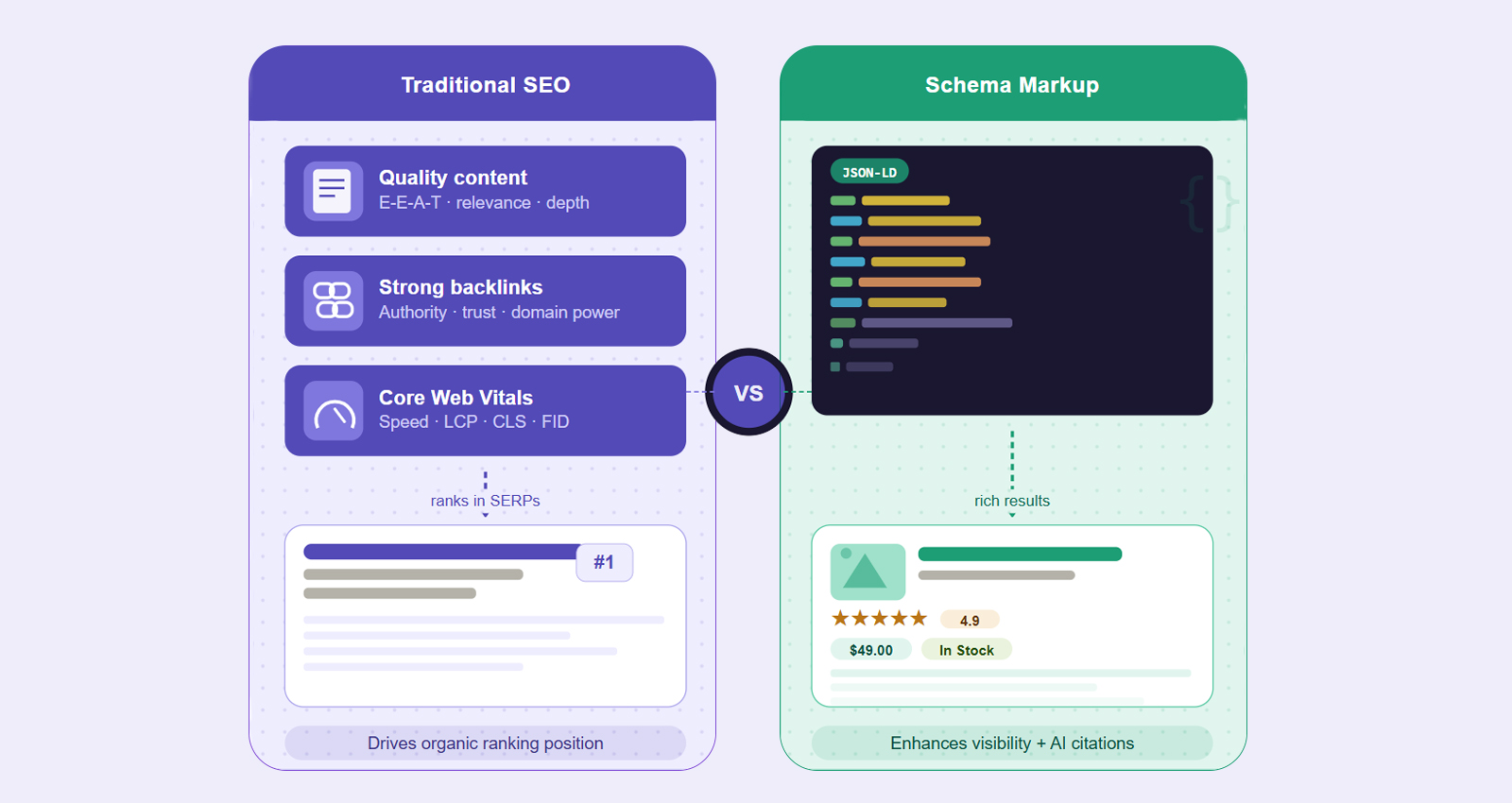
The fundamentals that have always driven rankings, quality content, strong backlinks, fast page speeds, and solid on-page optimization, are still doing the heavy lifting. The data backs this up clearly. According to Search Engine Land, the #1 ranking result on Google has 3.8x more backlinks than pages in positions 2–10. Meanwhile, an analysis of over 100 ranking domains found that 92.3% of top-ranking pages have at least one backlink, while an astonishing 95% of pages on the web have zero backlinks at all.
The pillars of on-page SEO vs technical SEO haven’t been dismantled. If anything, Google’s E-E-A-T signals, experience, expertise, authoritativeness, and trustworthiness have made traditional SEO more important than ever. Google has made E-E-A-T one of the most impactful ranking factors across both traditional and AI-driven search.
So, the question isn’t whether traditional SEO still works. It’s whether it’s sufficient on its own.
Why Schema Markup Has Become a Core SEO Signal in 2026
Schema markup has become a core SEO signal in 2026 because search engines and AI platforms now rely on structured data to understand, verify, and feature content.
The shift is driven by AI-powered search. Google AI Overviews now appear on roughly 30% of search queries, according to The Discoverability Company’s 2026 audit data. Google AI Overviews appear in a significant portion of queries, and platforms like Perplexity, ChatGPT Search, and Gemini are changing how information is selected and presented. These systems don’t just read content, they analyze structured, machine-readable data to decide which sources to trust and cite.
The numbers highlight this shift:
- A study referenced by Outpace SEO found that 71% of pages cited by ChatGPT utilize schema markup. That’s not a coincidence, it’s how AI systems build trust in a source.
- According to Google’s own case studies cited by Sixth City Marketing, pages displaying as rich results saw an 82% higher CTR versus non-rich result pages.
- Rotten Tomatoes independently recorded a 25% CTR improvement for schema-enabled pages versus those without it.
In simple terms, ranking alone is no longer enough. Schema markup helps your content stand out, earn clicks, and get featured in AI-driven results, where a growing share of search visibility now exists.
Schema Markup vs Traditional SEO: A Direct Comparison
Rather than positioning these as opponents, it’s more useful to understand what each one does, and where their strengths differ.
| Factor | Traditional SEO | Schema Markup |
|---|---|---|
| Primary function | Drives organic ranking position | Enhances how results appear + AI visibility |
| Direct ranking factor? | Yes (content, backlinks, Core Web Vitals) | No (indirect via CTR and entity signals) |
| Impact on CTR | Moderate (position-based) | High (up to 82% improvement) |
| AI Overview visibility | Partially (authority + content quality) | Critical (structured data feeds AI citation) |
| Voice search readiness | Limited | High (schema powers voice answers) |
| Effort to implement | Ongoing content and link work | One-time implementation + maintenance |
| Visible to users? | Somewhat (titles, descriptions) | Yes (stars, FAQs, prices in SERPs) |
The key takeaway: traditional SEO gets you into the search results. Schema markup determines how you appear, and increasingly, whether AI systems choose to feature you at all.
How Google AI Overviews Use Structured Data (And Why You Should Care)
How Google AI Overviews use structured data is not a mystery anymore. After Google’s March 2026 core update, Digital Applied’s structured data analysis confirmed that Google’s Gemini-powered AI Mode uses schema markup as a trust verification signal. It uses structured data to verify claims, establish entity relationships, and assess source credibility during answer synthesis.
In other words, when Gemini is deciding which sources to pull from when writing an AI Overview answer, your schema tells it: “This is who we are, what we do, and why you can trust us.” That’s a fundamentally different role than the one schema played three years ago, and it’s why structured data is now widely treated as a baseline requirement, not a competitive advantage.
Google’s Knowledge Graph, which contains over 500 billion facts about five billion entities and feeds directly into Gemini, is partially built from schema data across the web. Your website schema markup is literally how you feed your entity information into that graph.
The JSON-LD Approach: What Best Practice Looks Like in 2026
When it comes to how to implement schema, the format debate is long settled. Google strongly recommends JSON-LD structured data, and for good reason: it sits entirely separate from your visible HTML, making it easy to maintain, update, and validate without touching your page content.
Here’s a simple example of an Organization schema in JSON-LD format:
	<script type="application/ld+json">
	{
	"@context": "https://schema.org",
	"@type": "Organization",
	"name": "Your Company Name",
	"url": "https://www.yourwebsite.com",
	"logo": "https://www.yourwebsite.com/logo.png",
	"contactPoint": {
	"@type": "ContactPoint",
	"telephone": "+1-000-000-0000",
	"contactType": "customer service"
	}
	}
	</script>
This goes in the <head> of your HTML document, or, on CMS platforms, is injected via a dedicated schema markup app.
The most impactful schema types in 2026, based on ROI and rich result eligibility, are:
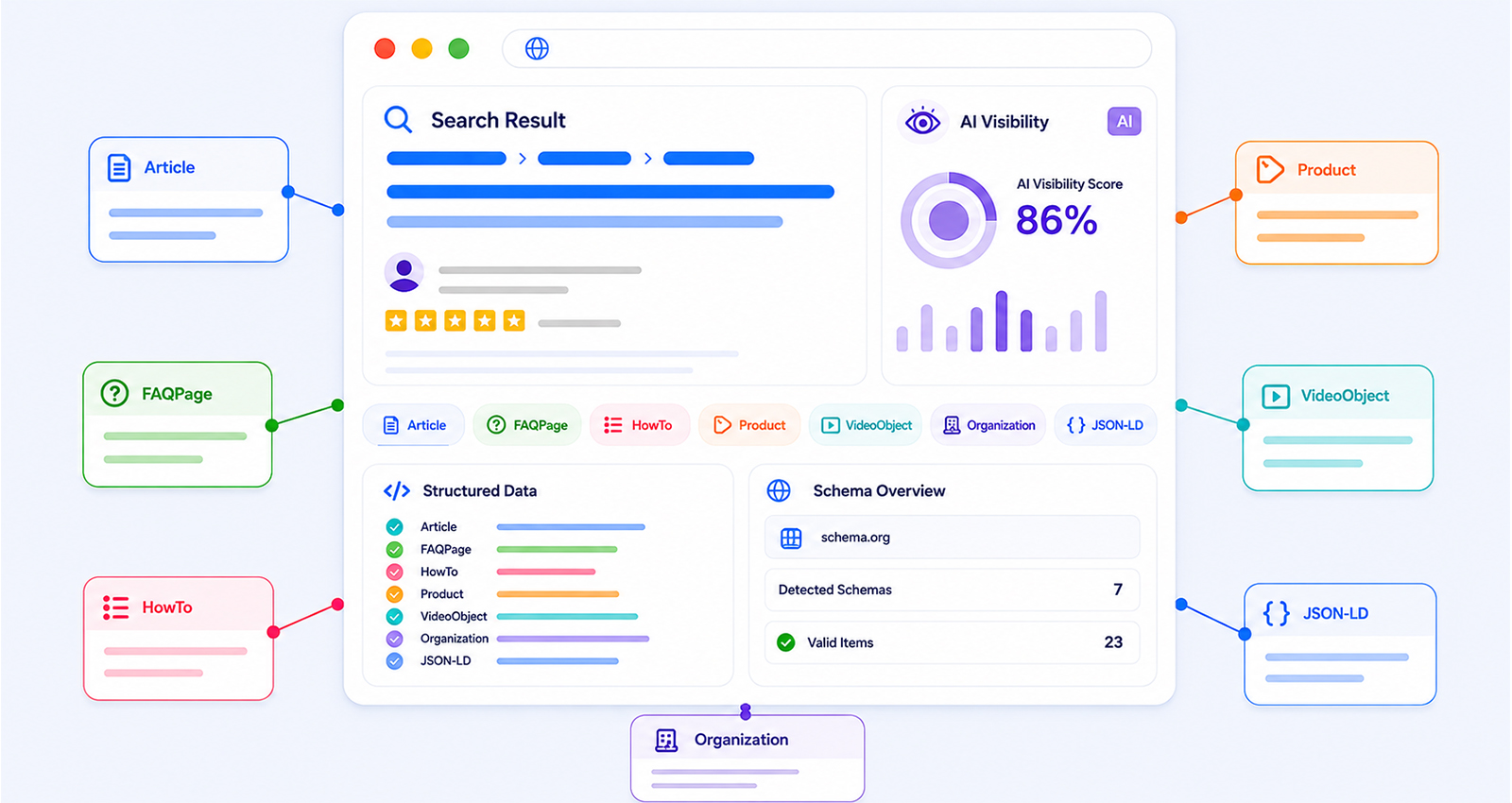
- Article / BlogPosting – for content-heavy pages
- Product – essential for e-commerce (pricing, availability, reviews)
- FAQ – triggers expandable dropdowns in SERPs, boosts CTR significantly
- LocalBusiness – critical for local SEO visibility and AI citation
- Organization – establishes entity identity for Google’s Knowledge Graph
- HowTo – powers voice search and instructional rich results
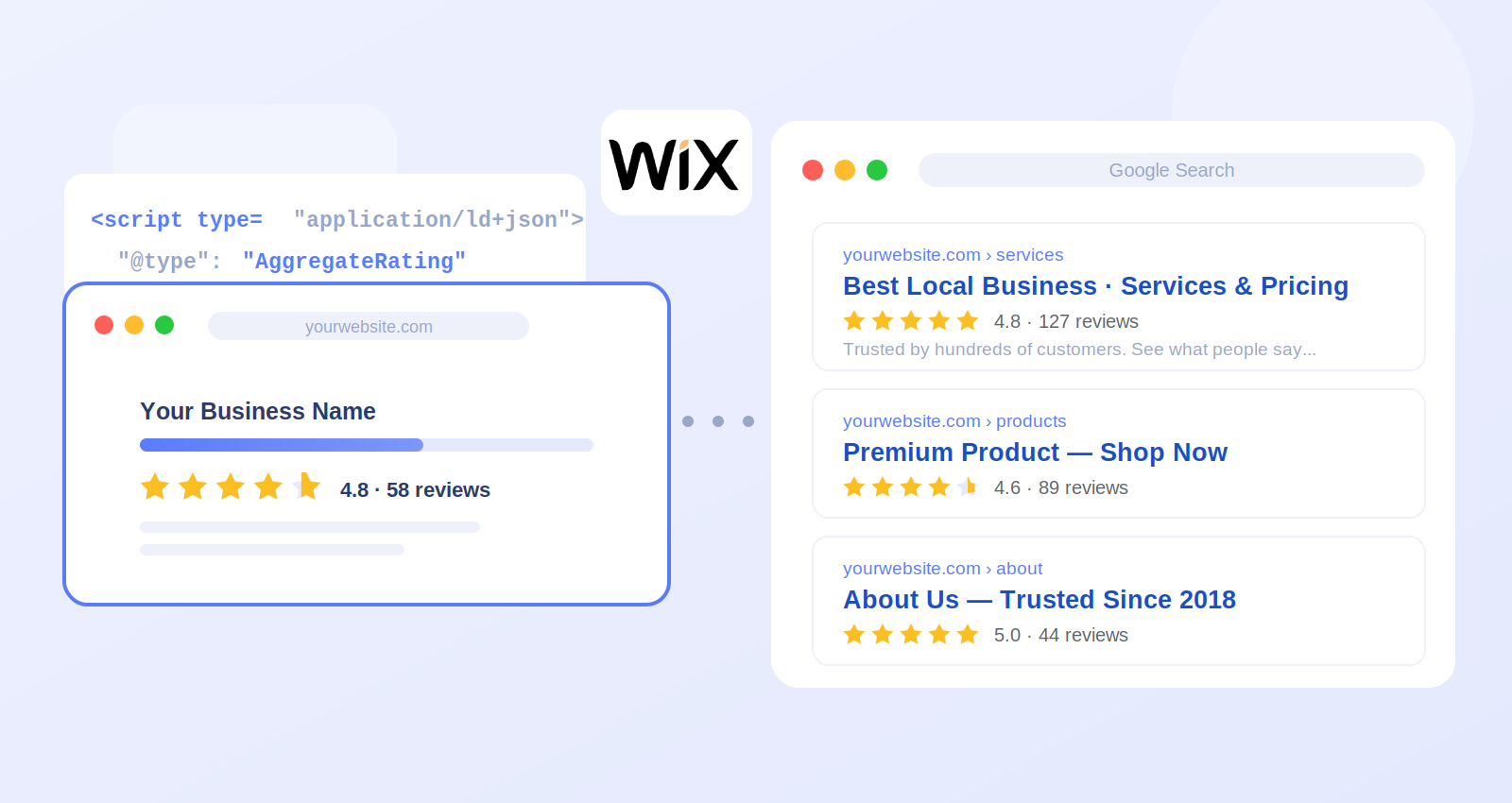
- Review / AggregateRating – displays star ratings in results
One important note following Google’s March 2026 core update: FAQ and How-To schema on pages where that content isn’t genuinely the primary focus saw reduced rich result eligibility. Schema needs to accurately represent what’s actually on the page, a mismatched or manipulative implementation now carries real risk.
Validate Before You Launch: Why This Step Gets Skipped Too Often
One of the biggest mistakes people make is implementing a schema and never checking whether it actually works. Google won’t show rich results from schema with errors, and it won’t always tell you immediately when something breaks.
The right workflow is straightforward:
- Build your schema using a reliable schema markup tool or AI schema markup generator that validates as you go.
- Test with Google’s Rich Results Test before deploying.
- Use a JSON-LD schema validator (or a dedicated schema markup validator tool) to check for missing required fields, format errors, and eligibility issues.
- After deploying, monitor the Enhancements section of Google Search Console monthly. This is where rich result impressions and CTR data lives.
If you’re looking for tools to simplify this process, a good schema markup tool can dramatically reduce implementation time, especially for sites with many page types. A well-designed schema markup generator will walk you through the required and recommended fields for each schema type, reducing errors and missed opportunities.
The Combined Strategy: How to Win Both Games in 2026
The schema markup vs traditional SEO framing is really a false choice. The teams winning in search right now are doing both, and doing both well.
Here’s how to think about it:
Traditional SEO establishes your authority and relevance. This means publishing genuinely useful, well-researched content; earning quality backlinks from authoritative sources; maintaining strong Core Web Vitals; and demonstrating E-E-A-T signals across your site and your brand’s presence on the open web.
Schema markup amplifies that authority into visibility. Once you’ve earned a strong ranking position, structured data is what converts that position into a high-CTR rich result, and what makes your content eligible for AI Overview citations, voice search answers, and featured snippets.
Think of it this way: traditional SEO gets you a seat at the table. Schema markup makes sure you’re speaking the language everyone at that table understands.
Conclusion
The schema markup vs traditional SEO debate isn’t about choosing one. Traditional SEO helps you rank, while schema markup improves how your result appears and gets clicked. In 2026, both are essential. Without SEO, you won’t rank. Without a schema, you may miss visibility in rich results and AI-driven search experiences.
FAQs
Q1: Is schema markup a direct Google ranking factor?
No. Schema markup isn’t a direct ranking factor, but it improves CTR, enhances content understanding, and enables rich results and AI visibility. These indirect benefits can significantly impact traffic and overall search performance.
Q2: Can schema markup replace traditional SEO?
No. Schema markup cannot replace traditional SEO. It helps search engines understand content, but rankings still depend on quality content, backlinks, and technical SEO. Schema works best when built on a strong SEO foundation.
Q3: How do I validate my JSON-LD structured data?
Use Google’s Rich Results Test to check eligibility. A JSON-LD schema validator helps identify errors and missing fields. After deployment, monitor Google Search Console’s Enhancements report to track performance and fix issues.
Q4: Does schema markup help with AI search platforms?
Yes. Schema markup helps AI platforms understand and trust your content. Structured data improves chances of being cited in AI-generated answers by clearly defining entities, relationships, and key information for machine-readable processing.
Q5: What is JSON-LD and why does Google prefer it?
JSON-LD is a structured data format added via a script tag. Google prefers it because it’s easy to implement, doesn’t affect page content, and simplifies updates while keeping structured data clean and separate from HTML.
Q6: Is keyword research still important in 2026?
Yes. Keyword research remains essential for understanding user intent. While keyword density matters less, it helps structure content around topics and search behavior, making it critical for both traditional and AI-driven SEO strategies.








 Wix Schema
 Squarespace Schema
 BigCommerce Schema
 Shopify Schema
 Hubspot Schema
 Webflow Schema
 GoHighlevel Schema
 Duda Schema
 Weebly Schema
 ClickFunnel Schema