

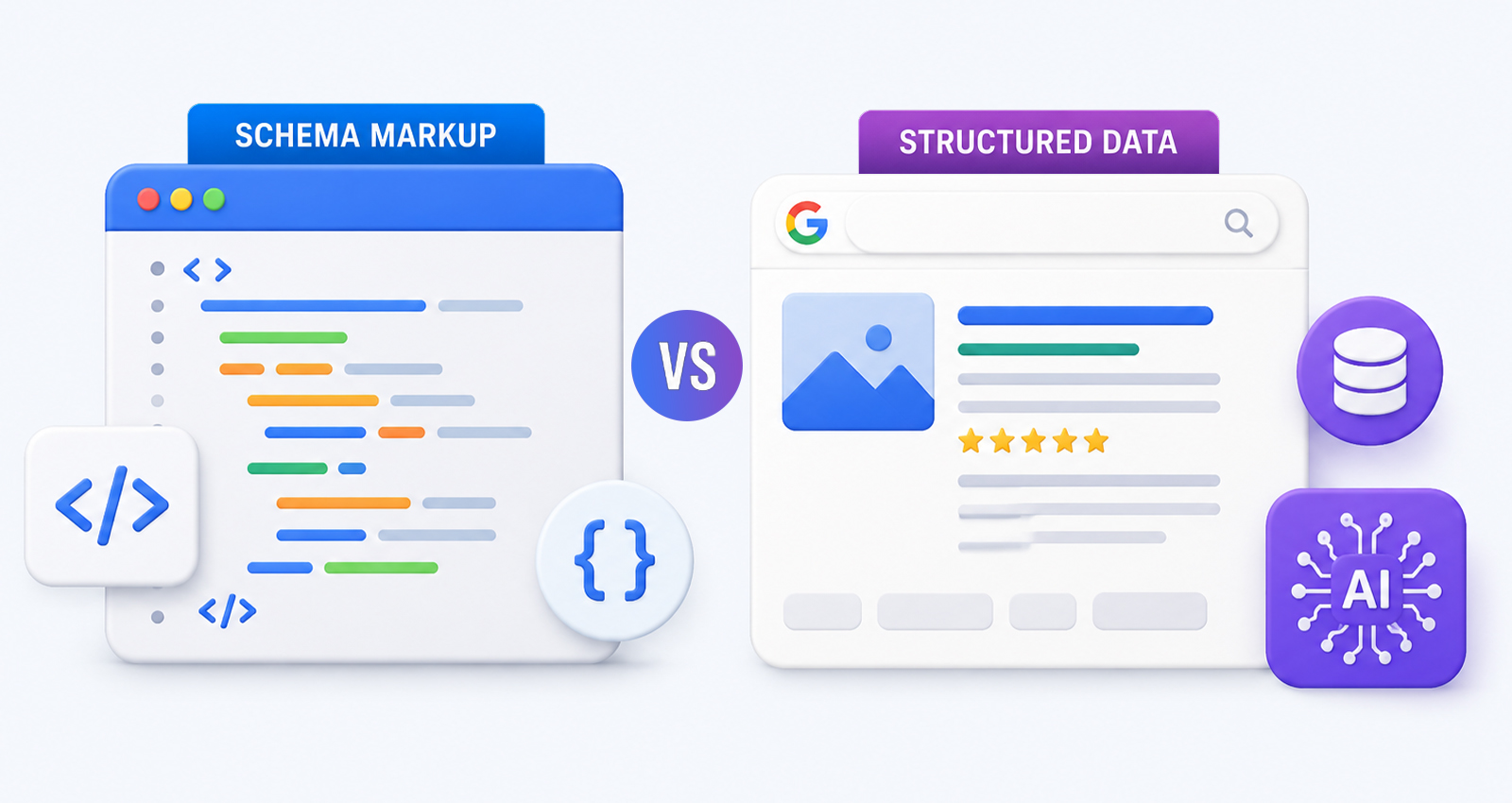
Search engines no longer just read content, they interpret it. They identify entities, understand relationships, and increasingly rely on AI to deliver precise answers. This evolution has made structured data and schema markup essential components of modern SEO.
If your content lacks structured clarity, search engines may still index it, but they won’t fully understand it. And if they don’t understand it, they can’t present it effectively in rich results or AI-driven experiences.
This is where the confusion often begins, Schema Markup vs Structured Data. They are closely related, but not the same. Understanding the difference is critical if you want better visibility, higher click-through rates, and stronger performance in both traditional and AI-powered search.
What Is the Difference Between Schema Markup vs Structured Data?
Structured data is the format used to organize information, while schema markup is the vocabulary used to define and label that information.
Structured data provides the overall structure that makes content machine-readable, but on its own, it doesn’t define meaning. That’s where schema markup comes in. Using the standardized vocabulary from Schema.org, schema markup assigns clear definitions to each piece of data, such as identifying whether something is a product, review, article, or event.
In practical terms, structured data ensures your content is organized, while schema markup ensures it is understood correctly by search engines like Google. Together, they eliminate ambiguity and improve how your content is interpreted, indexed, and displayed.
To make this difference clearer, here’s a simple comparison:
| Aspect | Structured Data | Schema Markup |
|---|---|---|
| Definition | A standardized format for organizing data | A vocabulary used to define structured data |
| Purpose | Makes content machine-readable | Gives meaning to the structured data |
| Scope | Broad concept | Specific implementation |
| Example | JSON-LD, Microdata formats | Article, Product, FAQ schema types |
| Managed By | General data structuring principles | Schema.org |
Think of structured data as the framework, and schema markup as the language used within that framework.
Search engines like Google rely on both working together. Without structured data, your content lacks organization. Without schema markup, it lacks meaning.
What Is Structured Data in SEO?
Structured data in SEO is a machine-readable format that helps search engines understand the meaning and relationships within your content.
Instead of relying on guesswork, structured data explicitly tells search engines what your content represents. It transforms unstructured text into clearly defined information.
Why Structured Data Matters
Structured data for search engines goes beyond simple organization, it directly influences how your content is processed, interpreted, and presented in search results.
By adding structured data, you help search engines understand the context of your content instead of relying on assumptions. This clarity enables features like rich results, knowledge panels, and enhanced listings, which improve visibility and user engagement.
It also ensures consistency in how your content is interpreted across different platforms, including search engines, voice assistants, and AI systems. In short, structured data acts as a foundation for both SEO performance and AI-driven discoverability.
Common Structured Data Examples
You encounter structured data examples regularly in search results:
- Product listings showing price, availability, and ratings
- FAQ sections appearing directly in SERPs
- Articles with author and publish date
- Events with time, date, and location
These enhancements increase visibility and improve user engagement by making results more informative.
What Is Schema Markup in SEO?
Schema markup is the code added to your website that implements structured data using a standardized vocabulary. Schema markup, developed through Schema.org, ensures that search engines interpret your data consistently.
How Schema Markup Works
Schema markup works by embedding structured information into your website, typically using JSON-LD structured data.
Here’s how the process works:
- You define the type of content (e.g., Article, Product)
- You assign properties (e.g., author, price, rating)
- You format it using JSON-LD
- Search engines read and interpret the structured layer
This process removes confusion. For example, a number like “4.7” becomes a clearly defined rating instead of just a random value.
Schema Markup vs Structured Data for Google Rich Results
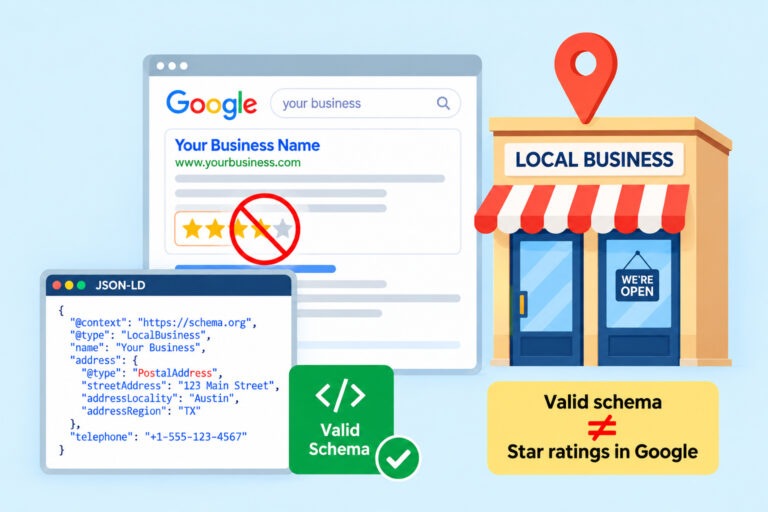
Structured data enables rich results, while schema markup powers and activates them. Rich results are enhanced listings that include additional visual or interactive elements. These features are highly valuable because they increase visibility and attract more clicks.
Examples of Rich Results
- Star ratings for products and reviews
- FAQ dropdowns in search results
- Breadcrumb navigation
- Recipe details with cooking time
Search engines such as Google use schema markup to determine eligibility for these features.
Validation Tools You Should Use
To ensure your structured data works correctly, validation is essential:
Without proper validation, your schema may be ignored. Without proper validation, your schema may be ignored.
These tools not only detect errors but also highlight warnings and eligibility issues, helping you refine your markup for better chances of appearing in rich results.
Schema Markup vs JSON-LD: What’s the Relationship?
JSON-LD is the most recommended format for implementing schema markup. Schema markup can be implemented using multiple formats, but JSON-LD structured data is widely preferred, especially by Google. The reason is its simplicity and flexibility.
Unlike Microdata or RDFa, JSON-LD does not require embedding markup directly into HTML elements. Instead, it allows you to add structured data as a separate script, making it easier to manage, update, and scale across your website.
This separation reduces errors and improves maintainability, which is why most modern schema markup generators and tools default to JSON-LD.
Comparison of Schema Formats
| Format | Ease of Use | SEO Recommendation | Flexibility |
|---|---|---|---|
| JSON-LD | High | Recommended | High |
| Microdata | Medium | Supported | Moderate |
| RDFa | Low | Less common | Complex |
JSON-LD stands out because it keeps your HTML clean and allows easier updates. Most schema markup generators and JSON-LD schema generator tools default to this format.
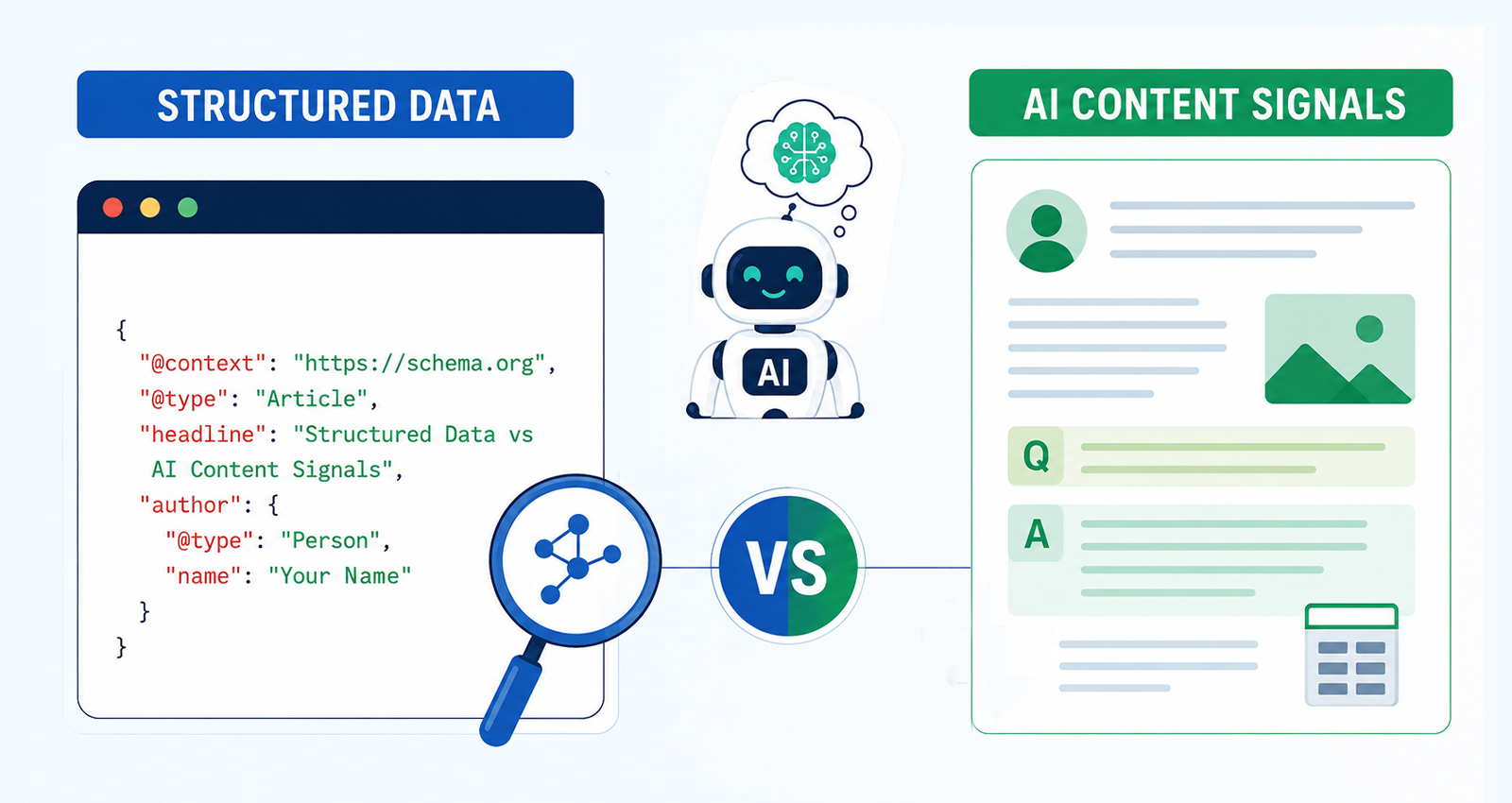
Why Schema Markup and Structured Data Matter for AI Search
They help AI systems understand entities, context, and relationships, making your content more discoverable and usable.
AI-driven search focuses on meaning, not just keywords. Structured data plays a key role in this transformation.
How Schema Supports AI
- Identifies entities like people, products, and organizations
- Defines relationships between entities
- Improves contextual understanding
- Enhances AI-generated answers and summaries
Without structured data, your content may still rank, but it is less likely to be deeply understood or featured in AI-driven results.
Key Benefits of Schema Markup for SEO
Schema markup improves visibility, enhances search listings, and strengthens content understanding.
When implemented correctly, schema markup does more than just support SEO, it enhances how your content appears and performs in search results. It helps search engines interpret your content more precisely and present it in a way that attracts attention.
Schema Markup Benefits
- Enhanced visibility: Rich snippets such as ratings, FAQs, and product details make your listings stand out in crowded SERPs
- Higher CTR: More informative and visually appealing results naturally attract more clicks
- Better understanding: Search engines can clearly interpret your content’s meaning, improving relevance
- AI readiness: Structured data supports voice search, assistants, and AI-generated answers
- Semantic SEO: Strengthens entity-based optimization and improves topical authority
A well-implemented website schema markup strategy gives you a competitive advantage without requiring changes to your core content, it simply makes that content easier to understand and showcase.
How to Implement Schema Markup (Step-by-Step)
Schema markup can be implemented using tools, generators, or manual coding, depending on your technical expertise and scale. Here’s the step-by-step process:
1. Choose the right schema type
Start by identifying the purpose of your page. Whether it’s an article, product, FAQ, or business listing, selecting the correct schema ensures relevance and eligibility for rich results.
2. Generate schema code
Use a reliable schema markup tool or app to create accurate code without manual errors. These tools simplify implementation and ensure your markup aligns with search engine requirements.
3. Add the code to your website
Insert the JSON-LD structured data into the <head> section of your page or implement it via your CMS or plugin. This keeps your markup clean and separate from visible content.
4. Validate your markup
Always test your implementation using:
- Schema markup validator
- Google Rich Results Test
Validation ensures your schema is error-free and eligible for rich results.
5. Monitor performance
Use Google Search Console to track impressions, clicks, and enhancements. This helps you measure the real impact of structured data on your SEO.
Common Mistakes to Avoid
Avoid incorrect or misleading schema implementations to maintain SEO performance and eligibility for rich results.
Key Mistakes
- Mismatch between schema and content: Adding markup that doesn’t reflect visible content can lead to ignored or penalized schema
- Skipping validation: Even small errors can break your structured data
- Using outdated schema types: Unsupported or deprecated schema types reduce effectiveness
- Overloading pages: Adding excessive or irrelevant schema can dilute clarity
Focusing on accuracy, relevance, and proper validation ensures your structured data delivers real SEO value.
Conclusion
Schema Markup vs Structured Data is not just a technical distinction, it’s a strategic advantage.
Structured data organizes your content, while schema markup defines it clearly. Together, they help search engines and AI systems interpret, enhance, and present your content more effectively.
As search continues to evolve toward AI-driven experiences, implementing structured data is no longer optional. It’s a foundational step toward better visibility, stronger engagement, and long-term SEO success.
FAQs
Q1: Is schema markup the same as structured data?
No, they are closely related but not the same. Structured data is the format that organizes content, while schema markup is the vocabulary that defines and labels that structured data for search engines.
Q2: What is schema markup in SEO?
Schema markup is code added to your website that helps search engines understand your content more clearly. It uses standardized definitions to describe elements like products, articles, and reviews.
Q3: What is structured data in SEO?
Structured data is a machine-readable format that organizes information so search engines can interpret its meaning, relationships, and context more accurately.
Q4: Does structured data improve rankings?
Structured data does not directly impact rankings, but it improves visibility through rich results, which can increase click-through rates and indirectly support SEO performance.
Q5: What is the best format for schema markup?
JSON-LD structured data is the preferred format recommended by Google because it is easier to implement and maintain.
Q6: How do I validate schema markup?
You can validate your schema using tools like Schema Markup Validator and Google Rich Results Test to ensure your markup is correct and eligible for enhancements.
Q7: What are rich results?
Rich results are enhanced search listings that display additional information such as ratings, FAQs, and product details, making them more engaging and informative.
Q8: Why is schema markup important for AI search?
Schema markup helps AI systems understand entities and relationships within your content, improving how it is interpreted and used in AI-driven search experiences.






 Wix Schema
 Squarespace Schema
 BigCommerce Schema
 Shopify Schema
 Hubspot Schema
 Webflow Schema
 GoHighlevel Schema
 Duda Schema
 Weebly Schema