

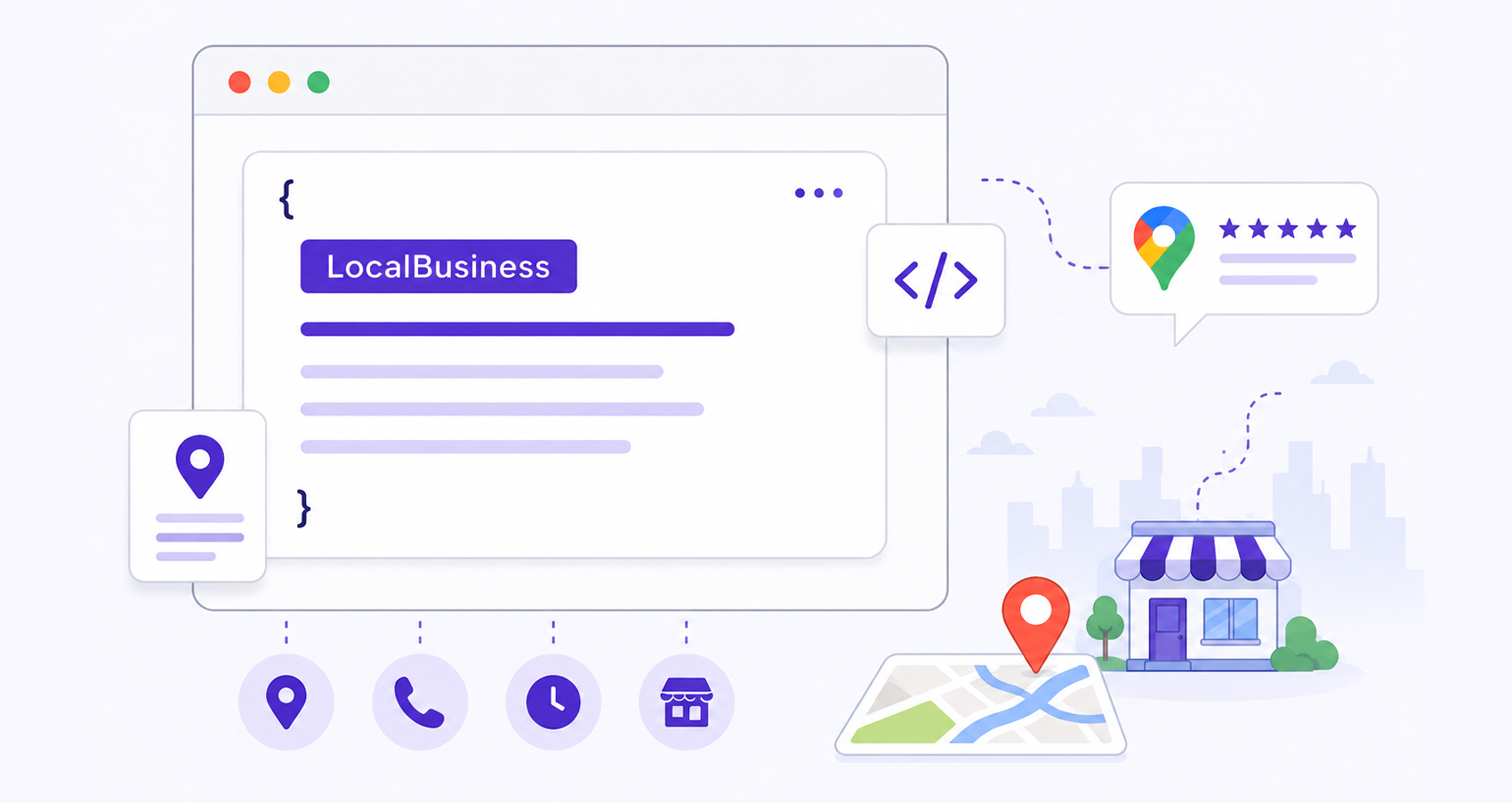
When business owners think about how to show up in Google Maps, most focus on reviews, citations, and their Google Business Profile. Those elements are important, but many overlook a foundational piece of local SEO, the local business schema for maps visibility.
Local Business schema gives search engines structured information about your company in a format they can easily understand. Instead of relying solely on page content, Google can read clearly defined business details and use them to better interpret your location, services, and relevance for local searches.
As Google continues improving how it understands businesses, locations, and their relationships, implementing Local Business schema helps reinforce the consistent information Google looks for when connecting your website with local search and Google Maps.
The Role of Local Business Schema in Google Maps Visibility
Local Business schema helps Google better understand and verify important information about your business. While it does not directly boost Google Maps rankings, it strengthens the data signals that support local search visibility.
| How Local Business Schema Helps | Impact on Google Maps Visibility |
|---|---|
| Provides structured business information | Helps Google accurately interpret your business details |
| Reinforces your name, address, and phone number (NAP) | Improves consistency across local search signals |
| Connects your website with your Google Business Profile | Strengthens entity recognition and trust |
| Clarifies business category and services | Helps Google determine relevance for local searches |
| Includes location and service area information | Supports geographic targeting and local discovery |
| Reduces ambiguity in business data | Makes it easier for Google to verify business information |
In short, the Local Business schema helps search engines better understand your business, making it easier for Google to connect your website with your local presence and build confidence in the information it uses for local search and Google Maps.
What Is Local Business Schema?
Local Business schema is a structured data type that helps search engines understand exactly who you are, where you’re located, and what your business offers. It uses the standardized vocabulary provided by Schema.org to present business information in a format that search engines can interpret more accurately than regular webpage content.
For example, while a visitor can easily find your address, phone number, and business hours on a contact page, search engines may need additional context to identify and connect those details confidently. Local business schema provides that context by labeling important information in a structured way. It typically includes:
- Business name
- Address
- Phone number
- Website URL
- Business category
- Opening hours
- Geographic location
- Service information
Google states that Local Business structured data can provide information such as business hours, departments, reviews, and location details, helping search engines better understand and process your business information.
Think of it as a standardized business information sheet attached to your website that search engines can read instantly.
Why Structured Data Matters for Local Search
Search engines rely on information from multiple sources to understand local businesses, but business details are not always presented consistently across websites. Structured data helps solve this problem by organizing important information in a standardized format that search engines can easily interpret.
For local businesses, structured data provides additional context about who you are, where you operate, and what services you offer. This makes it easier for Google to connect your website with your Google Business Profile and other local signals, reducing ambiguity and improving its overall understanding of your business.
The clearer that understanding is, the more confidently Google can evaluate your relevance for local searches and map results. For businesses with a physical location, Local Business schema is one of the most important schema types for strengthening local SEO signals because it provides clear information about business identity, location, and services.
Why Google Needs Clear Business Information for Maps Visibility
Google’s local ranking system primarily evaluates three factors:
- Relevance
- Distance
- Prominence
These factors determine which businesses appear in local search results and map listings. The challenge is that Google first needs to understand exactly:
- What your business does
- Where your business is located
- Whether your website and business profile refer to the same entity
Google doesn’t rely on a single source to understand your business. Instead, it compares information from your website, your Google Business Profile, trusted business directories, customer reviews, and structured data to build a more complete understanding of your business.
When these sources consistently describe the same business, Google can connect them with greater confidence, making it easier to understand your business and present accurate information in local search and Google Maps.
This is where schema markup for Google Maps visibility becomes valuable. Structured data reduces ambiguity and provides clear business information that complements other local SEO signals.
How Local Business Schema Supports Maps Visibility
Google Maps visibility depends on how accurately Google understands your business. Local Business schema reinforces key business details, helping search engines connect your website with your local presence and improve business understanding.
Improves Business Information Accuracy
One of the biggest challenges in local SEO is inconsistent business data across websites. If your website, Google Business Profile, and directory listings show slightly different information, Google may have less confidence in your business details.
Local business structured data provides a consistent source of truth directly on your website. It reinforces your:
- Business name
- Address
- Phone number
- Website URL
The more consistently this information appears across the web, the easier it is for Google to trust and verify your business.
For example, if your website lists one phone number while a business directory lists another, Google may have difficulty determining which information is correct. Consistent schema markup helps reinforce the information you want search engines to trust.
Helps Google Associate Your Website With Your Business Profile
Google Business Profile and your website work together in local search.
When you implement schema markup for a local business, you help Google connect:
- Your website
- Your physical location
- Your Google Business Profile
This strengthens entity recognition and reduces confusion, especially for businesses with similar names or multiple locations.
Supports Better Local Relevance Signals
Google evaluates how well a business matches a user’s search intent.
Local Business schema can include:
- Business type
- Services
- Operating hours
- Location information
These details help search engines understand whether your business is relevant to a particular local query. Relevance remains one of Google’s core local ranking factors.
Enhances Knowledge Graph Understanding
Google increasingly relies on entities and relationships rather than simple keyword matching. Schema markup helps define your business as a recognized entity with clear attributes.
This improved understanding can contribute to:
- Knowledge panel accuracy
- Business information consistency
- Better local search interpretation
While schema alone does not improve Google Maps rankings directly, it helps Google understand your business more accurately and connect it with other trusted local signals.
Key Local Business Schema Properties That Support Maps Visibility
For an effective local SEO schema, include as many accurate business details as possible.
| Schema Property | Why It Matters |
|---|---|
| Business Name | Identifies your business entity |
| Address | Confirms physical location |
| Phone Number | Supports contact consistency |
| Website URL | Connects website and business profile |
| Opening Hours | Improves business information accuracy |
| Business Category | Clarifies relevance |
| Geo Coordinates | Provides location precision |
| Service Area | Helps define coverage regions |
Google recommends providing complete and accurate LocalBusiness properties wherever applicable.
Does Local Business Schema Directly Improve Google Maps Rankings?
This is one of the most common misconceptions in local SEO. Local business schema for maps visibility is not a direct ranking factor in the same way as reviews, distance, or prominence are. However, it contributes indirectly by helping Google:
- Understand your business better
- Verify business information
- Connect local SEO signals
- Reduce ambiguity
A useful way to think about schema is that it improves interpretation rather than acting as a standalone ranking boost. Even Google’s documentation emphasizes that structured data helps Google understand content and business details more effectively.
Common Mistakes That Limit Google Maps Visibility
Many businesses implement schema incorrectly and unintentionally create conflicting signals. Common issues include:
- Incorrect business addresses
- Outdated phone numbers
- Missing opening hours
- Using the wrong business category
- Marking up information that does not appear on the page
- Inconsistent NAP (Name, Address, Phone) information
These inconsistencies can reduce trust and make it harder for Google to confidently interpret business information. For businesses managing multiple locations, keeping structured data synchronized across all location pages becomes especially important.
Conclusion
Local business schema for map visibility helps search engines interpret your business information with greater accuracy, making it an important part of a modern local SEO strategy.
By clearly defining your location, contact information, business category, and operational details, Local Business schema strengthens the foundation of your local SEO efforts.
When combined with a well-optimized Google Business Profile, consistent citations, and strong customer engagement, it can contribute to better Google Maps visibility and a stronger local search presence overall.
FAQs
Q1. How do I get my business to appear in Google Maps?
Create and verify a Google Business Profile, provide complete business information, maintain consistent NAP details across the web, gather customer reviews, and implement Local Business schema on your website.
Q2. Does Local Business schema help with Google Maps visibility?
Yes. While it is not a direct ranking factor, Local Business schema helps Google understand and verify your business information, supporting overall Google Maps visibility.
Q3. Why isn’t my business showing up in local search results?
Common reasons include an unverified Google Business Profile, incomplete business information, weak local SEO signals, inconsistent citations, insufficient prominence, or strong local competition.
Q4. What business details should be included in the Local Business schema?
Include your business name, address, phone number, website URL, opening hours, business category, and location information whenever applicable.
Q5. Can incorrect schema markup hurt local search visibility?
Yes. An incorrect or misleading schema can create inconsistent business signals and may prevent search engines from trusting the information on your website.








 Wix Schema
 Squarespace Schema
 BigCommerce Schema
 Shopify Schema
 Hubspot Schema
 Webflow Schema
 GoHighlevel Schema
 Duda Schema
 Weebly Schema