

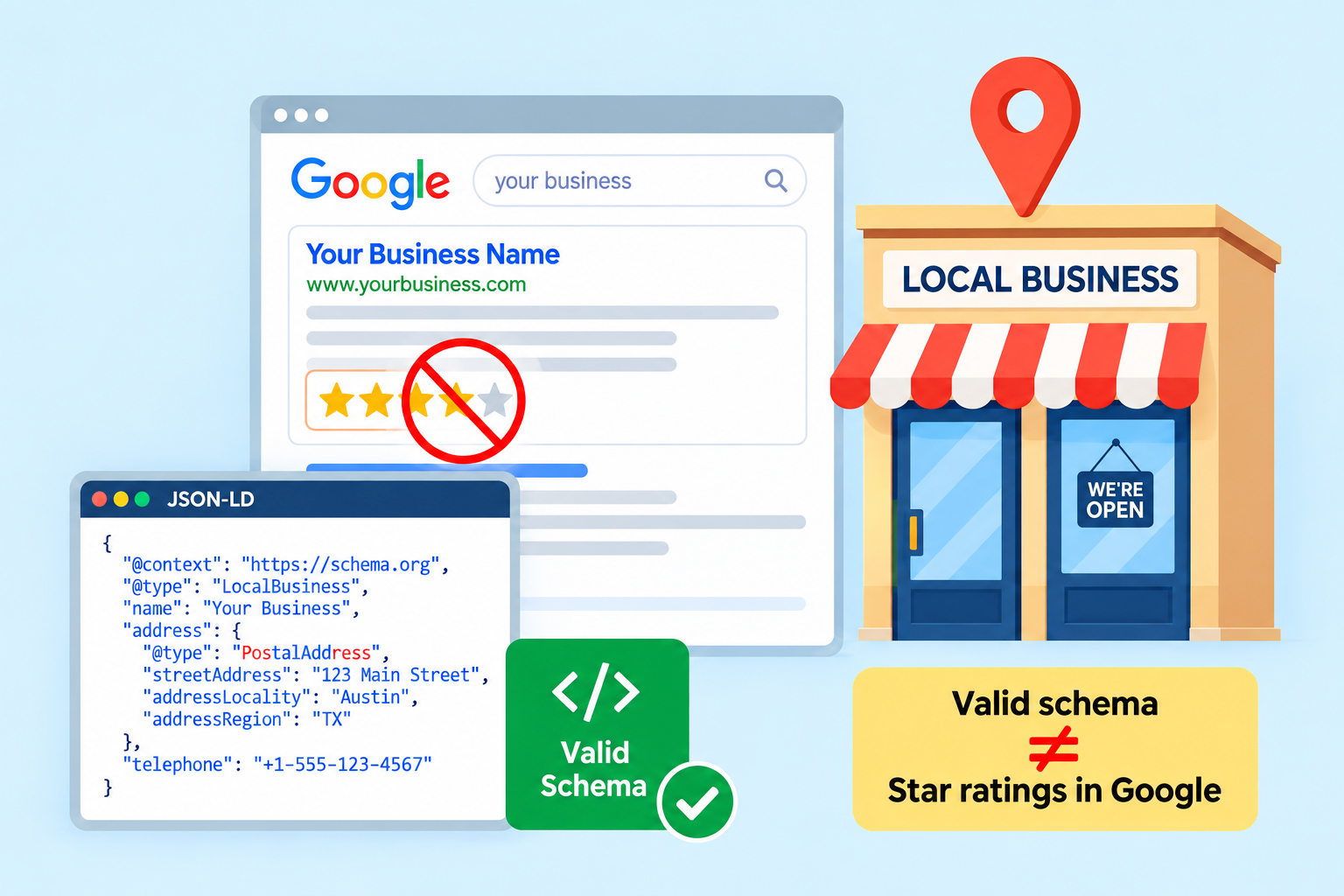
Many local businesses believe that adding LocalBusiness review schema is all it takes to earn star ratings in Google Search. They carefully implement structured data, validate their JSON-LD, and wait for review stars to appear. Then nothing happens.
The reason isn’t usually a technical mistake. It’s a misunderstanding of Google’s review eligibility rules. In 2019, Google significantly changed how it treats review markup on LocalBusiness pages, making many previously valid implementations ineligible for review rich results.
Understanding this distinction can save hours of debugging and help you implement schema markup for local business correctly from the start.
Can LocalBusiness Schema Generate Star Ratings in Google Search?
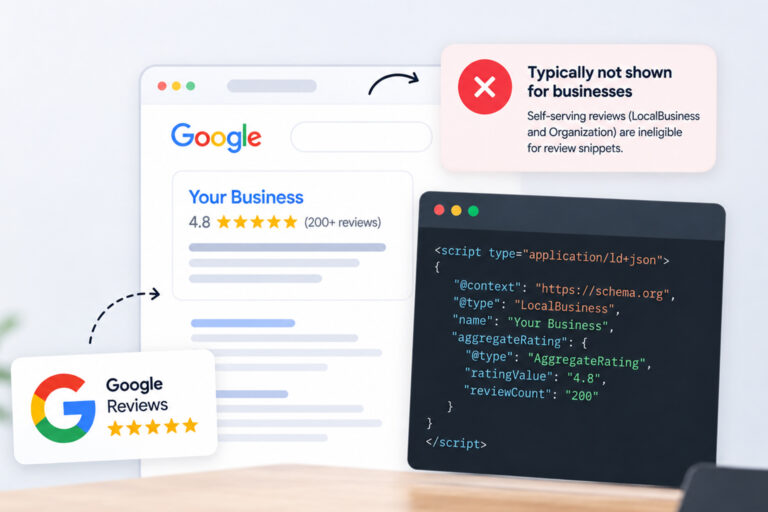
Usually, no. Google generally doesn’t display LocalBusiness schema star ratings when a business marks up reviews about itself on its own website. Although the structured data may be valid under Schema.org, Google’s self-serving reviews policy makes most LocalBusiness review markup ineligible for review rich results.
| LocalBusiness Schema & Star Ratings | Quick Answer |
|---|---|
| Can LocalBusiness schema show star ratings? | Usually no. Self-serving business reviews aren’t eligible for review snippets. |
| Why aren’t my star ratings showing? | Valid schema doesn’t guarantee review rich results. |
| Is LocalBusiness schema still useful? | Yes. It helps search engines understand your business. |
| Can I use AggregateRating? | Yes, but Google may ignore it for self-serving reviews. |
| What’s the biggest mistake? | Expecting valid schema to automatically generate star ratings. |
| What should I focus on? | Accurate structured data and Google’s review guidelines. |
What Is LocalBusiness Schema?
LocalBusiness schema markup is structured data based on Schema.org vocabulary that helps search engines understand important information about a business, including:
- Business name
- Address
- Phone number
- Opening hours
- Website
- Geographic location
- Business category
Most websites implement this using JSON-LD, Google’s recommended structured data format.
Here’s a simplified example:
{
"@context": "https://schema.org",
"@type": "LocalBusiness",
"name": "Example Dental Clinic",
"address": {
"@type": "PostalAddress",
"streetAddress": "123 Main Street",
"addressLocality": "Austin",
"addressRegion": "TX"
},
"telephone": "+1-555-123-4567"
}
This markup helps Google better understand your business information. However, it does not automatically qualify your website for star ratings.
Why LocalBusiness Schema Star Ratings Usually Don’t Appear
This is the rule that many businesses miss. Before 2019, many websites added LocalBusiness aggregateRating and reviews directly to their own homepage. Search results often displayed review stars.
Google later updated its review markup guidelines to reduce misleading review snippets. Today, when a business marks up reviews about itself on its own website, those reviews are generally considered self-serving and are no longer eligible for review rich results.
This means:
- The schema can still be technically valid.
- The page is usually not eligible for Google review stars.
This distinction between valid Schema.org markup and Google eligibility causes much of the confusion around LocalBusiness schema star ratings.
Understanding Google’s Self-Serving Reviews Rule
Google defines self-serving reviews as reviews that a business controls about itself on its own website. For example:
- A restaurant adding customer reviews to its homepage
- A dental clinic marking up testimonials on its About page
- A law firm using review markup for reviews hosted on its own domain
Even if those reviews are genuine, Google generally does not display them as review-rich results. This policy applies to most review schema for local business implementations.
Google introduced this change to improve search quality and prevent businesses from influencing search snippets with reviews they control.
Schema.org Validation vs. Google’s Review Schema Eligibility
One of the biggest misconceptions is believing that Schema.org rules and Google Search rules are identical. They are not.
| Schema.org | Google Search |
|---|---|
| Defines structured data vocabulary | Defines eligibility for rich results |
| Allows LocalBusiness with AggregateRating | May ignore review stars because of review eligibility rules |
| Valid schema can pass validation | Valid schema may still not earn rich results |
This is why your LocalBusiness schema reviews may validate perfectly while producing no visible star ratings. Understanding this difference helps avoid unnecessary debugging.
Can You Use AggregateRating With LocalBusiness Schema?
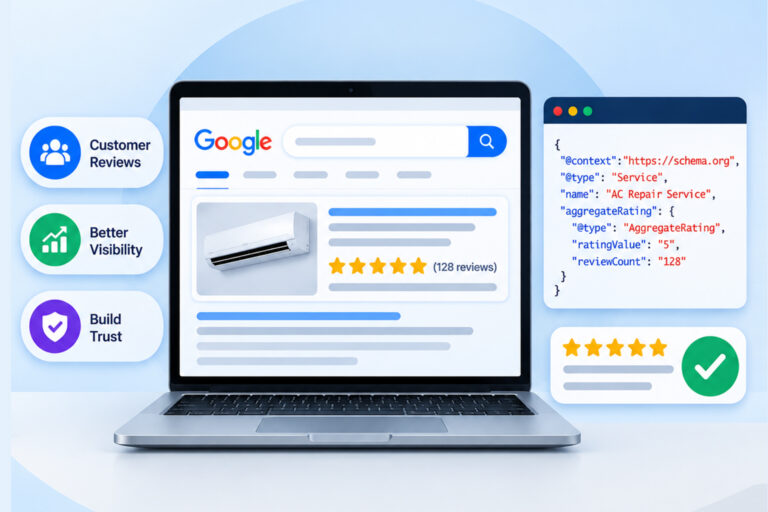
Many businesses ask whether they should remove LocalBusiness aggregateRating entirely. Schema.org still supports aggregateRating for LocalBusiness, but that does not make the page eligible for Google’s review rich results.
However, Google’s review rich result guidelines determine whether that markup can qualify for review stars in Search.
For example:
{
"@type": "AggregateRating",
"ratingValue": "4.8",
"reviewCount": "268"
}
This markup is valid structured data. But if those ratings describe your own business on your own website, Google will generally not display review stars in search results.
That is why LocalBusiness aggregateRating is not the same as guaranteed rich snippets.
When Can Review Rich Results Still Appear?
Although Google’s self-serving reviews policy limits LocalBusiness schema star ratings, review rich results are still available for many other eligible content types. In these cases, the review is about a specific item rather than the business itself, making it eligible under Google’s review markup guidelines when all requirements are met.
Common examples include:
- Products
- Books
- Software applications
- Recipes
- Courses (where supported)
- Movies
For example, an e-commerce store can add Product review schema to an individual product page, or a recipe website can mark up user ratings for a recipe. These pages review a distinct item, not the organization publishing the content, which is why they may qualify for review snippets.
Because review eligibility varies by schema type, it’s important to understand which schema types can actually generate Google star ratings. This distinction explains why some pages qualify for review rich results while others remain ineligible despite having valid structured data.
Common Mistakes Businesses Make
Most issues with LocalBusiness schema star ratings aren’t caused by invalid code, they stem from incorrect assumptions about Google’s review rich results eligibility. These are the mistakes local businesses make most often.
Assuming Valid Schema Means Eligible Rich Results
Validation tools only confirm that your structured data follows Schema.org syntax. They do not determine whether Google will display star ratings. Eligibility and validity are different concepts.
Marking Up Testimonials
Businesses often mark up testimonials as reviews. Even genuine customer testimonials typically fall under Google’s self-serving reviews schema policy when they describe the business hosting them. If you’re planning dedicated testimonial pages, it’s also worth understanding when review markup is appropriate.
Using Third-Party Reviews Incorrectly
Embedding Google Business Profile reviews or reviews from another platform does not make a business eligible for review rich results. Google can still treat these as self-serving reviews when the business controls the page, and the reviews are about that business.
Chasing Star Ratings Instead of Structured Data Quality
Many websites focus only on earning stars. In reality, Google LocalBusiness schema is useful beyond review snippets because it helps search engines better understand:
- Business identity
- Location
- Contact information
- Opening hours
- Geographic relevance
These signals support broader search understanding even when review stars aren’t displayed.
Best Practices for LocalBusiness Schema Markup
If your goal is long-term SEO rather than short-term rich snippets, follow these best practices.
Keep Business Information Accurate
Ensure every property matches visible page content. Avoid discrepancies in addresses, business names, or phone numbers.
Use JSON-LD
Google continues to recommend JSON-LD because it separates structured data from page content and is easier to maintain.
Follow Google’s Review Markup Guidelines
Before adding any review markup, confirm that your implementation satisfies Google’s review schema eligibility requirements rather than only Schema.org syntax. Google’s guidance evolves over time, so reviewing the official documentation periodically is worthwhile.
Validate Your Structured Data
Use both:
- Schema.org Validator
- Google’s Rich Results Test
Remember: Passing both tools confirms technical correctness, not guaranteed review stars.
Choose the Correct Schema Type
Many websites use LocalBusiness when another schema type better represents the content.
For example:
- Product pages → Product schema
- Software pages → SoftwareApplication
- Service pages → Service schema
Using the correct schema type improves your chances of qualifying for the appropriate rich results.
LocalBusiness Schema Helps Even Without Star Ratings
It’s easy to think LocalBusiness schema star ratings are the primary reason to implement structured data. They aren’t.
Structured data still helps search engines understand:
- Who you are
- Where you’re located
- What services you offer
- How customers can contact you
- Your business category
These signals contribute to Google’s understanding of your business, even when no review snippet appears in search.
In other words, schema markup remains valuable because its primary purpose is improving machine understanding, not simply generating visual enhancements.
Conclusion
The biggest misunderstanding surrounding LocalBusiness schema star ratings isn’t about coding, it’s about eligibility.
Many businesses spend time debugging perfectly valid structured data when the real limitation comes from Google’s self-serving reviews policy. While LocalBusiness review schema remains useful for describing your business, it shouldn’t be implemented with the expectation of earning review stars on your own business pages.
The most effective approach is to use accurate JSON-LD, follow Google’s review markup guidelines, choose the correct schema type for each page, and treat structured data as a way to improve search understanding rather than as a shortcut to rich results. Doing so creates a stronger technical foundation while keeping your implementation aligned with current search guidance.
Frequently Asked Questions
Q1: Does LocalBusiness schema automatically generate star ratings?
No. Adding LocalBusiness schema markup alone does not make a page eligible for star ratings. Google also evaluates its review rich results eligibility rules.
Q2: Why did my LocalBusiness review stars disappear?
Google’s self-serving reviews update removed review rich results for many LocalBusiness pages where businesses marked up reviews about themselves.
Q3: Can I still use AggregateRating in LocalBusiness schema?
Yes. Schema.org supports LocalBusiness aggregateRating, but Google may still choose not to display review stars.
Q4: Is my schema wrong if no star ratings appear?
Not necessarily. Your structured data can be completely valid while still being ineligible for review rich results.
Q5: Should local businesses stop using LocalBusiness schema?
No. Google LocalBusiness schema continues to help search engines understand your business information and supports other search features, even without review stars.
Q6: What’s the difference between valid schema and review eligibility?
Valid schema follows Schema.org specifications. Review eligibility determines whether Google will display review snippets in search results. A page can satisfy the first without qualifying for the second.






 Wix Schema
 Squarespace Schema
 BigCommerce Schema
 Shopify Schema
 Hubspot Schema
 Webflow Schema
 GoHighlevel Schema
 Duda Schema
 Weebly Schema