

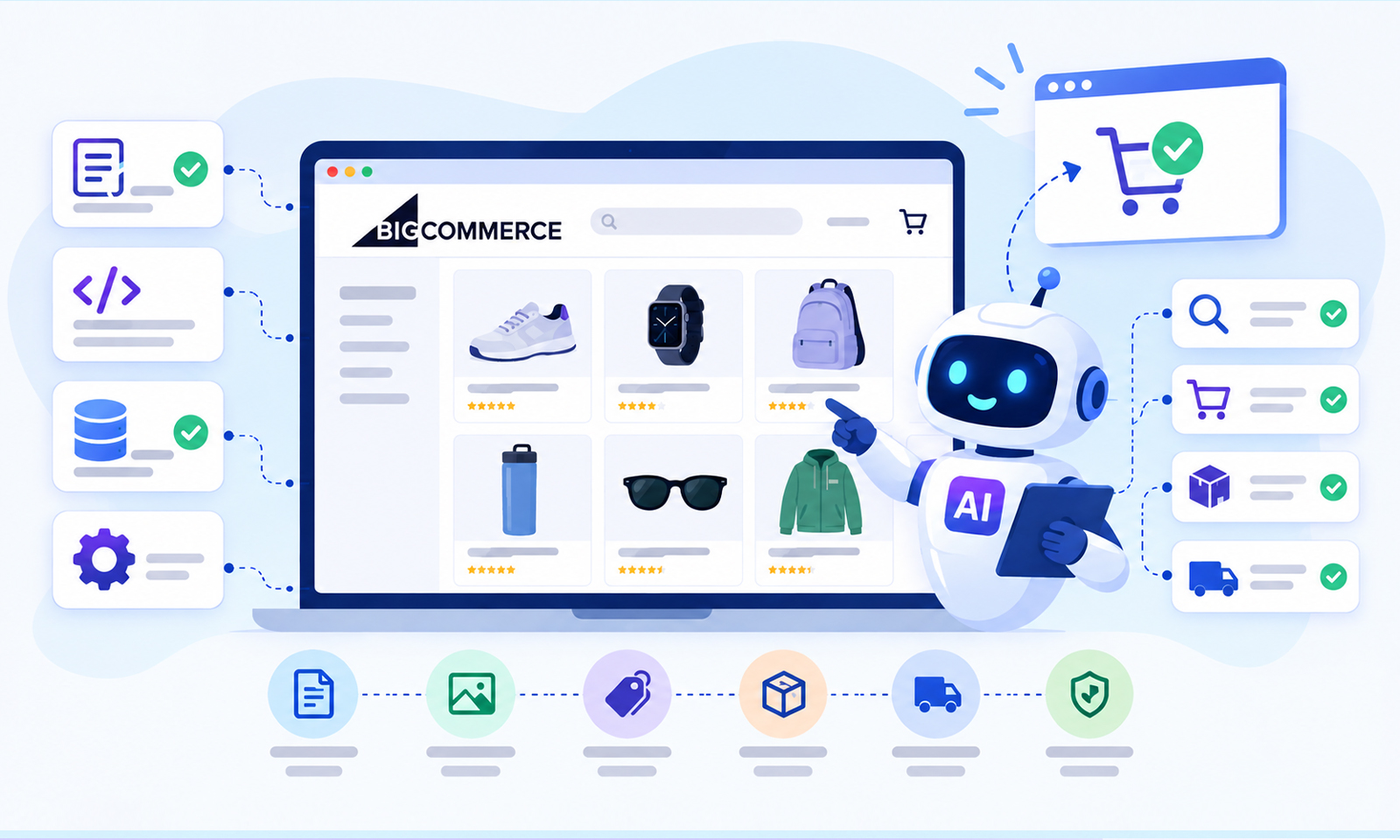
AI agents are starting to change how shoppers discover, compare, and interact with products online. For BigCommerce merchants, that creates a practical question: can an AI agent accurately understand your products and complete the actions a shopper expects?
That creates a new requirement for ecommerce businesses: your store needs to be understandable not only to people and traditional search engines, but also to software agents acting on a shopper’s behalf.
For BigCommerce merchants, this means thinking beyond conventional SEO. BigCommerce agentic browsing requires a combination of accurate product information, accessible storefronts, structured data, reliable commerce infrastructure, and clear business policies.
The good news is that this does not require rebuilding your store from scratch. Much of the foundation is the same work that already supports good ecommerce SEO.
Make Your BigCommerce Store Ready for Agentic Browsing: Quick Overview
BigCommerce agentic browsing readiness means making your store easy for AI agents to discover, understand, and interact with. That starts with clear product information, accurate pricing and availability, accessible pages, and reliable commerce functions.
| What AI agents need | What your BigCommerce store should provide |
|---|---|
| Understand products | Complete names, descriptions, specifications, images, SKUs, and identifiers |
| Compare products | Consistent attributes, variants, prices, and availability |
| Verify commercial details | Accurate price, stock, shipping, returns and other policies |
| Interpret page meaning | BigCommerce structured data and clear page architecture |
| Access product information | Crawlable pages and accessible content |
| Take commerce actions | Appropriate APIs, integrations or supported agentic commerce infrastructure |
| Trust the information | Consistent data across storefront, feeds, structured data and commerce systems |
Google notes that AI agents can perform tasks on users’ behalf and may interact with websites through their rendered content, DOM, and accessibility tree.
What Is Agentic Browsing in Ecommerce?
Agentic browsing for ecommerce refers to AI systems navigating websites or connected commerce systems to accomplish a shopper’s goal.
Consider a shopper asking:
“Find me waterproof hiking shoes under $150, available in size 10, that can arrive this week.”
A conventional search engine primarily returns pages for the shopper to investigate. An AI agent may instead need to discover products, interpret attributes, compare prices and availability, and potentially continue into a cart or checkout flow.
That is the broader idea behind BigCommerce agentic commerce: AI becomes an intermediary between the shopper and the merchant’s commerce infrastructure.
BigCommerce itself is already developing infrastructure for this model. Its current MCP implementation allows AI agents to search product catalogs, build carts, and generate checkout links through dedicated commerce tools.
This distinction matters because being visible to an AI answer and being usable by an AI agent are not exactly the same thing.
How to Prepare Your BigCommerce Store for Agentic Browsing
To prepare your BigCommerce store for agentic browsing, focus on accurate product data, clean structured data, accessible pages, and commerce systems that AI agents can reliably understand and use.
1. Make Your Product Data Complete and Consistent
The foundation of an AI-ready BigCommerce store is good product data. An agent cannot reliably recommend a product if important information is missing, contradictory, or difficult to interpret.
At minimum, review whether your catalog consistently provides:
- Product name and description
- Brand
- SKU and product identifiers where applicable
- Product images
- Price and currency
- Availability
- Product variants
- Size, color, material, dimensions, or other relevant attributes
- Shipping information
- Return information
- Reviews and ratings, when applicable
Think about this from the agent’s perspective.
If one product says “Available” in the page content but structured data says OutOfStock, the agent has conflicting signals. Similarly, if the price visible on the page is $129 but another machine-readable source still says $149, automated product comparison becomes less reliable.
BigCommerce’s own current agentic commerce guidance emphasizes the importance of rich product data, real-time inventory, and APIs for agent-driven commerce.
2. Implement BigCommerce Structured Data
One practical way to make your BigCommerce product information more explicit and machine-readable is to implement structured data correctly. Structured data makes key product attributes more explicit, including information such as price, availability, and product details.
JSON Schema App helps manage and deploy structured data such as Product, Offer, Review, and other relevant Schema.org types across ecommerce pages.
Structured data provides explicit information about what a page represents. For ecommerce, that commonly includes Product, Offer, Review, AggregateRating, Brand, and related entities.
Google explains that Product structured data can communicate information such as price, availability, ratings, and review information. It also recommends validating structured data and ensuring that it accurately represents visible page content.
For example, a simplified BigCommerce Product schema can communicate information like:
{
"@context": "https://schema.org",
"@type": "Product",
"name": "Trail Running Shoes",
"sku": "TRAIL-100",
"brand": {
"@type": "Brand",
"name": "Example Brand"
},
"offers": {
"@type": "Offer",
"price": "129.00",
"priceCurrency": "USD",
"availability": "https://schema.org/InStock"
}
}
The important point is not simply having JSON-LD on the page. The values need to be accurate, current, and consistent with the actual product.
Schema.org defines Product as a type for products or services offered for sale and supports properties that describe the product and its commercial details.
3. Keep Price, Inventory and Variants Synchronized
This is where many ecommerce implementations become fragile. Prices change. Products go out of stock. Promotions expire. Variants are added or removed.
Your product information therefore cannot be treated as a one-time SEO task.
Google specifically warns that dynamically generated Product markup can create crawling and freshness challenges for rapidly changing information such as price and availability.
For stores with variants, the relationship between the parent product and individual variants also matters. Google recommends ProductGroup , variesBy, and hasVariant where appropriate to communicate variant relationships.
A practical workflow is:
Catalog change → storefront update → structured-data update → feed/API update → validation
The objective is simple: whichever system an agent encounters, it should receive the same current commercial information.
4. Make Your Store Easy for Agents to Navigate
BigCommerce for AI agents is not only about structured data. Browser-based agents can interact with the actual website. Google notes that agents may inspect visual rendering, DOM structure, and the accessibility tree.
That makes basic web usability important. Product information should not exist only inside complicated interactive components that are difficult to interpret. Important information such as product names, prices, availability, specifications, and policies should have clear representations in the rendered page.
Use descriptive headings, meaningful links, accessible form controls, descriptive image text where appropriate, and predictable navigation.
This is also why traditional technical SEO remains relevant to agentic browsing. Google says its existing SEO fundamentals continue to be foundational for generative AI experiences.
5. Make Commerce Functions Accessible to AI Systems
There is an important difference between an AI agent understanding your storefront and being able to perform commerce actions.
Reading requires discoverable information. Action requires commerce functionality. For example, an AI system may need to:
- Search the catalog.
- Retrieve product details.
- Check availability.
- Add an item to a cart.
- Generate or hand off to checkout.
BigCommerce’s MCP documentation currently describes tools that let AI agents search products, build carts, and generate checkout links.
BigCommerce has also announced integrations connecting merchant catalogs, inventory and order management to AI-powered discovery and checkout experiences.
For merchants, the takeaway is that how to prepare BigCommerce for agentic commerce increasingly involves both the storefront and the systems behind it.
6. Make Shipping, Returns, and Policies Easy for AI Agents to Understand
A shopper’s decision is rarely based on price alone. An agent comparing two products may need to understand:
- How much shipping costs
- Where the product can be delivered
- How quickly it can arrive
- Whether returns are accepted
- What the return window is
- Whether an item is currently available
Google’s merchant listing documentation supports structured information for product price, availability, shipping, and return information.
Your visible policy pages should therefore be clear and specific. Avoid forcing shoppers or agents to interpret vague statements such as “fast delivery” when an actual timeframe is available.
The goal is not to create special content for AI. It is to make the information genuinely useful and unambiguous.
7. Keep Your BigCommerce Schema Clean
Adding more schema is not automatically better. A common implementation problem is duplicate or conflicting markup. For example, a theme may already generate Product data while another application adds a second Product entity with different prices, ratings, or availability.
Before adding BigCommerce JSON-LD, inspect what your storefront already outputs.
Then check:
| Check | What to look for |
|---|---|
| Product | Correct product and variant information |
| Offer | Current price, currency and availability |
| Reviews | Real review and rating information |
| Brand | Correct brand association |
| Identifiers | SKU, GTIN or other applicable identifiers |
| Duplicates | Multiple conflicting Product entities |
| Visibility | Markup reflects content users can actually see |
Google recommends testing structured data with the Rich Results Test and correcting critical issues before deployment.
8. Build an AI-Ready BigCommerce Store Around One Source of Truth
As AI-driven shopping develops, consistency becomes increasingly important. Your product database, storefront, structured data, feeds, and commerce APIs should not behave like separate versions of the catalog.
Imagine a product with:
- Storefront: $89 – In stock
- Structured data: $99 – In stock
- Feed : $89 – Out of stock
- API : $89 – In stock
A human might eventually notice the discrepancy. An automated system may not know which value to trust. For that reason, how to make BigCommerce product data AI-readable is partly a data-governance problem.
Use the BigCommerce catalog as a reliable source and build automated synchronization wherever possible. For larger catalogs, monitor changes rather than relying on occasional manual updates.
9. Test Agent Readiness Like a Real Shopping Journey
Don’t stop after validating the schema. Run practical tests that reflect what a shopper might ask an agent to do.
For example:
“Find a black waterproof jacket under $200 in size large.”
Then check whether the information needed to answer that request is actually available and consistent.
Test:
- Discovery : Can the product be found?
- Interpretation: Are size, color, and product attributes clear?
- Comparison: Are price and specifications available?
- Availability : Is stock information current?
- Transaction: Can the agent reach an appropriate cart or checkout experience?
- Trust: Are shipping, returns, and other purchase conditions clear?
This gives you a much more useful definition of BigCommerce AI visibility than simply asking whether your pages appear in an AI answer.
Conclusion
Preparing for BigCommerce agentic browsing is about making your store’s data reliable, accessible, and actionable for AI agents. Focus on accurate product information, synchronized prices and inventory, clean BigCommerce structured data, accessible pages, clear policies, and dependable commerce integrations.
As AI agents play a larger role in ecommerce discovery and transactions, these fundamentals can support both agentic experiences and traditional search visibility.
FAQs
What is BigCommerce agentic browsing?
BigCommerce agentic browsing is the use of AI agents to navigate, interpret and potentially interact with a BigCommerce storefront or its connected commerce systems on behalf of shoppers.
How do I make a BigCommerce store ready for AI agents?
Start with complete product data, accurate pricing and inventory, crawlable pages, accessible navigation, clean structured data, clear policies, and APIs or supported integrations that allow appropriate commerce actions.
Does BigCommerce schema markup help with AI agents?
Structured data can make product and business information more explicit and machine-readable, but it is not a requirement for every AI agent and does not guarantee visibility or selection by an AI system. It remains useful for communicating structured product information to search engines and other systems that support Schema.org data.
What BigCommerce schema should ecommerce stores use?
Product pages commonly use Product with relevant Offer information. Depending on the site, other structured data such as Organization, BreadcrumbList, Review, AggregateRating , or ProductGroup may also be appropriate. Google’s eligibility requirements should guide implementation.
Is JSON-LD necessary for BigCommerce agentic browsing?
JSON-LD is not a universal requirement for an AI agent to browse a website. However, it is a practical format for communicating structured product information and is supported by Google’s structured-data systems.
Can AI agents buy products from BigCommerce stores?
BigCommerce currently provides MCP capabilities that allow supported AI agents to search products, retrieve product details, add items to carts, and generate checkout links. The final checkout experience can still involve the shopper and the storefront.







 Wix Schema
 Squarespace Schema
 BigCommerce Schema
 Shopify Schema
 Hubspot Schema
 Webflow Schema
 GoHighlevel Schema
 Duda Schema
 Weebly Schema