

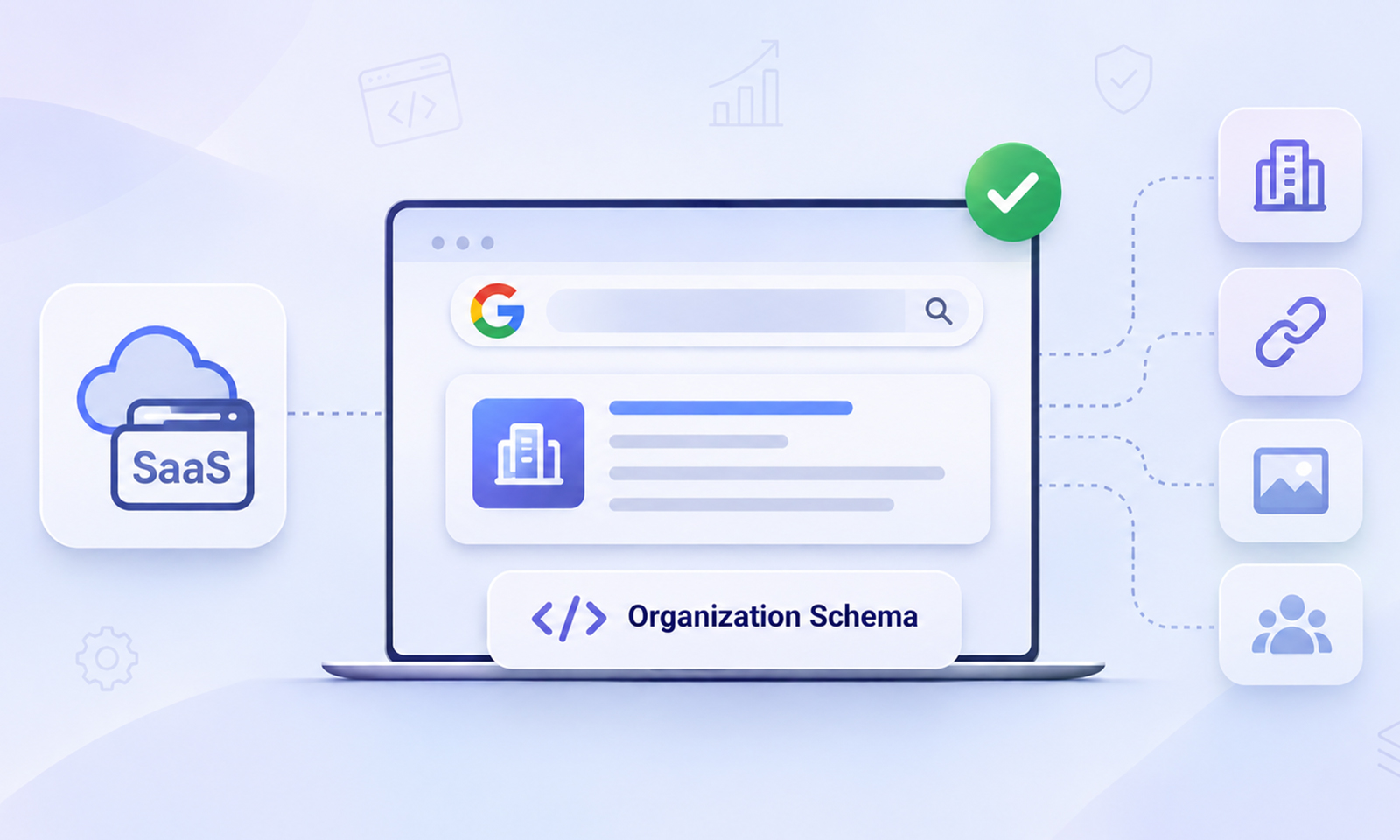
Not every schema type is meant to earn rich snippets or star ratings. Organization schema for SaaS is a good example. Its purpose isn’t to make your search listings more eye-catching with review stars but to help Google clearly understand who your company is.
If your SaaS website only focuses on review-related schema, you’re overlooking an important part of structured data. Organization schema helps connect your business name, logo, website, and official profiles into a consistent entity, making it easier for search engines to interpret your brand.
When combined with other schema types, it forms a stronger foundation for both search visibility and AI-powered search experiences.
Quick Checklist: What Organization Schema Does for SaaS
While it doesn’t generate star ratings, it strengthens your company’s identity and improves how search engines understand your brand. Use this quick checklist to understand what Organization schema for SaaS actually helps with.
What Organization Schema Does for SaaS (Besides Stars):
- Helps Google identify your company as an organization.
- Connect your official website and social media profiles using sameAs.
- Supports logo recognition in Google Search.
- Strengthens your brand’s Knowledge Graph signals.
- Provides consistent business information across search engines.
- Works alongside other schema types like SoftwareApplication instead of replacing them.
- Improves machine readability for AI-powered search systems.
What Is Organization Schema?
Organization schema is a type of structured data that describes the business behind your website. Instead of explaining a product, article, or FAQ, it tells search engines who owns the site.
A typical JSON-LD organization schema can include information such as:
- Company name
- Official website
- Logo
- Social media profiles
- Contact information
- Business address (if applicable)
Google recommends JSON-LD as a structured data format because it is generally easier to implement and maintain at scale compared with other supported formats.
For SaaS companies, Organization schema usually belongs on the homepage, while individual product pages use schema types that describe the software itself.
Does Organization Schema Generate Google Star Ratings?
No, organization schema does not generate Google star ratings. This is one of the most common misconceptions around organization schema markup.
Many SaaS companies assume that adding company information with an aggregateRating property will automatically make review stars appear in Google Search. That’s not how Google’s review snippet guidelines work.
Google supports review snippets for certain structured data types, including Organization and SoftwareApplication. However, there is an important restriction: a company cannot earn review stars for itself by adding reviews or ratings to its own website using Organization markup. Google considers these self-serving reviews and doesn’t display review snippets for them.
For SaaS products, SoftwareApplication schema may support review snippets when the markup meets Google’s technical requirements and review policies. Simply adding an aggregateRating property isn’t enough to guarantee stars in search results.
If your goal is review snippets for a SaaS product, SoftwareApplication schema is generally the appropriate schema type when implemented correctly and when it meets Google’s eligibility requirements.
Google requires review information to be genuine, visible to users, and associated with the specific software being reviewed. You should not aggregate ratings from external review platforms such as G2 or Capterra and present them as your own aggregateRating data.
Google also makes it clear that structured data doesn’t guarantee rich results. Eligibility depends on using supported schema types, following review markup guidelines, and Google’s own ranking systems.
What Organization Schema Actually Helps With
If review stars aren’t the goal, why should SaaS companies implement Organization schema for software companies?
Because search engines need to understand the business behind your software before they can confidently interpret everything else on your website. Organization schema provides that context.
Helps Google Understand Your Company
Every SaaS website has two identities:
- The company that builds the software.
- The software product users purchase.
The organization schema describes the company, while the SoftwareApplication schema describes the product. Using both gives search engines a clearer understanding of your website.
Connects Your Official Brand Profiles
The sameAs schema property links your website to official profiles such as:
- X (Twitter)
- GitHub
- YouTube
- Crunchbase
This helps Google associate these profiles with the same organization instead of treating them as unrelated web pages. It’s important to include only official accounts that genuinely represent your company.
Supports Logo Recognition
The logo schema markup property tells search engines which logo represents your business.
While adding a logo doesn’t guarantee it will appear in search results or knowledge panels, it gives Google a clear, machine-readable reference instead of relying solely on page content or image discovery.
Helps Google Understand Your Brand as an Entity
Organization schema provides Google with structured information that helps distinguish your company from other organizations with similar names. By connecting your company name, official website, logo, and business profiles, you provide clearer information about your brand identity. Organization schema contributes to these connections by providing consistent details such as:
- Company name
- Official URL
- Logo
- Social profiles
- Contact information
Over time, these signals can help Google better understand your business as a distinct entity, especially when the same information appears consistently across trusted sources.
Complements Other Schema Types
Think of SaaS organization schema as the foundation rather than the complete structure.
For example:
- Organization identifies your company.
- SoftwareApplication describes your SaaS product.
- WebSite helps define your website.
- Breadcrumb explains page hierarchy.
- FAQ adds context where appropriate.
Each schema type serves a different purpose, and together they create a more complete structured data implementation. This is why relying on a single schema type rarely provides the full SEO benefit for SaaS websites.
Organization Schema vs SoftwareApplication Schema
Although they’re often implemented together, Organization schema and SoftwareApplication schema serve different purposes. One describes your business, while the other describes the software you offer.
| Feature | Organization Schema | SoftwareApplication Schema |
|---|---|---|
| Describes | Your company | Your SaaS product |
| Typical page | Homepage, About page | Product or pricing page |
| Can show review stars? | No | Potentially, if eligible |
| Supports logo and social profiles | Yes | No |
| Includes software details | No | Yes |
A common mistake is using only Organization schema across an entire SaaS website. While it helps Google understand your business, it doesn’t provide details about your software, such as pricing, operating system, or application category.
For SaaS websites, it’s usually best to implement both schema types on the pages where they make the most sense.
What Properties Should SaaS Companies Include?
A basic JSON-LD organization schema doesn’t need dozens of properties. Including accurate, relevant information is more important than adding every available field. The most useful properties are:
| Property | Purpose |
|---|---|
| name | Company name |
| url | Official website |
| logo | Primary brand logo |
| sameAs | Official social profiles |
| contactPoint | Customer support or sales contact |
| email (optional) | Business email |
| address (if applicable) | Physical business location |
If your company has a public office, you can also include an address. However, fully remote SaaS companies don’t need to add one unless it’s relevant.
When using the sameAs schema property, link only to official profiles that represent your organization. Avoid adding inactive accounts or third-party listing pages.
For SaaS teams that don’t want to write JSON-LD manually, JSON Schema App provides a no-code way to generate structured data using Schema.org markup. This can make it easier to create accurate Organization schema and maintain structured data as your website evolves.
Common Organization Schema Mistakes
Organization schema is relatively simple to implement, but a few common mistakes can reduce its effectiveness or create confusion for search engines.
Using Organization Schema to Add Review Stars
Adding ratings to Organization schema won’t make your homepage eligible for review snippets. Google has specific rules about review markup, so it’s important to use the appropriate schema type for eligible content.
Using Different Company Information Across Pages
Your company name, URL, logo, and social profiles should stay consistent everywhere they appear.
For example, if your homepage uses one logo URL and another page references an outdated version, Google receives conflicting signals about your brand.
Linking Unofficial Social Profiles
Only include profiles your company actually owns and manages. The sameAs property is meant to connect verified brand identities, not every mention of your business across the web.
Placing Organization Schema on Every Page
In most cases, Organization schema for SaaS belongs on the homepage or main company page.
Adding multiple, conflicting Organization entities across your site can make your structured data harder to interpret. Product pages should generally use schema types that describe the product itself, such as SoftwareApplication.
Forgetting to Validate Structured Data
Even small syntax errors can prevent Google from reading your schema correctly. After implementation, validate your markup using:
- Schema Markup Validator
- Google Rich Results Test (where applicable)
If you’re auditing an existing implementation, the process is similar to checking any SaaS structured data for errors.
How Organization Schema Fits Into a Complete SaaS Schema Strategy
Think of Organization schema as one piece of a broader structured data strategy. A typical SaaS website may include several schema types, each describing a different aspect of the site:
| Schema Type | Purpose |
|---|---|
| Organization | Describes your company |
| SoftwareApplication | Describes your software product |
| WebSite | Defines your website |
| WebPage | Provides page-specific context |
| BreadcrumbList | Explains page hierarchy |
| FAQ | Marks up eligible question-and-answer content |
Each type adds a different layer of information. Together, they help search engines understand not just your product, but also the business behind it and how your website is organized.
This approach also aligns with Google’s preference for structured, machine-readable content that accurately reflects what’s visible on the page.
If you’re building your schema strategy from scratch, it’s helpful to first understand schema markup implementation, then expand with schema types that match your content.
For teams managing large SaaS websites, keeping structured data consistent across product pages can become difficult. That’s one reason many businesses choose to automate schema generation rather than maintaining JSON-LD manually as their site evolves.
Organization Schema Example for a SaaS Company
Below is a simple JSON-LD organization schema example for a SaaS company. It focuses on the core properties Google uses to identify an organization.
{
"@context": "https://schema.org",
"@type": "Organization",
"name": "Example SaaS",
"url": "https://www.examplesaas.com",
"logo": "https://www.examplesaas.com/logo.png",
"sameAs": [
"https://www.linkedin.com/company/examplesaas",
"https://x.com/examplesaas",
"https://github.com/examplesaas"
],
"contactPoint": {
"@type": "ContactPoint",
"contactType": "customer support",
"email": "support@examplesaas.com"
}
}
This example is intentionally minimal. Add only properties that accurately represent your business, and ensure they match the information visible on your website.
Conclusion
Organization schema for SaaS isn’t meant to generate star ratings, its purpose is to help search engines understand the company behind your software. By providing structured information about your brand, logo, website, and official profiles, it strengthens your overall schema strategy.
When used alongside schema types like SoftwareApplication, WebSite, and Breadcrumb, it gives search engines and AI systems a clearer understanding of your business and products. Consistent, accurate organization structured data lays a stronger foundation for long-term SEO and AI visibility.
Frequently Asked Questions
Q1. Does Organization schema show star ratings?
No. Organization schema isn’t eligible for Google review snippets, so it won’t generate star ratings in search results. If your goal is review stars for a SaaS product, SoftwareApplication schema may be appropriate when it meets Google’s eligibility requirements.
Q2. Should every SaaS company use Organization schema?
In most cases, yes. It helps search engines identify your company, understand your brand, and connect information such as your logo, website, and official social profiles.
Q3. Can I use Organization schema and SoftwareApplication schema together?
Yes. They describe different entities, so they complement each other rather than compete. Organization schema identifies your business, while SoftwareApplication schema describes the software you offer.
Q4. Where should Organization schema be added?
It’s typically added to your homepage or About page because those pages represent the company itself. Product pages should use a schema that describes the specific product or service.
Q5. What is the sameAs property used for?
The sameAs property links your website to official profiles, such as LinkedIn, GitHub, YouTube, or X. This helps search engines recognize that these profiles belong to the same organization.
Q6. Does Organization schema improve SEO?
Organization schema isn’t a direct ranking factor, but it helps search engines better understand your business and supports a more complete structured data strategy. Clear entity information can contribute to stronger brand recognition in Google Search and AI-powered search experiences.




 Wix Schema
 Squarespace Schema
 BigCommerce Schema
 Shopify Schema
 Hubspot Schema
 Webflow Schema
 GoHighlevel Schema
 Duda Schema
 Weebly Schema
 ClickFunnel Schema