

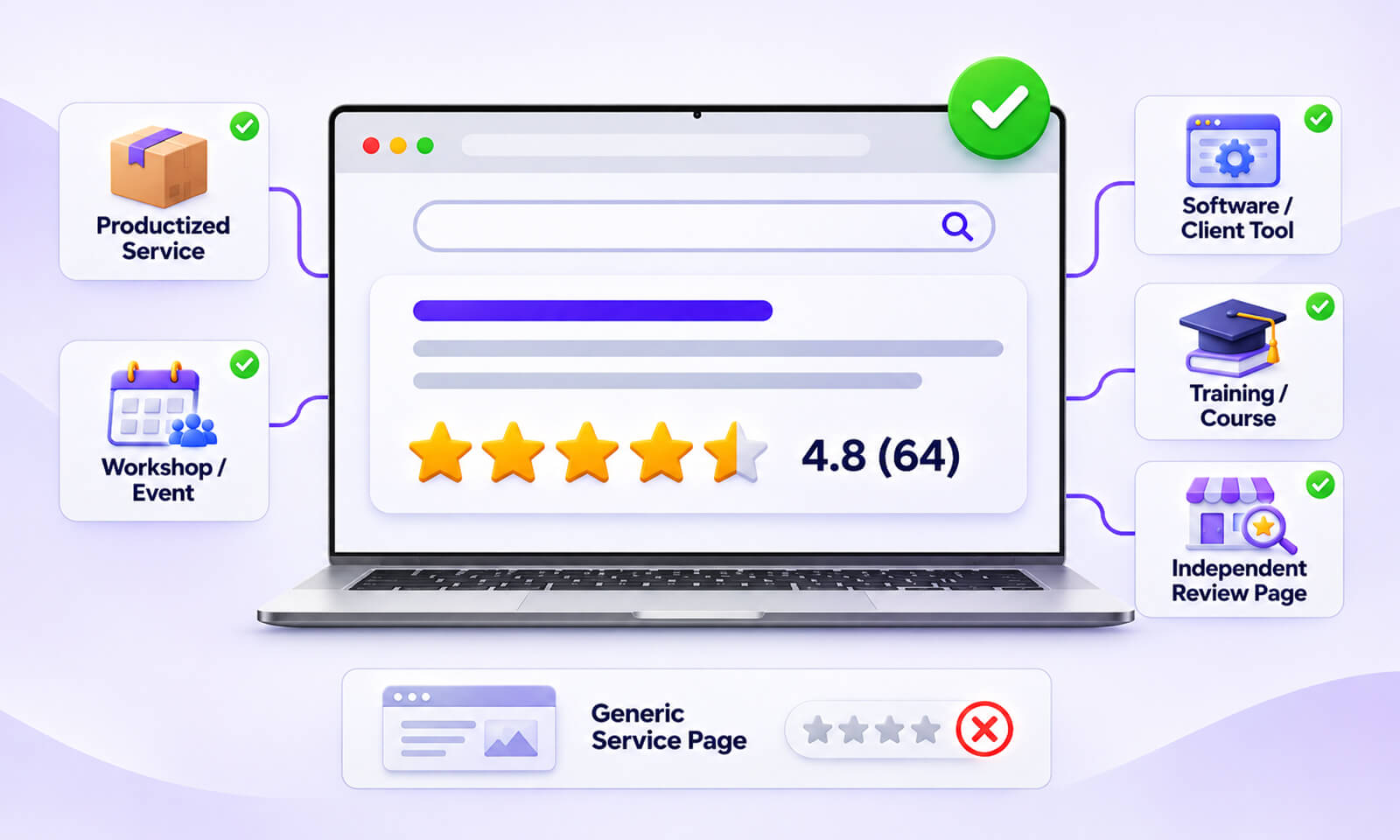
TL;DR: Some service businesses can qualify for Google review stars, but not by simply adding AggregateRating to a standard service or company page. The opportunity depends on what the page actually represents. A genuinely packaged offering may qualify as a Product, while training programs, eligible events, software applications, and independent review pages have their own paths. The important rule is to choose structured data based on the real content of the page, not the desire to obtain stars.
A service business may have dozens of pages: individual services, locations, packages, courses, workshops, tools, and customer-review pages. But those pages do not all have the same structured-data opportunities.
For star ratings for service businesses, the useful question is therefore not simply whether the business has reviews. It is:
What exactly does this page represent, and does Google support review snippets for that type of content?
Google currently supports review snippets for types including Course, Event, LocalBusiness in specific circumstances, Product, and SoftwareApplication, among others. For local businesses, however, the site must be reviewing other local businesses rather than publishing self-serving reviews about itself.
That makes page-level classification more important than adding the same review markup everywhere.
Which Service Business Pages Can Get Google Review Stars
Service businesses can qualify for Google review stars only when a page represents a genuinely eligible entity, such as a productized service, software application, or course. A standard service, homepage, or business page does not qualify simply by adding review markup.
| Page type | Potential review-star route | Main condition |
|---|---|---|
| Productized service page | Product |
The offering must genuinely function as a specific product |
| Software or client tool page | SoftwareApplication |
The page must represent a genuine software application |
| Training/course page | Course |
It must be a real course with an educational outcome |
| Workshop or eligible event page | Event |
It must represent a genuine event |
| Independent review page | LocalBusiness / Organization |
The publisher reviews another business and independently collects user ratings |
Important: A normal Service, Organization, homepage, testimonials page, or generic service-category page does not become eligible simply because it contains an AggregateRating.
What Makes a Service Business Page Eligible for Review Stars?
Google's review snippet documentation is based on the thing being reviewed, not simply the fact that a page contains customer feedback.
The page needs to clearly represent a specific item, and the review or aggregate rating must be visible to users. Google also requires the structured data to accurately describe that visible content. Reviews should come directly from users, and Google says not to aggregate ratings from other websites.
This is where many service businesses make the wrong assumption. A page titled "Our Services" might contain ten offerings and a 4.9/5 company rating. That does not make it equivalent to a page for one specific product, course, event, or software application. The page type determines the appropriate schema.
5 Service Business Page Types That Can Qualify for Review Stars
Not every service page is eligible for Google review stars. The key is whether the page represents a specific entity or offering supported by Google's review snippet requirements, rather than simply a business collecting its own reviews.
1. Productized Service Pages
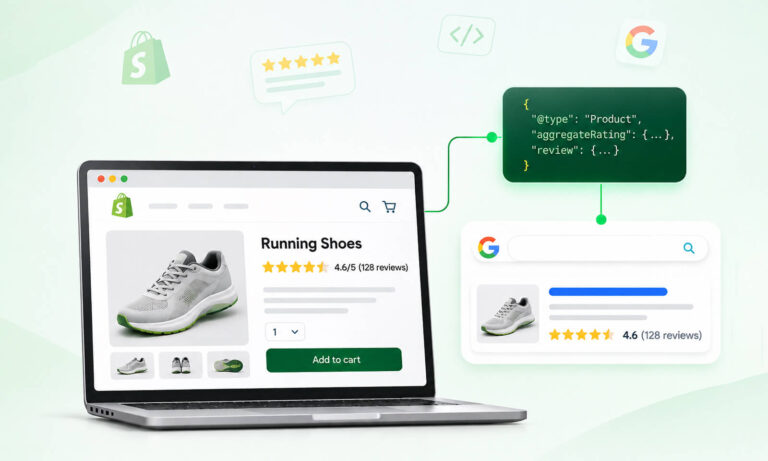
A clearly defined, productized offering may be represented using Product when that classification accurately describes what is being sold. Schema.org's definition of Product includes certain offered services, but Google's Product rich-result requirements are more specific.
For example, a $499 Website Performance Audit with defined deliverables is more product-like than an open-ended Custom SEO Consulting service. However, a fixed price or defined scope alone does not guarantee eligibility. The page must genuinely represent a specific offering and satisfy Google's applicable structured-data and review snippet guidelines.
{
"@type": "Product",
"name": "Website Performance Audit",
"aggregateRating": {
"@type": "AggregateRating",
"ratingValue": "4.8",
"reviewCount": "64"
}
}
Don't label a generic service as a Product solely to pursue review stars.
2. Software or Client Tool Pages
Agencies and service companies that offer a genuine application, platform, plugin, or client tool may have a separate SoftwareApplication page.
The page should describe the actual software rather than the company's consulting services. Google supports review snippets for SoftwareApplication, subject to its requirements.
{
"@type": "SoftwareApplication",
"name": "Example Reporting Platform",
"applicationCategory": "BusinessApplication",
"aggregateRating": {
"@type": "AggregateRating",
"ratingValue": "4.7",
"reviewCount": "128"
}
}
This distinction is especially useful for businesses that provide both services and software.
3. Course and Training Pages
Training providers, educators, and certification businesses may qualify when they offer a genuine course with structured instruction and a defined educational outcome.
For example, a six-week HVAC certification course is different from a general HVAC consulting service. A qualifying course page can use Course structured data, provided its review information also meets Google's requirements.
4. Workshop, Class, or Event Pages
Service businesses can use Event structured data for genuine, individually defined events such as workshops, classes, and seminars.
Google supports Event as a reviewed-item type for review snippets. However, adding Event markup alone does not qualify a page for review stars. The page must also contain valid review or aggregate-rating information that meets Google's review snippet guidelines. Event rich-result eligibility and review-snippet eligibility are separate requirements.
5. Independent Review Pages About Service Businesses
Independent directories and review platforms can publish pages reviewing service businesses and collect ratings directly from their own users.
For example, a directory reviewing ABC Plumbing may qualify for review snippets when it independently collects genuine user ratings about that business. This differs from ABC Plumbing publishing customer reviews about itself on its own website.
Unlike the other examples in this article, this opportunity applies to independent publishers rather than the service business's own website.
What Pages Usually Do Not Qualify?
Understanding the five opportunities is easier when you know what not to force into a review-snippet implementation.
Generic Service pages
A page such as:
/services/
or
/web-design-services/
does not become review-star eligible merely because AggregateRating is attached to a Service object.
Homepage
Adding a 4.9 rating to the site's Organization or LocalBusiness markup does not make the homepage eligible for self-serving review stars. Google's restriction specifically covers self-serving reviews for businesses and organizations.
Testimonials pages
A page containing customer testimonials can still be useful to visitors, but its existence does not create review-rich-result eligibility.
Location pages
A business should not copy the same business-wide rating onto every city or service-area page and expect each URL to qualify separately. The review information needs to describe the specific item represented by the page. Google's review guidelines explicitly say to provide review information about a specific item, not a category or list of items.
How to Choose the Right Page Type
A practical way to classify a service-business page is to ask what the visitor is actually evaluating.
| If the visitor is evaluating… | Consider |
|---|---|
| A defined, purchasable offering | Product |
| A software application | SoftwareApplication |
| A structured educational program | Course |
| A scheduled public event | Event |
| A local business reviewed by an independent publisher | LocalBusiness |
The key is classification before markup. Do not start with:
"Which schema gives me stars?"
Start with:
"What is this page actually about?"
Then determine whether Google supports review snippets for that content type. This approach also helps avoid the common mistake of adding multiple competing types to the same page simply because each one might provide a different search enhancement.
Review Data Still Has to Match the Page
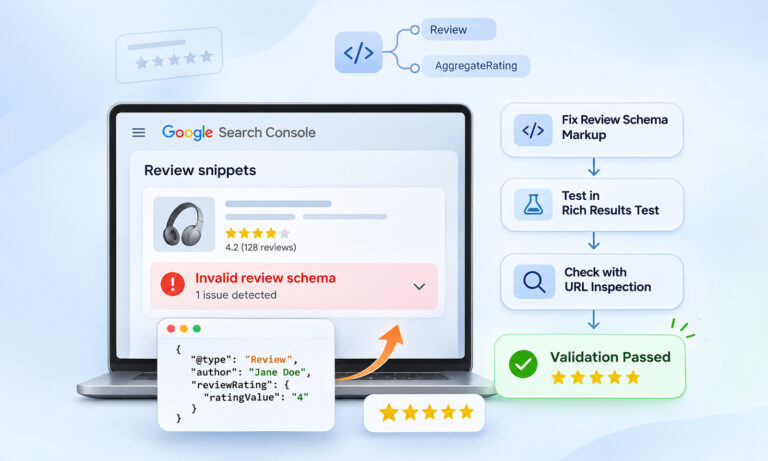
Choosing an eligible type is only the first step. Google's review snippet guidelines require the review content to be available to users on the marked-up page.
If you use AggregateRating, users should be able to see that aggregate rating on the page. Google also recommends accepting ratings accompanied by a review comment and author name.
For example, if the page visibly says:
4.7/5 based on 128 customer reviews
The structured data should represent the same underlying information.
The markup should not say:
ratingValue: 4.9
reviewCount: 450
while the visible page says:
4.7/5 from 128 reviews.
That is not a page-type problem. It is a structured-data accuracy problem.
Why the Rich Results Test Is Not the Final Answer
Even when you have selected the right page type and implemented the markup correctly, Google does not guarantee that stars will appear.
Google's general structured-data documentation makes this explicit: valid structured data can make a page eligible for a rich result, but Google does not guarantee that the feature will actually appear in Search.
That means there are three separate questions:
- Is the page type appropriate?
- Is the structured data valid and compliant?
- Will Google actually display the enhancement?
The Rich Results Test is useful for checking supported structured data, but passing the test should not be interpreted as a promise of a visible star rating.
The Practical Takeaway for Service Businesses
If your website is built around conventional services, do not try to turn every service page into a review-rich result. Instead, audit the site for genuine distinct entities.
You may have a productized service that is genuinely sold as a defined product. You may have a software application alongside your consulting work. You may operate structured training courses or recurring public events.
Those pages deserve their own structured-data evaluation. Your normal company, service, testimonial, and location pages have a different purpose. They can still contain useful business information and genuine customer feedback without being treated as opportunities for Google review stars.
This approach also keeps your schema aligned with the actual content rather than building a site around a particular Search appearance.
Conclusion
For star ratings for service businesses, the opportunity is less about adding reviews to more URLs and more about correctly identifying what each page represents.
A productized offering, genuine software application, qualifying course, event, or independently published business review can have a legitimate review-snippet path. A generic service page, homepage, testimonial page, or location page does not become eligible simply by attaching AggregateRating.
The safest strategy is straightforward: classify the page first, choose a schema that accurately describes it, make the review information visible and consistent, and then evaluate Google's specific eligibility requirements. That produces structured data that reflects the business rather than markup designed solely to chase stars.
FAQs
Can a service business put a review schema on every service page?
No. Each page needs to represent the specific item being reviewed, and the schema type must be appropriate for that content. Repeating the same business-wide rating across service pages does not create separate review eligibility.
Can a packaged service use Product schema?
Potentially, if it genuinely functions as a specific product. The page should represent one defined offering rather than using Product simply as a way to obtain review stars. Google's product documentation emphasizes pages focused on a specific product.
Can a course page get Google review stars?
Course is one of the types Google supports for review snippets. However, the content must genuinely qualify as a course, and the review information must follow Google's review snippet guidelines.
Can an event page show review stars?
Event is supported for review snippets, but event eligibility and review-snippet eligibility are separate requirements. The page must genuinely represent a specific event, while the ratings must independently meet Google's review guidelines.
Can a service business use Service schema with AggregateRating?
Schema.org may allow AggregateRating relationships, but that does not mean Google supports the resulting markup for a review-rich result. Google has a defined set of supported review-snippet types, so schema validity and Google Search eligibility are separate questions.
Does adding a valid review schema guarantee stars?
No. Google states that even correctly implemented structured data does not guarantee a rich result will appear. Eligibility is necessary, but the final Search appearance remains Google's decision.





 Wix Schema
 Squarespace Schema
 BigCommerce Schema
 Shopify Schema
 Hubspot Schema
 Webflow Schema
 GoHighlevel Schema
 Duda Schema
 Weebly Schema
 ClickFunnel Schema