

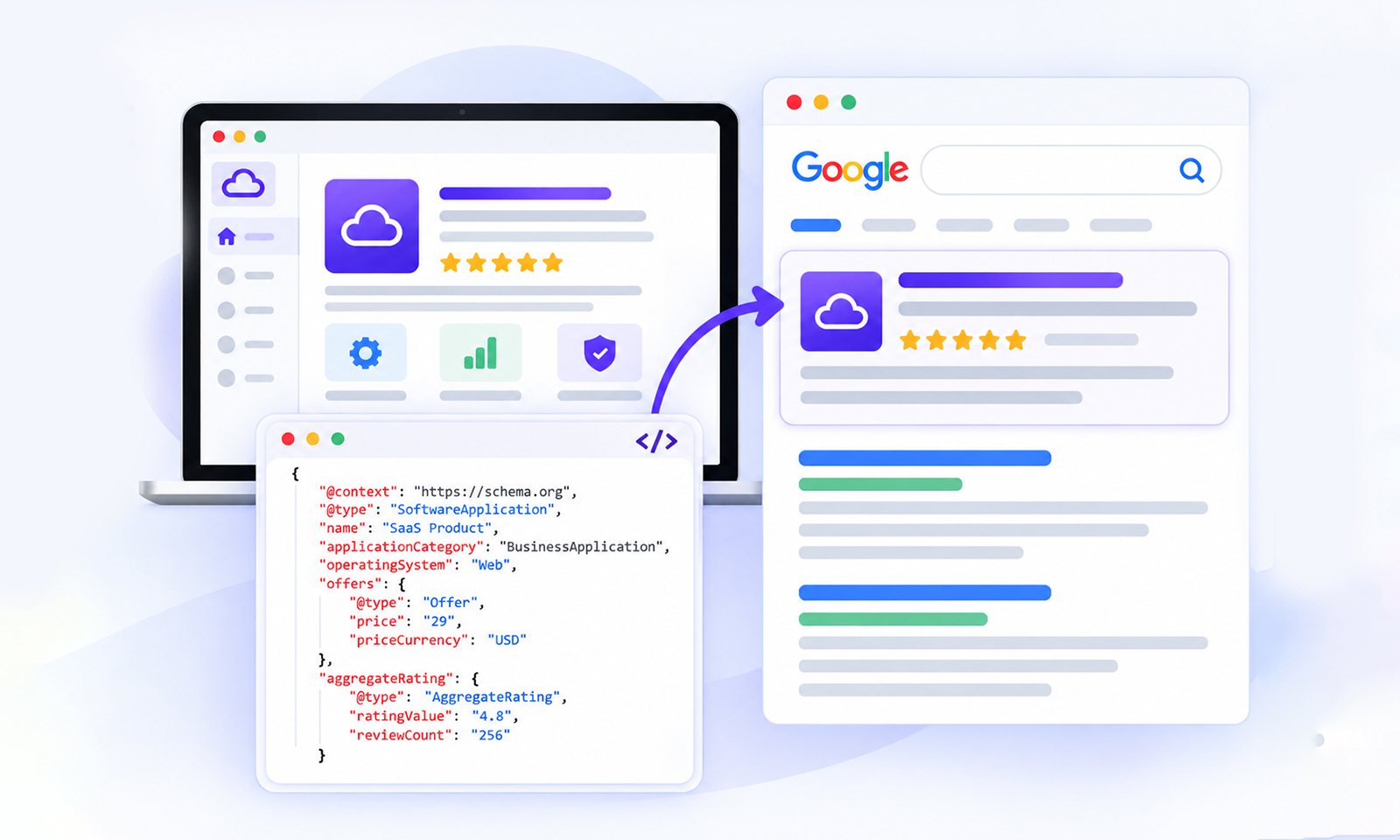
Many SaaS companies showcase customer reviews on their websites but never see Google star ratings in search results. That’s because reviews alone aren’t enough.
To become eligible for review snippets, Google needs to understand that your page represents a software application, not just a business. That’s where SoftwareApplication schema markup comes in. When implemented correctly and aligned with Google’s Review Snippet guidelines, it can help your SaaS product qualify for star ratings in search results.
How SaaS Products Get Google Star Ratings: Quick Steps
SoftwareApplication schema markup is the recommended structured data type for describing SaaS products and software applications. While it doesn’t guarantee Google star ratings, it makes eligible software pages compliant with Google’s review snippet requirements.
- Use SoftwareApplication schema: Describe the software product, not just the company behind it.
- Implement JSON-LD: Google recommends JSON-LD for adding structured data.
- Add valid review markup: Reviews and ratings should be genuine and visible on the page.
- Validate your schema: Test your implementation using Google’s Rich Results Test and Schema Markup Validator.
- Remember, eligibility isn’t a guarantee: Google decides whether to display star ratings based on its review snippet guidelines and other ranking signals.
If you’re implementing SoftwareApplication schema for a SaaS product, the video below walks through how to make the product’s structured data more useful for both SEO and AI visibility.
What Is SoftwareApplication Schema Markup?
SoftwareApplication schema markup is a Schema.org structured data type designed to describe software products. It helps search engines understand that a page is about a software application by providing information such as its name, category, operating system, pricing, publisher, and reviews in a machine-readable format.
For SaaS companies, this means search engines don’t have to infer whether a page represents a software product or simply a business website. Instead, the page is explicitly identified as a software application, making it easier to interpret its purpose and eligibility for relevant search features.
This distinction is important because SoftwareApplication structured data describes the product itself, while schema types such as Organization describe the company behind it.
For example:
- A CRM platform should be described as a SoftwareApplication.
- The company that develops the CRM can be described using Organization schema.
- Both can exist on the same website, but they represent different entities.
Most SaaS websites use multiple schema types together. Schema markup for SaaS often combines SoftwareApplication with Organization, Breadcrumb, FAQ, and Article schema to provide search engines with a more complete understanding of the website.
Can SoftwareApplication Schema Earn Google Star Ratings?
Yes, but eligibility is not the same as a guarantee.
One of the biggest misconceptions about SoftwareApplication review schema is that adding review markup automatically produces star ratings in Google Search. In reality, SoftwareApplication schema simply makes a page eligible for review snippets. Google decides whether those stars are displayed.
Software applications are among the schema types that Google recognizes for review snippets, making them different from many business-focused schema types. However, several conditions still need to be met before a page becomes eligible.
SoftwareApplication Schema Eligibility at a Glance
| Requirement | Why It Matters |
|---|---|
| The page represents a software application | Google needs to understand the page is about a software product. |
| Reviews are visible on the page | Structured data should reflect what users can actually see. |
| Valid review markup is implemented | Review data should follow Google’s Review Snippet guidelines. |
| Google’s quality evaluation | Even valid schema doesn’t guarantee rich snippets. |
It’s also worth remembering that review markup isn’t the only factor Google considers. Overall page quality, trust signals, search intent, and relevance can all influence whether SoftwareApplication rich results appear.
Which SaaS Products Should Use SoftwareApplication Schema?
Not every business that sells a service should use SoftwareApplication schema markup. It’s intended for businesses whose primary offering is a software application that users access, install, or subscribe to.
Common examples include:
- Customer Relationship Management (CRM) software
- Project management platforms
- AI writing and productivity tools
- Email marketing software
- Accounting software
- Help desk and customer support platforms
- HR and payroll systems
- Website builders
- Marketing automation platforms
If users sign up to use a software product, the SoftwareApplication schema for SaaS is usually the most appropriate choice.
On the other hand, businesses that primarily provide consulting, legal services, healthcare, design, or other professional services generally shouldn’t describe their website as a software application unless the software itself is the main product being offered. The table below offers a simple guideline.
| Website Type | Recommended Schema |
|---|---|
| SaaS product | SoftwareApplication |
| Ecommerce product | Product |
| Digital agency | Organization |
| Local business | LocalBusiness |
Choosing the correct schema type matters because it helps search engines understand the primary entity on the page. Using SoftwareApplication schema markup where appropriate creates a stronger semantic connection between your content and your software product, making your structured data more accurate and easier for search engines to interpret.
How to Implement SoftwareApplication Schema Markup
Google recommends using JSON-LD to implement SoftwareApplication schema markup because it’s easier to maintain and keeps the structured data separate from your page content.
For most SaaS websites, the implementation process is straightforward:
- Add JSON-LD SoftwareApplication schema to the software product page.
- Describe the software using relevant properties, such as its name, category, operating system, publisher, and pricing (where applicable).
- Add AggregateRating or Review only when the rating or review information is genuine, visible on the page, and follows Google’s Review Snippet guidelines.
- Validate the markup using Google’s Rich Results Test and Schema Markup Validator.
- Monitor your implementation through Google Search Console to identify any structured data issues.
Here’s a simplified Software schema example:
<script type="application/ld+json">
{
"@context": "https://schema.org",
"@type": "SoftwareApplication",
"name": "Example CRM",
"applicationCategory": "BusinessApplication",
"operatingSystem": "Web",
"url": "https://example.com",
"offers": {
"@type": "Offer",
"price": "49",
"priceCurrency": "USD"
},
"aggregateRating": {
"@type": "AggregateRating",
"ratingValue": "4.8",
"reviewCount": "325"
}
}
</script>
This example shows the core properties commonly used on a SaaS product page. Depending on your software, you may include additional properties such as description, featureList, or individual Review objects, but only when they accurately represent the visible content.
As your SaaS website grows, manually maintaining SoftwareApplication structured data across every product or feature page can become difficult. That’s why many businesses move toward automated schema markup, especially when managing frequent content updates or multiple software offerings.
Common Mistakes That Prevent SaaS Star Ratings
Even technically valid schema doesn’t always lead to SoftwareApplication rich results. In many cases, the issue is how the markup is implemented rather than the schema type itself.
Using Organization Instead of SoftwareApplication
Your company and your software are different entities. If the page is about the software product, SoftwareApplication schema should describe it. Organization schema can still be present on the website, but it shouldn’t replace the software entity.
Adding Reviews That Aren’t Visible
Google expects structured data to match what users can see. If your review markup includes ratings that aren’t displayed on the page, Google may ignore the markup altogether.
Using Inaccurate or Misleading Ratings
Your AggregateRating should reflect genuine review data. Inflated ratings, fake reviews, or values that don’t match the visible content can affect your eligibility for rich snippets.
Applying SoftwareApplication Schema to the Wrong Pages
Not every page on a SaaS website should use SoftwareApplication schema markup. For example, pages such as About Us, Careers, Contact, and Blog articles are usually better described with other schema types.
Reserve Software application schema for SaaS pages that actually describe the software product.
Assuming Schema Guarantees Star Ratings
This is probably the most common misconception. Even if your Software application review schema is perfectly implemented, Google may choose not to display review snippets. Structured data creates eligibility, it doesn’t control search results.
Best Practices for SoftwareApplication Schema
Following a few best practices can help keep your SaaS schema markup accurate and maintain eligibility over time.
- Use JSON-LD whenever possible, as it’s Google’s recommended structured data format.
- Keep ratings and review counts up to date.
- Ensure your structured data matches the information visible on the page.
- Validate your markup whenever you make significant changes.
- Combine SoftwareApplication schema with other relevant structured data, such as Organization, Breadcrumb, FAQ, or Article schema, where appropriate.
If your goal extends beyond review stars, combining multiple schema types can improve your chances of earning different rich snippets while helping search engines better understand your website as a whole.
Conclusion
For most SaaS businesses, SoftwareApplication schema markup is the correct way to describe a software product to search engines. When implemented with accurate review markup and valid JSON-LD, it can make your pages eligible for Google star ratings and other SoftwareApplication rich results.
The important thing to remember is that eligibility isn’t a promise. Google decides when review snippets appear based on its own quality and relevance signals. By using the right schema type, keeping your structured data accurate, and following Google’s guidelines, you give your software pages the best opportunity to earn rich results in search.
FAQs
Q1: Can SoftwareApplication schema show Google star ratings?
Yes. SoftwareApplication schema markup is one of Google’s eligible schema types for review snippets. However, your page must comply with Google’s Review Snippet guidelines, and Google ultimately decides whether to display star ratings.
Q2: Is SoftwareApplication schema better than Product schema for SaaS?
For most subscription-based SaaS products, SoftwareApplication schema is the more appropriate choice because it specifically describes software applications. Product schema is generally better suited for physical goods and many traditional ecommerce products.
Q3: Does review markup guarantee rich snippets?
No. Review markup only makes a page eligible for review snippets. Google evaluates many other factors before deciding whether rich snippets should appear in search results.
Q4: Can I use SoftwareApplication schema on my homepage?
Only if your homepage primarily represents the software application itself. If the homepage focuses on your company rather than the software product, another schema type may be more appropriate.
Q5: Which tools can validate SoftwareApplication structured data?
Google’s Rich Results Test and the Schema Markup Validator are the two most commonly used tools for validating SoftwareApplication structured data and identifying implementation issues.
Q6: Can SoftwareApplication schema be automated?
Yes. SoftwareApplication schema can be automated by apps like JSON Schema App, supporting automated schema markup to generate and maintain structured data across multiple software pages, reducing manual effort while keeping schema consistent.






 Wix Schema
 Squarespace Schema
 BigCommerce Schema
 Shopify Schema
 Hubspot Schema
 Webflow Schema
 GoHighlevel Schema
 Duda Schema
 Weebly Schema