

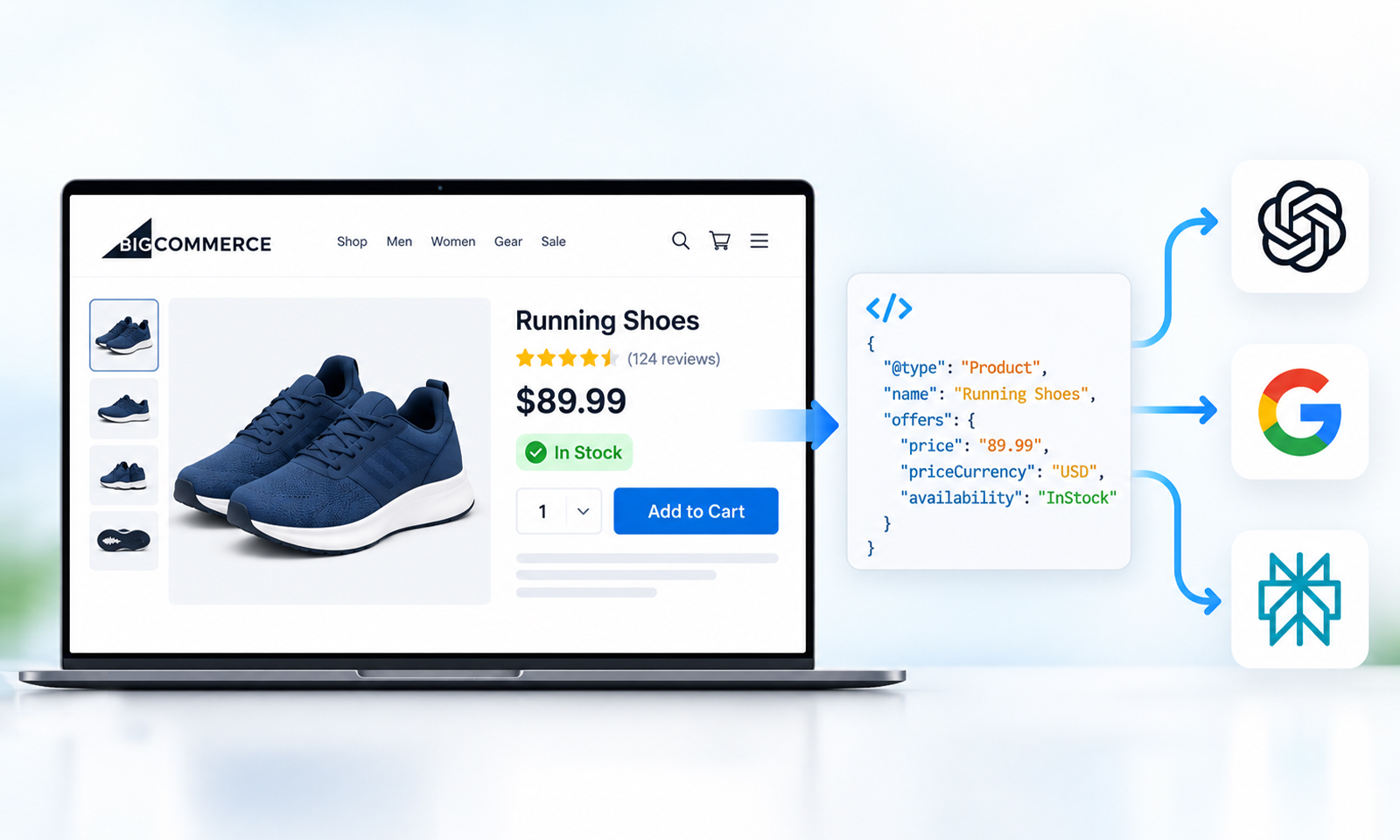
If you run a BigCommerce store, you may wonder whether adding structured data actually helps AI systems understand what you sell, how much it costs, and whether it is in stock.
Yes, BigCommerce structured data can provide clear, machine-readable signals about your products, prices, and availability to AI-driven search systems like ChatGPT search, Google AI Overviews, and Perplexity.
It is especially useful for helping search engines interpret product information and qualify pages for enhanced search experiences. However, structured data is not a direct feed to ChatGPT, Gemini, Perplexity, or every AI shopping agent, and it does not guarantee that an AI system will cite, recommend, or display your products.
The practical goal is simpler: make your product information explicit, accurate, and consistent across the page, structured data, and your BigCommerce catalog.
Does Structured Data Help AI Interpret BigCommerce Products?
Yes. BigCommerce structured data helps make product information more explicit and machine-readable. It can describe key details such as what the product is, its price, currency, and availability, giving search engines and other systems clearer signals about the product.
| Product signal | What structured data communicates |
|---|---|
| Product | Identifies the item and its core attributes |
| Price | Communicates the current offer price and currency |
| Availability | Indicates whether the product is in stock, out of stock, or another supported availability state |
| Overall value | Creates a structured representation that complements the information visible on the product page |
The important part is accuracy. Your structured data should match the product information shoppers see on the page and the underlying BigCommerce catalog. This makes your product information clearer to systems that process and interpret web content, although it does not guarantee AI citations or recommendations.
How Does BigCommerce Structured Data Help AI Systems Understand Products?
BigCommerce structured data adds an explicit machine-readable description of your product instead of making a system infer everything from the page layout. It gives structured meaning to information that might otherwise appear as separate text, labels, buttons, and visual elements.
For example, think about a product page that says:
Blue running shoes – $89.99 – In stock
A shopper can understand this immediately. A machine still needs to determine that:
- “Blue running shoes” is the product
- “$89.99” is the current offer price
- “USD” is the currency
- “In stock” describes product availability
With BigCommerce product structured data, those relationships can be represented explicitly through Schema.org properties.
Google describes structured data as a standardized format for providing information about a page and classifying its content.
That distinction matters for AI visibility because clear product data is more useful than product data that exists only as loosely connected text.
It is important, though, not to overstate what schema does. Google says its AI features do not require special AI-specific structured data, and recommends making structured data match the visible content on the page.
So schema should be treated as one layer of product information, not an AI shortcut.
What Product Information Should Your BigCommerce Schema Communicate?
Your product markup should accurately describe the information that matters for identifying and evaluating the product, especially the product itself, its offer, price, currency, and availability. For a typical BigCommerce product page, the structure can look conceptually like this:
| Product information | Common structured-data property |
|---|---|
| Product name | name |
| Product description | description |
| SKU | sku |
| Brand | brand |
| Product image | image |
| Current price | offers.price |
| Currency | offers.priceCurrency |
| Availability | offers.availability |
| Product URL | offers.url |
| Reviews, when applicable | review / aggregateRating |
Schema.org defines price as the offer price of a product, while availability describes whether an offer is available, such as in stock or on back order.
For Google Merchant Center listings, product pages can also communicate additional information such as shipping, returns, and product variants.
This is where BigCommerce product data for AI becomes practical. Instead of thinking only about “adding schema,” think about whether the important product facts are consistently represented across your store.
How Does Product Schema Communicate Price and Availability?
Product schema usually communicates price and availability through an Offer associated with the product. The Offer can contain the current price, currency, and availability value.
For example, a simplified structure might represent:
{
"@context": "https://schema.org",
"@type": "Product",
"name": "Blue Running Shoes",
"offers": {
"@type": "Offer",
"price": "89.99",
"priceCurrency": "USD",
"availability": "https://schema.org/InStock"
}
}
The important part is not the code itself. The values must represent the real offer available to shoppers.
Google’s documentation supports price and priceCurrency for product offers and recognizes availability values such as InStock, OutOfStock, BackOrder, and LimitedAvailability.
What happens when the schema price is wrong?
A wrong schema price creates conflicting product signals. If the page displays $89.99 but the structured data says $79.99, the markup is no longer an accurate representation of the page.
This can happen when a promotion ends, a product price changes, a currency changes, or someone hardcodes JSON-LD without connecting it to current BigCommerce product data.
Google specifically recommends that structured data should match the visible content on the page.
For that reason, dynamic BigCommerce JSON-LD is generally more practical for stores where prices and inventory change frequently.
What happens when availability is wrong?
Incorrect availability can be just as problematic as an incorrect price. A product marked InStock in schema while the page says “Out of stock” sends conflicting signals about whether the product can actually be purchased.
For stores with frequent inventory changes, the structured data should update when the underlying product status changes.
Google also warns that JavaScript-generated product markup can make shopping crawls less frequent or reliable for fast-changing information such as price and availability.
Dynamic product data does not necessarily mean JavaScript-generated structured data. For stores targeting Google’s shopping experiences, Google recommends placing Product structured data in the initial HTML where possible. This is particularly important when prices and availability change frequently.
How Do I Add Product Schema to BigCommerce?
Start by auditing the structured data your BigCommerce theme already outputs before adding anything new. Many stores create problems by adding a second Product schema when one already exists.
A practical process is:
1. Check the existing Product markup
Open a product page and inspect its structured data using Google’s Rich Results Test.
Look for:
- Product
- Offer
- Price
- Currency
- Availability
- Product identifiers
- Duplicate Product entities
2. Compare schema with the live product page
Check whether the structured data agrees with what shoppers see.
For example:
| Page | Structured data | Correct? |
|---|---|---|
| Price: $49.99 | Price: $49.99 | Yes |
| Price: $49.99 | Price: $44.99 | No |
| In stock | InStock | Yes |
| Out of stock | InStock | No |
This simple comparison catches many real-world ecommerce schema problems.
3. Choose an implementation method
You can maintain BigCommerce schema markup through your theme or use an automated implementation that pulls product information dynamically.
For stores with a small catalog and developer support, manual JSON-LD may be practical. For larger catalogs, maintaining every product’s markup manually becomes harder as prices, inventory, variants, and other attributes change. A dynamic JSON-LD Schema setup for your BigCommerce can keep the markup aligned with those product updates.
4. Validate after implementation
Use Google’s Rich Results Test and Search Console to identify errors and warnings.
Validation confirms whether the markup can be understood and is eligible for supported search features. It does not guarantee that Google will display a rich result. Google explicitly makes that distinction in its structured-data guidelines.
What BigCommerce Product Data Do AI Shopping Agents Need to Make Product Decisions?
AI shopping systems need enough reliable product information to identify, compare, and evaluate an item. That includes core product attributes, current pricing, availability, variants, and other information that affects a buying decision.
For a product page, focus on:
- Product name and description
- Brand
- SKU or other identifiers
- Product attributes and variants
- Current price and currency
- Availability
- Images
- Reviews when genuinely available
- Shipping and return information where relevant
- Clear purchasing information
Structured data can make several of these relationships explicit, but it should not replace the visible product information.
This is particularly relevant to structured data for AI shopping agents and BigCommerce agentic browsing. An agent that is evaluating products needs more than schema alone. It also needs access to the actual product page, accurate content, usable navigation, and, where supported, commerce functionality.
Google similarly emphasizes crawlability, useful textual content, internal links, accurate information, and consistency between structured data and visible content for AI search experiences.
How Can I Keep BigCommerce Product Information Consistent Across My Store?
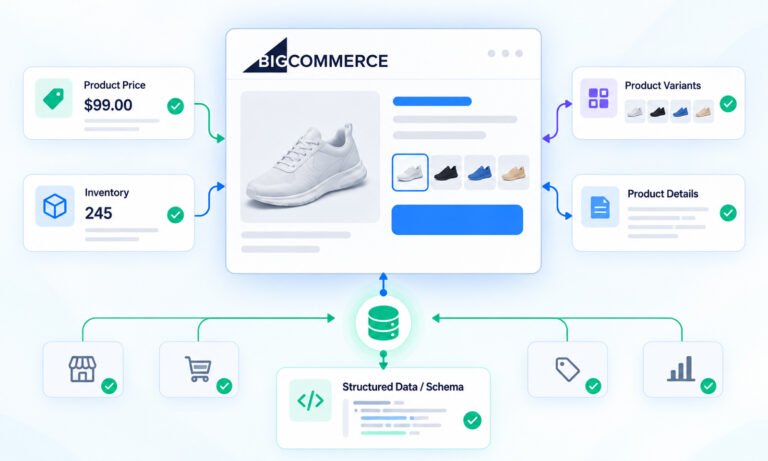
Treat product information as one source of truth and make every representation reflect it. Your BigCommerce catalog, visible product page, structured data, feeds, and other connected systems should not contradict one another.
Pay particular attention to products that frequently change:
- Sale prices
- Inventory status
- Product variants
- Currency
- Product names or descriptions
- Shipping or return information
This becomes more important as a catalog grows. A manually maintained schema block may be correct today but outdated after tomorrow’s price or inventory update.
For a broader consistency workflow, the natural next step is: how to keep BigCommerce product information consistent across your store.
If you are maintaining schema across a large catalog, JSON Schema App takes a dynamic approach by generating JSON-LD from BigCommerce product data rather than relying on manually updated product markup.
How Can I Improve BigCommerce AI Visibility?
Start with accurate product information, then make that information easy for search engines and other systems to crawl, interpret, and verify. Schema is one part of that foundation, not the entire AI visibility strategy.
A strong BigCommerce setup should combine:
- Accurate product information
- Valid Product and Offer structured data
- Consistent price and availability
- Crawlable product pages
- Clear product descriptions
- Correct variant information
- Useful internal linking
- Accessible page content
- Reliable shipping, returns, and purchasing information
This broader approach matters because BigCommerce product data for AI agents is not limited to JSON-LD. If you are also preparing your store for BigCommerce agentic browsing, product information should remain consistent across the page, structured data, and the systems that support your catalog and purchasing experience.
Google’s current guidance also makes an important point: there is no special schema markup required specifically for AI Overviews or AI Mode. The same technical SEO fundamentals still matter.
How Do I Validate BigCommerce Structured Data?
Use Google’s Rich Results Test first, then monitor eligible Product structured data in Search Console. Validation should be part of ongoing maintenance, not a one-time check after implementation.
Check for:
- Missing required properties
- Invalid JSON-LD
- Incorrect price or currency
- Incorrect availability
- Duplicate Product markup
- Variant inconsistencies
- Structured data that does not match visible content
Google provides separate reporting for product snippets and merchant listings in Search Console, depending on the type of product page and search experience.
If you find issues such as duplicate Product markup, missing properties, or conflicting product information, these are worth checking as part of your BigCommerce schema markup troubleshooting.
Common Mistakes That Reduce the Value of BigCommerce Schema Markup
The biggest problems are usually not the absence of schema, but inaccurate, duplicated, or incomplete schema.
Avoid these issues:
- Adding duplicate Product schema: Your theme may already generate markup.
- Hardcoding prices: A static price can become inaccurate after a promotion or catalog update.
- Using the wrong availability:
InStockshould reflect the actual product status. - Marking up information users cannot see: Structured data should represent page content.
- Ignoring variants: Different purchasable variants may have different prices, images, or availability.
- Assuming validation guarantees visibility: Passing the Rich Results Test only establishes eligibility; Google decides whether and how to show supported results.
Google’s product variant documentation specifically recommends that variant markup identify variants clearly and represent their corresponding product information accurately.
Conclusion
BigCommerce structured data for AI is most useful when it makes your product information explicit, accurate, and consistent. Product and Offer markup can clearly communicate what a product is, its price, currency, and availability, while also supporting Google’s product search experiences.
But schema should not be treated as a direct connection to AI models or a guarantee of AI visibility.
For a BigCommerce store, the stronger approach is to keep the entire product information layer consistent: accurate catalog data, visible page content, dynamic structured data, crawlable pages, correct variants, and reliable commerce information. When those signals agree, search engines and other systems have a much clearer representation of what your products actually offer.
FAQs
Q1: Does structured data help ChatGPT understand BigCommerce products?
It can provide useful machine-readable product signals, but it does not guarantee that ChatGPT will consume or cite your structured data. AI systems can use multiple sources and retrieval methods, so accurate visible content and crawlability remain important.
Q2: Does BigCommerce schema markup improve Google rankings?
Structured data is not a direct ranking guarantee. Google says structured data can make pages eligible for richer search features, but correctly implemented markup does not guarantee a particular search appearance.
Q3: Can Product schema show price and availability?
Yes. Product structured data can use an Offer to communicate the active price, currency, and availability. Google supports these properties for product search experiences.
Q4: Should BigCommerce JSON-LD match the visible product page?
Yes. Your structured data should accurately represent information available to users on the page. A mismatch between visible price or stock status and JSON-LD creates conflicting signals.
Q5: Is JSON-LD required for AI shopping agents?
No. JSON-LD is not a universal requirement for AI agents to browse a store. It is, however, a practical and standardized way to communicate structured product information to systems that support Schema.org data.
Q6: How often should BigCommerce product schema be updated?
It should stay synchronized with the underlying product information. If your prices, inventory, variants, or other product details change frequently, dynamic structured data is preferable to manually maintained values.








 Wix Schema
 Squarespace Schema
 BigCommerce Schema
 Shopify Schema
 Hubspot Schema
 Webflow Schema
 GoHighlevel Schema
 Duda Schema
 Weebly Schema
 ClickFunnel Schema