


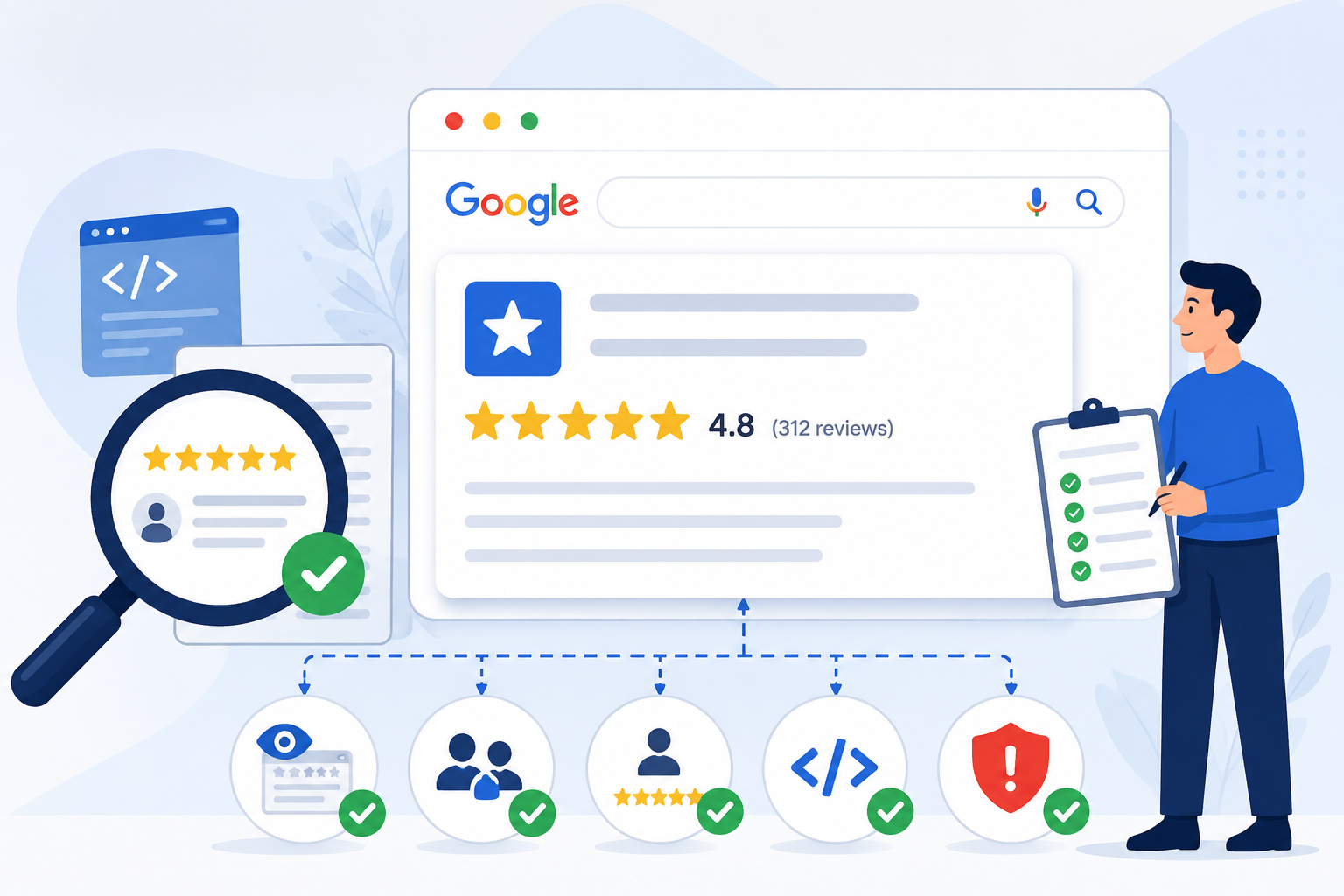
Adding review schema is one of the most misunderstood aspects of structured data. Many website owners assume that adding review schema is enough to earn star ratings in Google Search, but that’s not how Google’s review rich results work.
In reality, review schema rules vary by business model. An ecommerce product page follows different guidelines than a service business, local business, or SaaS website. Even businesses with genuine customer reviews may have different review schema eligibility depending on what they’re marking up.
This guide explains the review schema rules for service businesses, local businesses, SaaS companies, and ecommerce stores, helping you choose the right schema markup while following Google’s review markup guidelines.
Service vs Local vs SaaS vs Ecommerce: Review Schema Rules
Review schema works differently across business types. Ecommerce and SaaS can use supported reviewed-item types, while service and local businesses face different limits under Google’s review rich-result rules.
| Business Type | Recommended Schema Type | Google Review Rich-Result Eligibility |
|---|---|---|
| Ecommerce | Product + Review + AggregateRating | Supported for eligible product pages |
| SaaS | SoftwareApplication + Review or AggregateRating | Supported when the page describes the software |
| Local Business | LocalBusiness | Self-serving reviews about the business are not eligible for the star review feature |
| Service Business | Service + Review or AggregateRating | Schema.org supports it, but generic Service is not currently a supported reviewed-item type for Google’s review snippets |
The biggest mistake isn’t adding a review schema. It’s using markup that doesn’t accurately describe what is being reviewed or assuming that Schema.org support automatically means Google review rich-result eligibility.
Why Business Model Matters for Review Schema
Google doesn’t evaluate review markup based only on whether reviews exist. It also considers what is being reviewed and whether that reviewed item is supported for review rich results.
For example, a physical product sold on an ecommerce website is fundamentally different from a local accounting firm or a SaaS application. Each represents a different entity in Schema.org, and Google evaluates structured data accordingly.
This is why identical review markup can produce completely different outcomes. Consider these examples:
- An online electronics store adds Product schema with customer reviews for a smartphone.
- A law firm adds review markup describing its legal services.
- A project management SaaS platform adds ratings for its software.
- A restaurant displays customer reviews about dining experiences.
All four websites use reviews, but they don’t follow identical review schema rules because Google interprets these entities differently.
Understanding your business category is the first step toward choosing the correct schema markup.
The Core Review Schema Rules Every Business Should Follow
Before comparing different business models, it’s important to understand the review structured data guidelines that apply to everyone.
Although Google supports several Schema.org review properties, eligibility for review rich results depends on far more than simply adding JSON-LD.
Reviews Must Match Visible Content
One of Google’s most important review markup guidelines is consistency. If your structured data says a product has a 4.8 star rating from 523 reviews, visitors should be able to see those reviews or rating information on the page itself.
Hidden reviews, invisible ratings, or schema that doesn’t reflect visible content can reduce eligibility for rich results. This principle is explained throughout Google’s documentation for review structured data.
Reviews Must Be Genuine
Google expects reviews to reflect genuine user experiences. Fake reviews and reviews that aren’t based on a genuine experience should not be included in your structured data. Reviews provided in exchange for money, discounts, free products, or other benefits also need to be clearly disclosed when applicable.
If your website publishes reviews, make sure they accurately represent real customer experiences. For a deeper explanation of how Google validates review content, see:
Choose the Correct Schema Type
One of the biggest implementation mistakes is using the wrong structured data type. For example:
- Ecommerce websites generally use Product schema.
- Restaurants often use LocalBusiness.
- SaaS products may use SoftwareApplication.
- Professional services may use Service.
Adding Product schema to a consulting company’s homepage simply because it wants star ratings isn’t considered best practice. Instead, the schema should accurately describe the entity being reviewed.
Follow Google’s Self-Serving Review Rules
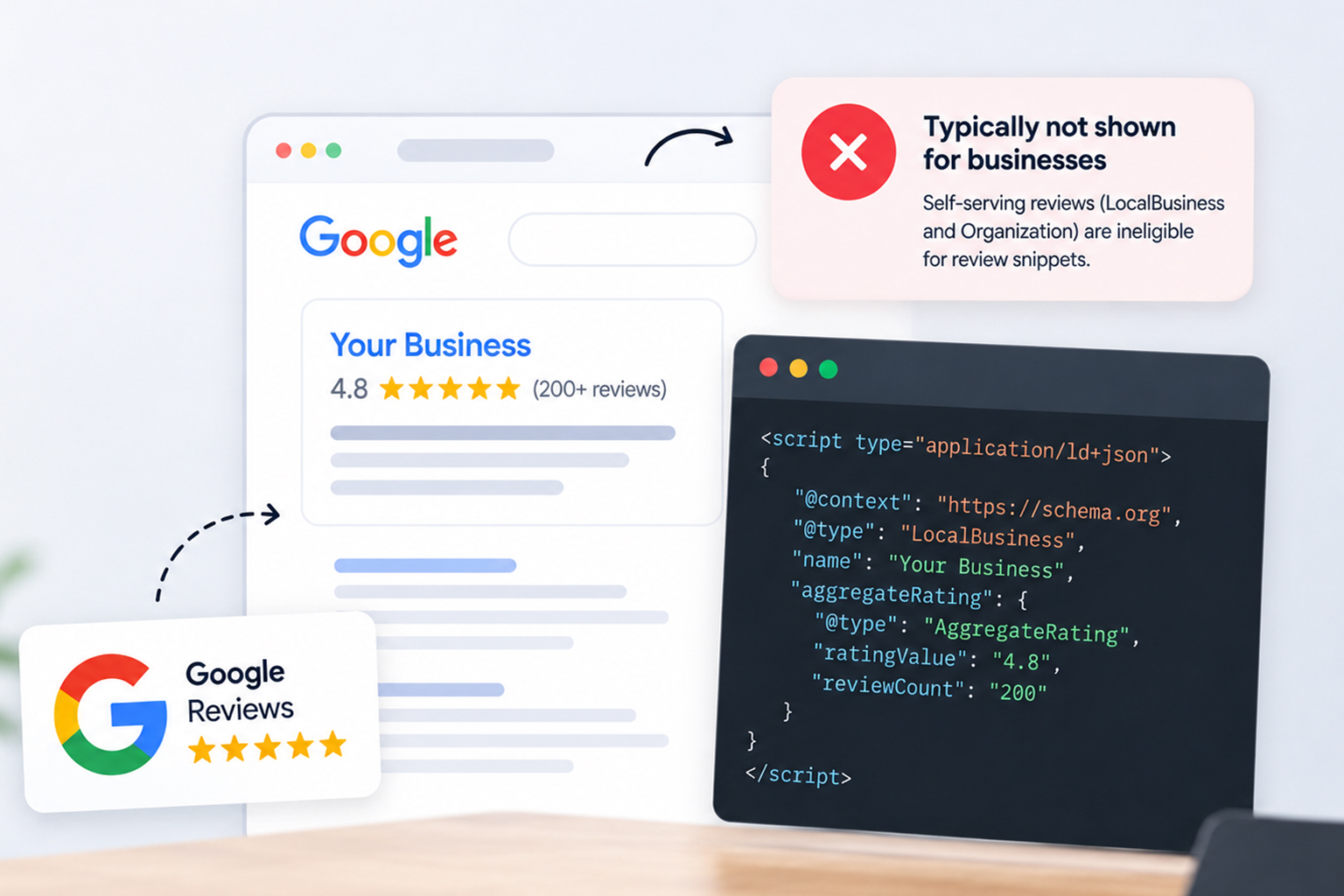
Google has restrictions on self-serving review markup. If a business or organization controls the reviews about itself on its own website, those pages are not eligible for Google’s star review feature.
For example, adding review markup to your own LocalBusiness homepage doesn’t automatically qualify it for review rich results. Many business owners still misunderstand this policy. If you’re unfamiliar with these restrictions, read:
Review Schema for Ecommerce Businesses
Among all business models, ecommerce websites usually have the clearest implementation path. That’s because Google explicitly supports review markup for individual products.
When a customer purchases a laptop, running shoes, coffee maker, or smartphone and leaves a review, those reviews naturally belong to that specific product. A typical ecommerce page combines:
- Product
- Review
- AggregateRating
- Offer
This combination provides Google with structured information about the product, pricing, availability, and customer sentiment.
Here’s a simplified JSON-LD example:
{
"@context": "https://schema.org",
"@type": "Product",
"name": "Wireless Gaming Mouse",
"aggregateRating": {
"@type": "AggregateRating",
"ratingValue": "4.8",
"reviewCount": "326"
}
}
When implemented correctly and supported by visible reviews, ecommerce review schema offers one of the strongest opportunities for review rich results. However, eligibility is never guaranteed. Google ultimately decides whether rich results appear.
Best Practices for Ecommerce Review Schema
Ecommerce stores should:
- Keep ratings updated.
- Display reviews visibly on product pages.
- Mark up individual products instead of entire categories.
- Use valid JSON-LD.
- Validate structured data regularly.
For stores selling hundreds or thousands of products, automated schema generation helps maintain consistency across the catalogue.
Review Schema for Service Businesses
Unlike ecommerce, service businesses operate in a more nuanced area. A marketing agency, plumbing company, legal practice, accounting firm, or home cleaning service doesn’t sell physical products. Instead, customers evaluate the quality of the service provided.
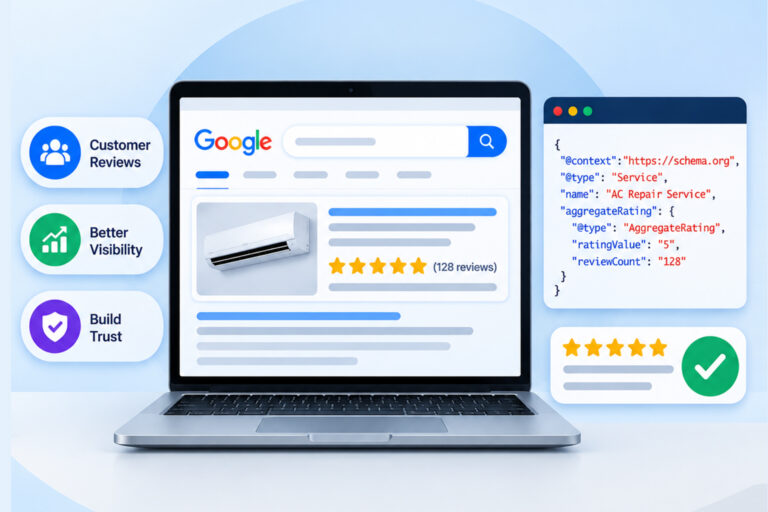
This means review schema for service business websites should accurately describe the service rather than forcing Product schema onto pages where it doesn’t belong. Schema.org supports reviews and aggregate ratings for Service, but that does not mean a generic Service page is eligible for Google’s review rich results.
A simplified example looks like this:
{
"@context": "https://schema.org",
"@type": "Service",
"name": "Residential Plumbing Services",
"aggregateRating": {
"@type": "AggregateRating",
"ratingValue": "4.9",
"reviewCount": "187"
}
}
However, this is where many businesses become confused.
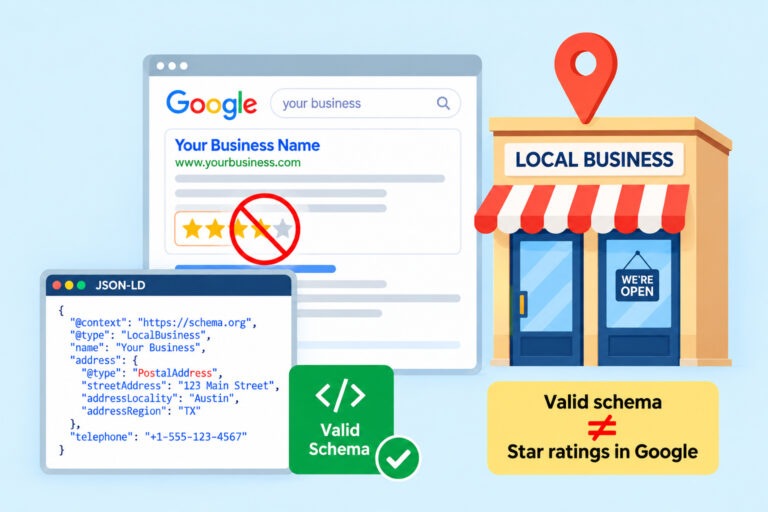
Just because Service schema supports reviews in Schema.org doesn’t mean Google will display review stars for a service page. Generic Service is not currently listed among Google’s supported reviewed-item types for review snippets.
For service businesses, the important distinction is between using valid Schema.org markup and qualifying for Google’s review rich results. A valid Service markup can describe the service and its ratings, but it does not by itself make the page eligible for Google’s review snippet.
In other words, review schema rules for service business websites are stricter than many business owners expect.
Review Schema for Local Businesses
Local businesses often assume that because they have hundreds of Google reviews, they can simply add those ratings to their website and expect star ratings to appear in search results. In reality, the review schema for local business websites follows additional rules that many business owners overlook.
A local business, such as a restaurant, dentist, salon, hotel, or repair service, typically uses LocalBusiness schema. This schema helps search engines understand important business details like your address, opening hours, contact information, and customer ratings.
A simplified example looks like this:
{
"@context": "https://schema.org",
"@type": "LocalBusiness",
"name": "Downtown Dental Clinic",
"aggregateRating": {
"@type": "AggregateRating",
"ratingValue": "4.7",
"reviewCount": "284"
}
}
However, implementing the markup correctly doesn’t automatically make your page eligible for review rich results.
Google has specific restrictions for reviews about local businesses and organizations. If a business controls the reviews about itself on its own website, those pages are not eligible for Google’s star review feature. This applies even when the reviews themselves are genuine, including reviews displayed through third-party widgets that the business controls.
That doesn’t mean local businesses should avoid review schema altogether. Structured data still helps search engines understand your business, even if review stars don’t appear in search results.
When implementing review schema rules for local businesses, focus on:
- Using accurate LocalBusiness schema.
- Displaying genuine customer reviews on the page.
- Keeping ratings updated.
- Following Google’s review structured data guidelines.
- Avoiding schema that exaggerates or misrepresents customer feedback.
Review Schema for SaaS Companies
SaaS businesses often fall somewhere between ecommerce and service businesses, which makes implementation more challenging.
Unlike ecommerce stores, SaaS companies don’t usually sell physical products. However, they do offer software that users can review, rate, and compare.
For SaaS websites, SoftwareApplication is generally the most appropriate type when the page describes the software application itself. Product should only be used when the page genuinely describes a product that fits that type, not simply as a way to pursue review stars.
For example:
{
"@context": "https://schema.org",
"@type": "SoftwareApplication",
"name": "ProjectFlow",
"applicationCategory": "BusinessApplication",
"aggregateRating": {
"@type": "AggregateRating",
"ratingValue": "4.8",
"reviewCount": "512"
}
}
If your software has authentic customer reviews displayed on its product page, adding a review schema can help search engines better understand your content.
However, a review schema for SaaS should accurately describe the software itself, not your company, homepage, or marketing claims.
For example:
- A CRM platform can mark up reviews of the CRM application.
- A project management tool can mark up reviews about the software.
- A homepage promoting the company generally shouldn’t be marked up as a software product simply to qualify for star ratings.
Following these review schema rules for SaaS helps ensure your structured data reflects the actual entity being reviewed.
Review Schema Comparison: Service vs Local vs SaaS vs Ecommerce
Although all four business models can use structured data, their implementation differs significantly.
| Business Type | Recommended Schema | Google Review Rich-Result Position | Primary Focus |
|---|---|---|---|
| Ecommerce | Product + Review + AggregateRating | Supported for eligible product pages | Individual products |
| SaaS | SoftwareApplication + Review or AggregateRating | Supported for eligible software pages | Software applications |
| Service Business | Service + Review or AggregateRating | Not currently a supported reviewed-item type for Google’s review snippets | Individual services |
| Local Business | LocalBusiness | Self-serving reviews about the business are not eligible for the star review feature | Business information |
The biggest takeaway is simple: Review schema rules aren’t universal. The schema type should always describe the actual entity being reviewed rather than the type of rich result you hope to receive.
Common Review Schema Mistakes by Business Model
Many structured data issues stem from using the right properties on the wrong pages. Here are some of the most common mistakes.
Ecommerce
Many stores place Product schema on category pages instead of individual product pages. Others continue displaying outdated ratings that no longer match the visible review count.
Service Businesses
Some agencies, consultants, and contractors incorrectly use Product schema because they believe it can help them qualify for review stars. This creates a mismatch between the page content and the structured data, especially when the page actually describes a service.
Local Businesses
A common mistake is copying ratings directly from a Google Business Profile without ensuring the reviews are visible on the page or without understanding Google’s self-serving review policies.
SaaS Companies
Software companies sometimes add review schema to their homepage instead of dedicated product pages, making it harder for search engines to understand exactly what is being reviewed.
Best Practices for Review Schema Across Every Business Model
Regardless of your industry, following a few consistent principles will improve the quality of your structured data.
- Use the schema type that best represents your business or offering.
- Keep review counts and average ratings accurate and up to date.
- Ensure structured data matches the visible content on the page.
- Display genuine reviews from real users.
- Validate your JSON-LD after every major website update.
- Monitor Google Search Console for structured data warnings and errors.
- Review Google’s documentation periodically, as eligibility requirements can change over time.
Remember that schema markup improves how search engines understand your content, but it doesn’t guarantee star ratings or higher rankings.
Choosing the Right Review Schema for Your Business
If you’re unsure which schema to implement, start by asking one simple question:
What exactly is being reviewed?
The answer determines which schema type you should use.
- If it’s a physical product, use Product schema.
- If it’s software, use SoftwareApplication where appropriate.
- If it’s a professional service, use Service schema.
- If it’s your business location and customer experience, LocalBusiness is typically the right choice.
Choosing the schema type that accurately represents the entity being reviewed is one of the most important review schema rules. It helps search engines understand your content correctly, reduces implementation errors, and ensures your structured data aligns with Google’s review markup guidelines.
Conclusion
Review schema isn’t a one-size-fits-all implementation. The correct approach depends on whether you’re running an ecommerce store, a local business, a SaaS platform, or a service-based company.
Following the appropriate review schema rules, choosing the correct schema markup type, and ensuring your JSON-LD reflects visible, genuine customer reviews gives search engines the clearest possible understanding of your content.
While no implementation can guarantee star ratings, following Google’s review structured data guidelines improves your chances of qualifying for review rich results and helps build a stronger foundation for long-term search visibility. As Google’s policies evolve, regularly reviewing your structured data ensures your website remains accurate, compliant, and eligible where applicable.
Frequently Asked Questions
Q1: Can every business use a review schema?
Schema.org supports reviews and aggregate ratings for many types, but that does not mean every business type is eligible for Google’s review rich results. Google has a specific list of supported reviewed-item types and additional restrictions, including the self-serving review rule for local businesses and organizations.
Q2: Can service businesses use Review schema?
Yes. Schema.org supports reviews and aggregate ratings for the Service type. However, generic Service is not currently listed by Google as a supported reviewed-item type for review snippets, so adding Service review markup does not make a service page eligible for Google review stars.
Q3: Is the review schema different for SaaS companies?
Yes. Review schema for SaaS generally focuses on the software product itself using SoftwareApplication or, where appropriate, Product schema rather than the company homepage.
Q4: Should local businesses use a review schema?
Yes. Local business review schema helps search engines understand your business information and customer feedback, even if review stars don’t always appear in search results.
Q5: Can I use Product schema for my service business?
Generally, no. Your structured data should accurately describe what the page is about. Using Product schema for a consulting service or agency simply to obtain star ratings doesn’t follow Google’s review schema rules.
Q6: How can I check whether my review schema is valid?
Validate your JSON-LD using Google’s Rich Results Test and the Schema.org Validator. These tools help identify syntax errors, missing properties, and structured data issues before they affect search visibility.





 Wix Schema
 Squarespace Schema
 BigCommerce Schema
 Shopify Schema
 Hubspot Schema
 Webflow Schema
 GoHighlevel Schema
 Duda Schema
 Weebly Schema