

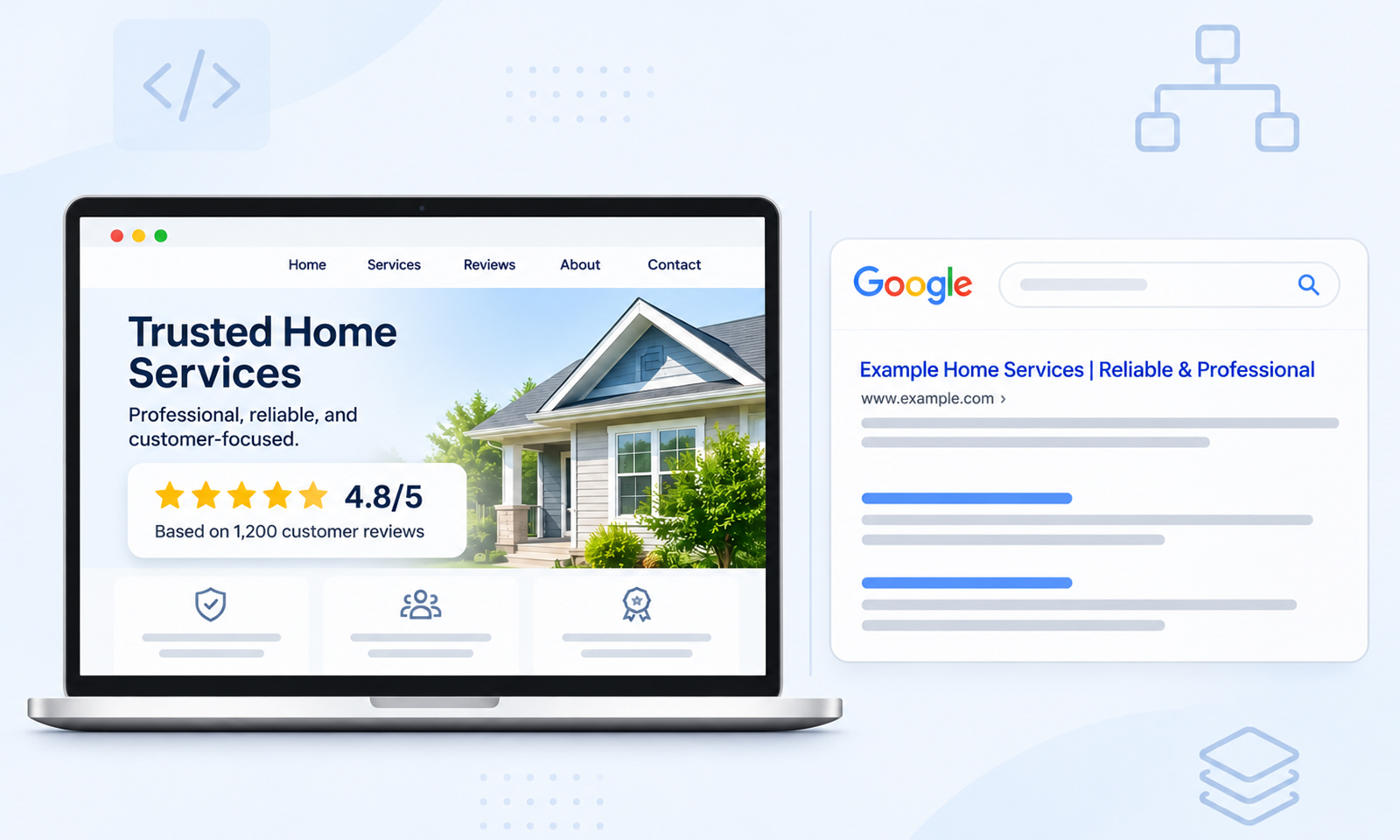
Seeing a business homepage with 4.8/5 stars and hundreds of reviews is common. Businesses display these ratings to build trust, provide social proof, and help visitors quickly judge customer satisfaction.
But there’s an important distinction: showing star ratings on your website doesn’t mean Google will show those same stars in Search. Google has specific rules around self-serving reviews and review rich results, so understanding where homepage ratings fit can prevent incorrect schema implementations and unrealistic expectations.
What Is the Purpose of Homepage Star Ratings for Businesses?
- To build trust: Star ratings quickly show visitors how existing customers rate the business.
- To reinforce social proof: A visible rating can support testimonials, reviews, and customer feedback already featured on the page.
- To help visitors decide: Ratings give potential customers an at-a-glance view of overall customer satisfaction.
- Because ratings can be displayed independently of Google: Businesses can show genuine customer ratings on their homepage even when those ratings are not eligible for Google review rich results.
- Google Search is a separate issue: A business displaying stars on its homepage does not mean Google will show those same stars in organic Search. Google’s self-serving review rules restrict rich-result eligibility for businesses marking up reviews about themselves.
Can Businesses Show Star Ratings on Their Homepage?
Yes. Businesses can show star ratings on their homepage.
There is no general Google rule preventing a company from displaying genuine customer ratings on its own website. A homepage might include:
★★★★★ 4.7/5 based on 850 customer ratings
The important question is what happens when that rating is represented as structured data. A business could technically use Schema.org’s aggregateRating property to describe an aggregate rating. But Schema.org support and Google’s Search feature eligibility are not the same thing.
Google’s review snippet documentation currently lists LocalBusiness and Organization among supported review-related types only in specific circumstances, namely, when a site captures reviews about other local businesses or organizations. That is the key distinction behind Google’s self-serving review policy.
Why Do Businesses Put Star Ratings on Their Homepage?
Homepage star ratings are primarily a user experience and trust signal, not a guaranteed Google Search feature.
A business might display something like 4.8/5 from 1,200 customers alongside testimonials, review excerpts, or a link to its review profile. The purpose is straightforward: visitors can quickly see that other customers have had positive experiences.
This is different from asking Google to display those same stars in an organic search result. That distinction matters because structured data and visible website content serve different purposes.
Structured data gives search engines explicit information about a page, while the visible rating is what your visitors actually see. Google’s documentation explains that structured data can help Google understand page content and make pages eligible for certain enhanced search features, but eligibility does not guarantee that a feature will appear.
Why Google’s Self-Serving Review Rule Matters
Google introduced its self-serving review restriction in 2019. The change specifically addressed businesses and organizations adding review markup about themselves to their own websites, including their homepages. Google explained that these reviews could be added directly by the business or through a third-party review widget.
Google’s current Review Snippet documentation explicitly states that if the entity being reviewed controls the reviews about itself, pages using LocalBusiness or any other Organization structured data type are not eligible for Google’s star review feature.
So, consider this example:
Example: A plumbing company displays:
4.9/5 – 2,000 customer reviews
on its homepage and adds:
{
"@type": "LocalBusiness",
"name": "Example Plumbing",
"aggregateRating": {
"@type": "AggregateRating",
"ratingValue": "4.9",
"reviewCount": "2000"
}
}
The markup may describe what is visibly displayed on the page, but that does not make the homepage eligible for Google’s review rich result when the business itself controls the reviews. This is why adding technically valid aggregateRating schema is not enough.
Does Google Support Star Ratings on Homepage Search Results?
Not when the stars represent self-serving reviews about the business or organization itself.
Google still supports the Review Snippet feature. Its current documentation says review snippets can include stars and other review information when valid markup is found. Supported review scenarios include products, software applications, recipes, movies, events, and certain review sites covering businesses or organizations.
The restriction is specifically important for businesses reviewing themselves.
| Scenario | Google Review Rich-Result Eligibility |
|---|---|
| Business displays its own customer rating on homepage | Not eligible as a self-serving review |
| Business adds aggregateRating about itself | Not eligible for the review star feature |
| Independent site reviews a local business | Can be eligible if requirements are met |
| Product page contains genuine product reviews | Can be eligible |
| Software application has eligible ratings | Can be eligible |
| Business uses a third-party widget containing its own reviews | Still considered self-serving |
So if you’re wondering if homepage ratings appear in Google Search, the answer depends on what those ratings represent and who controls the review content.
What About aggregateRating Schema on a Homepage?
This is where many implementations become confusing. AggregateRating is a Schema.org property used to describe an average rating based on multiple ratings. Google supports AggregateRating for several search features, but its eligibility rules are more restrictive than simply following the Schema.org vocabulary.
For a business homepage, the problem isn’t necessarily that aggregateRating is invalid JSON-LD. The issue is Google’s feature-specific policy.
Google also requires aggregate ratings marked up for review snippets to be visible to users on the page. In other words, you shouldn’t mark up a rating that visitors cannot actually see. Google additionally says not to aggregate reviews from other websites for this purpose.
For businesses, therefore, the practical rule is simple:
Use visible customer ratings on your homepage when they genuinely help users, but don’t expect aggregateRating on your own business homepage to produce Google review stars.
What About Organization aggregateRating?
The same issue applies to Organization aggregateRating.
Google’s current review snippet documentation supports Organization for review snippets only when the site is reviewing other organizations. It does not make a company’s own homepage eligible simply because the organization is represented correctly with Organization schema and an aggregateRating property.
This is an important example of why schema validity does not equal Google rich-result eligibility. A markup validator can understand your properties while Google Search can still decide that the page doesn’t qualify for a particular search feature.
Can You Use Google Review Schema on a Homepage?
You can use structured data to describe information that genuinely exists on a page, but don’t use Google review schema homepage markup as a shortcut to generate self-serving stars.
If the homepage contains testimonials or customer feedback, make sure the content is genuine, visible, and accurately represented. Google’s review snippet guidelines also state that review information should relate to a specific item and that ratings should come directly from users. Google recommends accepting ratings alongside review comments and author names because that gives users more context.
For businesses using reviews from Google, Trustpilot, Yelp, or another platform, there is another important distinction: embedding those reviews on your site does not bypass Google’s self-serving review restriction. Google’s documentation specifically says not to aggregate reviews or ratings from other websites for review snippets, and its self-serving example includes third-party widgets.
That makes the difference between review visibility on your website and Google review rich results especially important.
Why Do Some Businesses Still Have Stars in Google Search?
If you see a business with stars somewhere in Google, don’t immediately assume those stars came from aggregateRating on its homepage. Google has several review and rating-related systems, and they should not be treated as interchangeable.
For example, Google Business Profile ratings are different from organic review rich snippets generated from structured data. Google can use information from its own systems to display local business information independently of whether a website qualifies for review rich results.
Google also has a separate Store Ratings system. These ratings can appear alongside text ads and in unpaid shopping-related formats, including free product listings and merchant-focused rich results. Google collects ratings from its own users and supported third-party review partners, rather than simply generating them from a business’s homepage aggregateRating markup.
This is why comparing Google Business Profile stars vs. review rich snippets is useful when diagnosing where a particular rating in Search actually comes from.
What Should Businesses Do With Homepage Reviews?
The practical approach is to separate customer trust from rich-result eligibility.
1. Keep Genuine Ratings Visible
If your customers’ ratings help visitors evaluate your business, displaying them on the homepage can make sense regardless of whether Google shows stars in organic results.
2. Don’t Add Self-Serving Markup For the Stars
Adding aggregateRating solely because you want stars next to your organic listing doesn’t overcome Google’s self-serving review rule.
3. Make Review Content Transparent
Where appropriate, show the rating, number of ratings, review content, and reviewer information rather than presenting an unexplained number.
4. Use the Correct Schema For the Actual Page
Structured data should describe what the page and its entities actually represent. It shouldn’t be added merely because a particular rich result looks attractive in Search.
This broader principle is also why structured data should be treated as part of a technical SEO strategy rather than a replacement for traditional SEO.
How to Check Whether Your Review Markup Is Eligible
If you’ve already implemented review or rating markup, don’t stop at checking whether the JSON-LD is syntactically valid.
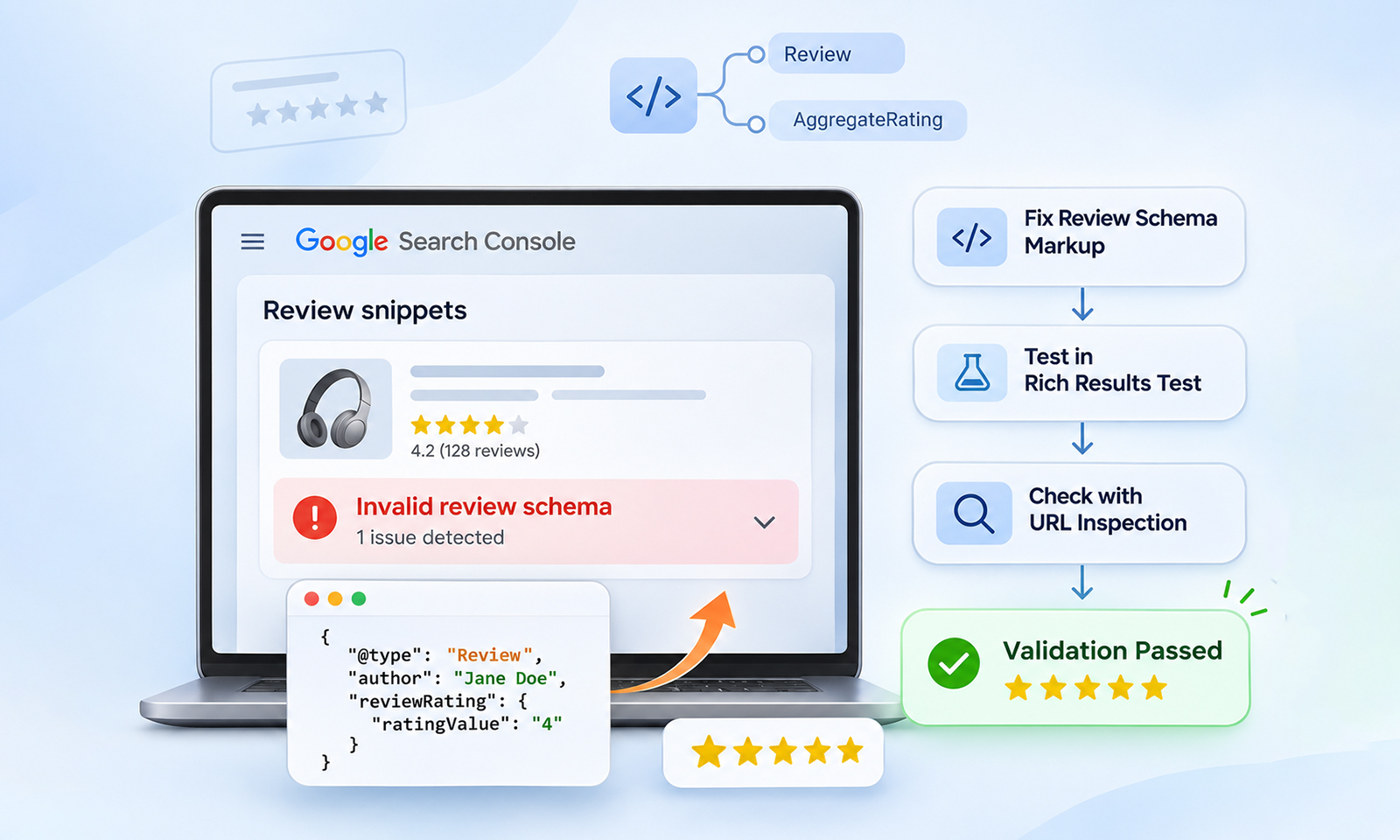
First, confirm that the rating is visible on the page and accurately represents the underlying reviews. Then check the markup using Google’s Rich Results Test and inspect the URL to make sure Google can access the page. Google specifically recommends these tools when implementing structured data.
More importantly, check the policy eligibility. A tool may tell you that the markup is valid while Google still refuses to display the review rich result because the content falls under the self-serving review restriction.
For platform-specific implementations, the same principle applies. For example, a Wix site can technically contain review markup while still failing Google’s eligibility requirements; the issue isn’t always a markup error.
Conclusion
Businesses can absolutely use homepage star ratings to show customers what others think about their products or services. The important distinction is that website display and Google Search eligibility are separate things.
Google still supports review rich results, but its rules exclude self-serving reviews for businesses and organizations that control the reviews about themselves. That means adding aggregateRating, Review, or other star rating schema for homepage markup is not a reliable way to generate stars besides your own organic listing.
The better approach is to keep genuine reviews useful and visible to visitors, use structured data only when it accurately represents eligible content, and evaluate Google Search eligibility separately from whether the markup itself is technically valid.
FAQs
Q1. Can businesses show star ratings on their homepage?
Yes. Businesses can display genuine customer ratings and reviews on their homepage. However, displaying those ratings on the website is different from making the homepage eligible for Google review rich results.
Q2. Does Google support star ratings on homepage search results?
Google still supports review rich results, but not for self-serving reviews controlled by the business or organization being reviewed. Google’s current guidelines explicitly exclude those cases.
Q3. Can I add aggregateRating to my business homepage?
You can represent an aggregate rating using Schema.org vocabulary when it accurately describes visible page content, but adding aggregateRating to your own business homepage does not make it eligible for Google’s self-serving review stars.
Q4. Why do some businesses have star ratings in Google Search?
The stars may come from a different Google system, such as local business information, or from an eligible review-rich-result scenario. Don’t assume that every visible star rating in Search originated from homepage aggregateRating markup.
Q5. Does embedding Google reviews make a homepage eligible for review stars?
No. Embedding reviews through a third-party widget does not bypass Google’s self-serving review restriction when the business is displaying reviews about itself. Google specifically includes third-party widgets in its explanation of self-serving reviews.
Q6. Can structured data guarantee Google star ratings?
No. Even eligible structured data does not guarantee a rich result. Google states that structured data enables eligibility, but Search decides whether and when a rich result appears.







 Wix Schema
 Squarespace Schema
 BigCommerce Schema
 Shopify Schema
 Hubspot Schema
 Webflow Schema
 GoHighlevel Schema
 Duda Schema
 Weebly Schema
 ClickFunnel Schema